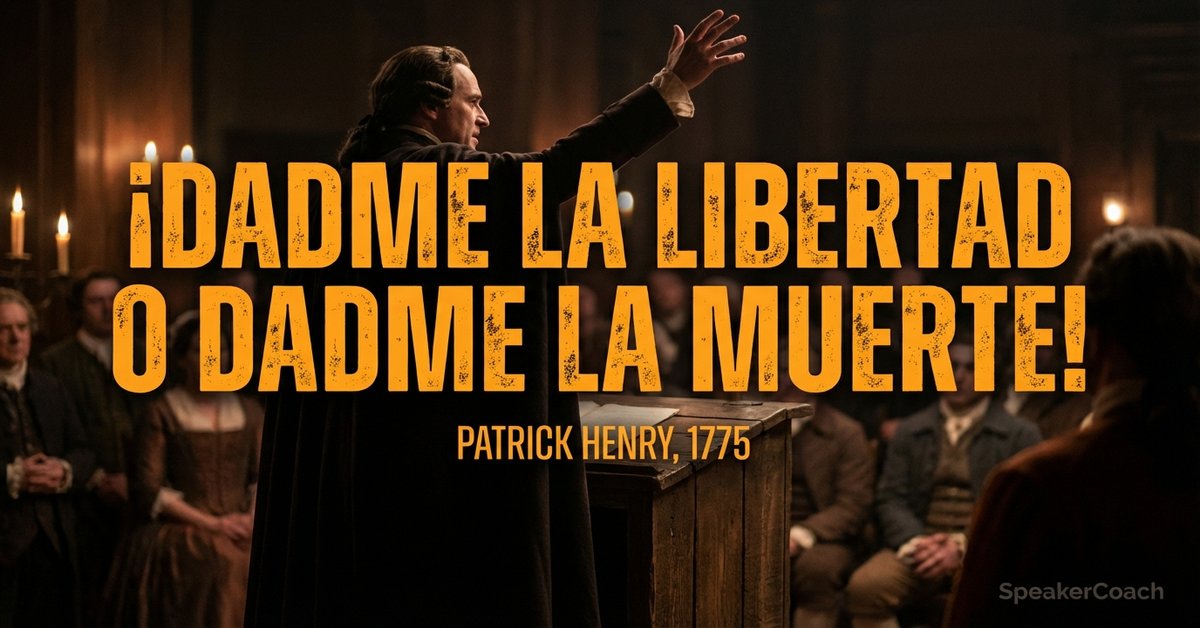
El discurso de Patrick Henry ante la Segunda Convención de Virginia es un apasionado llamado a las armas contra la tiranía británica. Pronunciado el 23 de marzo de 1775, pocas semanas antes de las batallas de Lexington y Concord, Henry desmonta sistemáticamente los argumentos a favor de continuar las negociaciones pacíficas con Gran Bretaña. Argumenta que una década de peticiones y protestas solo ha sido recibida con mayor opresión, que los preparativos militares británicos no dejan duda de su intención hostil y que la demora solo debilitará la posición colonial. El discurso se eleva hasta su legendario clímax en el que Henry declara que prefiere morir antes que vivir sin libertad, encapsulando el espíritu revolucionario que encendería la Guerra de Independencia de los Estados Unidos.
Contexto histórico
Para marzo de 1775, las tensiones entre las colonias americanas y Gran Bretaña habían llegado a un punto de ruptura. Las Leyes Intolerables de 1774, aprobadas en respuesta al Motín del Té de Boston, habían disuelto la legislatura de Massachusetts y cerrado el puerto de Boston. El Primer Congreso Continental se había reunido en septiembre de 1774 y había peticionado al rey Jorge III para obtener reparación, pero el rey declaró a las colonias en rebelión. El gobernador real de Virginia, Lord Dunmore, había disuelto la Cámara de los Burgueses, obligando a los delegados a reunirse independientemente como la Convención de Virginia. En esta segunda reunión en la Iglesia de St. John en Richmond, los moderados favorecían la continuación de las negociaciones, mientras que Patrick Henry y Thomas Jefferson impulsaban la preparación militar. Henry presentó una resolución para organizar una milicia, y este discurso fue su argumento a favor. La resolución fue aprobada, y apenas un mes después se dispararon los primeros tiros de la Revolución Americana en Lexington y Concord. Es importante señalar que no se tomó transcripción alguna en ese momento; el texto que tenemos fue reconstruido por el biógrafo William Wirt en 1817 basándose en los recuerdos de los asistentes, lo que hace que la redacción exacta sea objeto de debate académico.
Texto del discurso
Patrick Henry - Give Me Liberty Or Give Me Death Give Me Liberty Or Give Me Death Patrick Henry, March 23, 1775. No man thinks more highly than I do of the patriotism, as well as abilities, of the very worthy gentlemen who have just addressed the House. But different men often see the same subject in different lights; and, therefore, I hope it will not be thought disrespectful to those gentlemen if, entertaining as I do opinions of a character very opposite to theirs, I shall speak forth my sentiments freely and without reserve. This is no time for ceremony. The question before the House is one of awful moment to this country. For my own part, I consider it as nothing less than a question of freedom or slavery; and in proportion to the magnitude of the subject ought to be the freedom of the debate. It is only in this way that we can hope to arrive at truth, and fulfill the great responsibility which we hold to God and our country. Should I keep back my opinions at such a time, through fear of giving offense, I should consider myself as guilty of treason towards my country, and of an act of disloyalty toward the Majesty of Heaven, which I revere above all earthly kings. Mr. President, it is natural to man to indulge in the illusions of hope. We are apt to shut our eyes against a painful truth, and listen to the song of that siren till she transforms us into beasts. Is this the part of wise men, engaged in a great and arduous struggle for liberty? Are we disposed to be of the number of those who, having eyes, see not, and, having ears, hear not, the things which so nearly concern their temporal salvation? For my part, whatever anguish of spirit it may cost, I am willing to know the whole truth; to know the worst, and to provide for it. I have but one lamp by which my feet are guided, and that is the lamp of experience. I know of no way of judging of the future but by the past. And judging by the past, I wish to know what there has been in the conduct of the British ministry for the last ten years to justify those hopes with which gentlemen have been pleased to solace themselves and the House. Is it that insidious smile with which our petition has been lately received? Trust it not, sir; it will prove a snare to your feet. Suffer not yourselves to be betrayed with a kiss. Ask yourselves how this gracious reception of our petition comports with those warlike preparations which cover our waters and darken our land. Are fleets and armies necessary to a work of love and reconciliation? Have we shown ourselves so unwilling to be reconciled that force must be called in to win back our love? Let us not deceive ourselves, sir. These are the implements of war and subjugation; the last arguments to which kings resort. I ask gentlemen, sir, what means this martial array, if its purpose be not to force us to submission? Can gentlemen assign any other possible motive for it? Has Great Britain any enemy, in this quarter of the world, to call for all this accumulation of navies and armies? No, sir, she has none. They are meant for us: they can be meant for no other. They are sent over to bind and rivet upon us those chains which the British ministry have been so long forging. And what have we to oppose to them? Shall we try argument? Sir, we have been trying that for the last ten years. Have we anything new to offer upon the subject? Nothing. We have held the subject up in every light of which it is capable; but it has been all in vain. Shall we resort to entreaty and humble supplication? What terms shall we find which have not been already exhausted? Let us not, I beseech you, sir, deceive ourselves. Sir, we have done everything that could be done to avert the storm which is now coming on. We have petitioned; we have remonstrated; we have supplicated; we have prostrated ourselves before the throne, and have implored its interposition to arrest the tyrannical hands of the ministry and Parliament. Our petitions have been slighted; our remonstrances have produced additional violence and insult; our supplications have been disregarded; and we have been spurned, with contempt, from the foot of the throne! In vain, after these things, may we indulge the fond hope of peace and reconciliation. There is no longer any room for hope. If we wish to be free-- if we mean to preserve inviolate those inestimable privileges for which we have been so long contending--if we mean not basely to abandon the noble struggle in which we have been so long engaged, and which we have pledged ourselves never to abandon until the glorious object of our contest shall be obtained--we must fight! I repeat it, sir, we must fight! An appeal to arms and to the God of hosts is all that is left us! They tell us, sir, that we are weak; unable to cope with so formidable an adversary. But when shall we be stronger? Will it be the next week, or the next year? Will it be when we are totally disarmed, and when a British guard shall be stationed in every house? Shall we gather strength by irresolution and inaction? Shall we acquire the means of effectual resistance by lying supinely on our backs and hugging the delusive phantom of hope, until our enemies shall have bound us hand and foot? Sir, we are not weak if we make a proper use of those means which the God of nature hath placed in our power. The millions of people, armed in the holy cause of liberty, and in such a country as that which we possess, are invincible by any force which our enemy can send against us. Besides, sir, we shall not fight our battles alone. There is a just God who presides over the destinies of nations, and who will raise up friends to fight our battles for us. The battle, sir, is not to the strong alone; it is to the vigilant, the active, the brave. Besides, sir, we have no election. If we were base enough to desire it, it is now too late to retire from the contest. There is no retreat but in submission and slavery! Our chains are forged! Their clanking may be heard on the plains of Boston! The war is inevitable--and let it come! I repeat it, sir, let it come. It is in vain, sir, to extenuate the matter. Gentlemen may cry, Peace, Peace-- but there is no peace. The war is actually begun! The next gale that sweeps from the north will bring to our ears the clash of resounding arms! Our brethren are already in the field! Why stand we here idle? What is it that gentlemen wish? What would they have? Is life so dear, or peace so sweet, as to be purchased at the price of chains and slavery? Forbid it, Almighty God! I know not what course others may take; but as for me, give me liberty or give me death!
Análisis retórico
Henry despliega más de veinte preguntas retóricas a lo largo del discurso para desafiar la complacencia de su audiencia y obligarla a enfrentar verdades incómodas. Cada pregunta está diseñada no para buscar una respuesta, sino para hacer inevitable la única conclusión lógica.
¿Es la vida tan querida, o la paz tan dulce, como para ser compradas al precio de cadenas y esclavitud?
Henry estructura muchos de sus argumentos en torno a contrastes binarios marcados, obligando a su audiencia a elegir entre alternativas claramente opuestas. Esto elimina cualquier punto intermedio y empuja a los delegados hacia la única opción honorable.
¡dadme la libertad o dadme la muerte!
Henry repite estructuras gramaticales paralelas al comienzo de cláusulas sucesivas para crear intensidad rítmica y recalcar el agotamiento de las opciones pacíficas. La repetición acumulativa construye una sensación abrumadora de futilidad en la diplomacia.
Hemos peticionado; hemos protestado; hemos suplicado; nos hemos postrado ante el trono
Henry apela poderosamente a las emociones de su audiencia: su miedo a la esclavitud, su amor a la libertad, su devoción religiosa y su sentido del honor. Pinta imágenes vívidas de subyugación para despertar sentimientos de indignación y urgencia que anulan la deliberación cautelosa.
¡Nuestras cadenas están forjadas! ¡Su tintineo puede oírse en las llanuras de Boston!
Henry utiliza metáforas vívidas extraídas de la mitología clásica, las escrituras bíblicas y la experiencia cotidiana para hacer concretos y memorables los argumentos políticos abstractos. La lámpara de la experiencia, el canto de la sirena, las cadenas siendo forjadas: estas imágenes se alojan en la mente del oyente y portan una fuerza persuasiva más allá del argumento lógico por sí solo.
No tengo más que una lámpara que guía mis pasos, y esa es la lámpara de la experiencia.
Todo el discurso está estructurado como una escalada dramática. Henry comienza con un desacuerdo respetuoso, construye a través de la argumentación lógica y las apelaciones emocionales, y asciende a través de declaraciones cada vez más urgentes hasta alcanzar la inolvidable línea final. Cada sección eleva las apuestas más que la anterior, haciendo que la conclusión se sienta tanto inevitable como explosiva.
¡debemos luchar! ¡Lo repito, señor, debemos luchar! ¡Un llamado a las armas y al Dios de los ejércitos es todo lo que nos queda!
Henry entrelaza su discurso con referencias a las escrituras para alinear la causa colonial con la rectitud divina y resonar con su audiencia profundamente religiosa. Al enmarcar la lucha como un deber sagrado, eleva la resistencia política a un imperativo moral.
teniendo ojos, no ven, y teniendo oídos, no oyen las cosas que tan de cerca conciernen a su salvación temporal
Lecciones clave
- Enmarca tu argumento como una elección binaria para eliminar el cómodo punto intermedio. Henry transforma una cuestión política compleja en una elección tajante entre libertad y esclavitud, haciendo que la inacción se sienta como un fracaso moral en lugar de cautela prudente.
- Construye credibilidad antes de entregar verdades incómodas. Henry comienza elogiando el patriotismo y las habilidades de sus oponentes, ganando buena voluntad que permite que su desafío posterior aterrice sin provocar una actitud defensiva.
- Usa imágenes sensoriales concretas para hacer tangibles las amenazas abstractas. En lugar de hablar de la opresión en abstracto, Henry invoca cadenas tintineando, flotas oscureciendo la tierra y guardias apostados en cada casa -- imágenes que desencadenan respuestas emocionales viscerales.
- Escala la intensidad emocional progresivamente, reservando tu declaración más poderosa para el final. La estructura del discurso crea una trayectoria ascendente implacable, con cada párrafo elevando las apuestas para que la famosa línea final llegue como la cumbre inevitable de todo lo que la precedió.
- Vacuna a tu audiencia contra los contraargumentos abordándolos primero. Henry reconoce y desmonta cada posible objeción -- debilidad, mal momento, preparación insuficiente -- antes de que los oponentes puedan expresarlas, sin dejar refugio intelectual para quienes disienten.

Estudia la técnica de escalada de Henry. Observa cómo cada párrafo eleva la temperatura emocional un grado más que el anterior. Cuando necesites persuadir a una audiencia reacia a tomar medidas audaces, no comiences a máxima intensidad -- no tendrás adónde ir. En su lugar, abre con razón y respeto, luego superpón urgencia sobre urgencia, pregunta sobre pregunta, imagen sobre imagen, hasta que tu audiencia sienta que la conclusión que ofreces es la única posible. La línea final debe sentirse no como una sorpresa, sino como una liberación de la presión que se ha ido acumulando desde tu primera oración.
Ver el programa