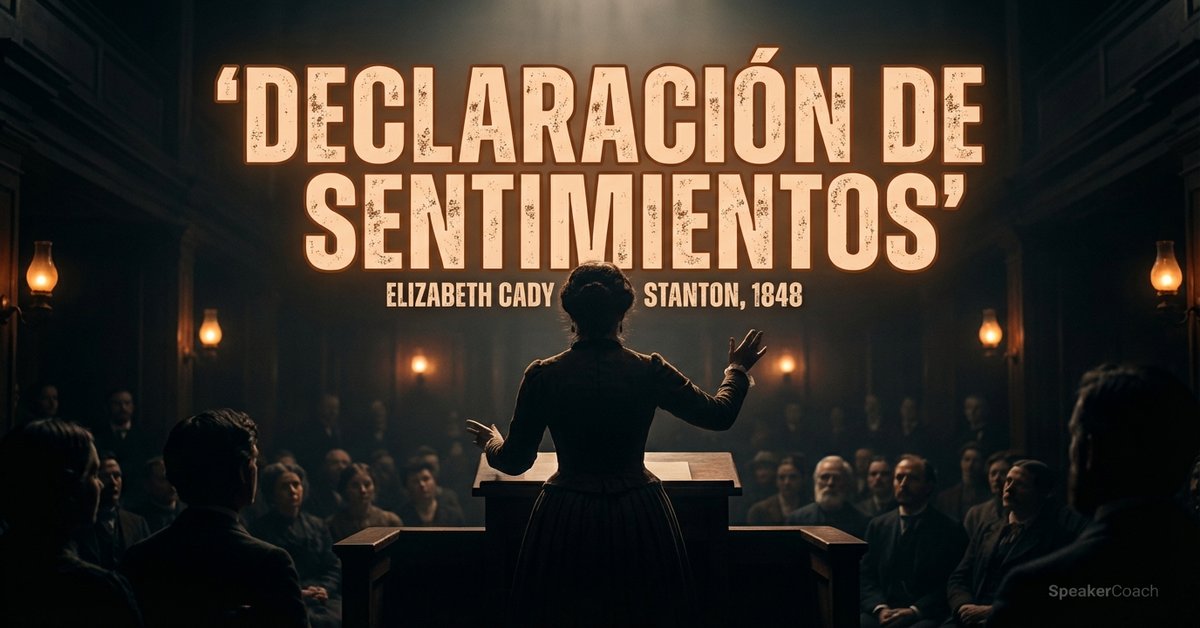
La Declaracion de Sentimientos, presentada en la primera convencion de derechos de la mujer en Seneca Falls, Nueva York, el 19-20 de julio de 1848, es una reescritura deliberada de la Declaracion de Independencia para incluir a las mujeres. Stanton reemplaza al 'Rey Jorge' con 'El' -- refiriendose al hombre colectivamente -- como tirano, y enumera un pliego de agravios documentando la opresion legal, economica, educativa y social de las mujeres a traves de quince cargos especificos. El documento culmina en una demanda intransigente de 'admision inmediata a todos los derechos y privilegios que les corresponden como ciudadanas de estos Estados Unidos.' Al reflejar el documento fundacional de la nacion, Stanton enmarca los derechos de la mujer no como una innovacion radical sino como el asunto pendiente de la Revolucion Americana, usando el propio lenguaje de la republica para acusarla.
Contexto histórico
La Convencion de Seneca Falls del 19-20 de julio de 1848, organizada por Elizabeth Cady Stanton y Lucretia Mott, fue la primera convencion de derechos de la mujer en la historia estadounidense. Celebrada en la Capilla Wesleyana de Seneca Falls, Nueva York, asistieron aproximadamente 300 personas, incluyendo a Frederick Douglass, cuyo apoyo fue crucial para aprobar la resolucion del sufragio. La convencion surgio de la exclusion de las mujeres delegadas en la Convencion Mundial Antiesclavista en Londres en 1840, donde Stanton y Mott se conocieron y resolvieron organizar su propia convencion. La Declaracion de Sentimientos fue firmada por 68 mujeres y 32 hombres. La decision estrategica de Stanton de modelar el documento sobre la Declaracion de Independencia fue en si misma un acto politico: en una era en que el discurso publico de las mujeres se consideraba escandaloso, envolver su argumento en el texto estadounidense mas venerado le conferia una autoridad dificil de desestimar. La resolucion sobre el sufragio fue la unica que no se aprobo por unanimidad, pasando por un estrecho margen gracias en gran parte a la defensa de Douglass.
Texto del discurso
website belongs to an official government organization in the United States. Secure .gov websites use HTTPS A lock ( Lock Locked padlock icon ) or https:// means you've safely connected to the .gov website. Share sensitive information only on official, secure websites. National Park Service Search Search This Site All NPS Exiting nps.gov Cancel Info Alerts Maps Calendar Fees Loading alerts Alerts In Effect Dismiss more information on current conditions... Dismiss View all alerts Declaration of Sentiments When, in the course of human events, it becomes necessary for one portion of the family of man to assume among the people of the earth a position different from that which they have hitherto occupied, but one to which the laws of nature and of nature's God entitle them, a decent respect to the opinions of mankind requires that they should declare the causes that impel them to such a course. We hold these truths to be self-evident; that all men and women are created equal; that they are endowed by their Creator with certain inalienable rights; that among these are life, liberty, and the pursuit of happiness; that to secure these rights governments are instituted, deriving their just powers from the consent of the governed. Whenever any form of Government becomes destructive of these ends, it is the right of those who suffer from it to refuse allegiance to it, and to insist upon the institution of a new government, laying its foundation on such principles, and organizing its powers in such form as to them shall seem most likely to effect their safety and happiness. Prudence, indeed, will dictate that governments long established should not be changed for light and transient causes; and accordingly, all experience hath shown that mankind are more disposed to suffer, while evils are sufferable, than to right themselves, by abolishing the forms to which they are accustomed. But when a long train of abuses and usurpations, pursuing invariably the same object, evinces a design to reduce them under absolute despotism, it is their duty to throw off such government, and to provide new guards for their future security. Such has been the patient sufferance of the women under this government, and such is now the necessity which constrains them to demand the equal station to which they are entitled. The history of mankind is a history of repeated injuries and usurpations on the part of man toward woman, having in direct object the establishment of an absolute tyranny over her. To prove this, let facts be submitted to a candid world. He has never permitted her to exercise her inalienable right to the elective franchise. He has compelled her to submit to laws, in the formation of which she had no voice. He has withheld from her rights which are given to the most ignorant and degraded men - both natives and foreigners. Having deprived her of this first right of a citizen, the elective franchise, thereby leaving her without representation in the halls of legislation, he has oppressed her on all sides. He has made her, if married, in the eye of the law, civilly dead. He has taken from her all right in property, even to the wages she earns. He has made her, morally, an irresponsible being, as she can commit many crimes, with impunity, provided they be done in the presence of her husband. In the covenant of marriage, she is compelled to promise obedience to her husband, he becoming, to all intents and purposes, her master - the law giving him power to deprive her of her liberty, and to administer chastisement. He has so framed the laws of divorce, as to what shall be the proper causes of divorce; in case of separation, to whom the guardianship of the children shall be given, as to be wholly regardless of the happiness of women - the law, in all cases, going upon the false supposition of the supremacy of man, and giving all power into his hands. After depriving her of all rights as a married woman, if single and the owner of property, he has taxed her to support a government which recognizes her only when her property can be made profitable to it. He has monopolized nearly all the profitable employments, and from those she is permitted to follow, she receives but a scanty remuneration. He closes against her all the avenues to wealth and distinction, which he considers most honorable to himself. As a teacher of theology, medicine, or law, she is not known. He has denied her the facilities for obtaining a thorough education - all colleges being closed against her. He allows her in Church as well as State, but a subordinate position, claiming Apostolic authority for her exclusion from the ministry, and with some exceptions, from any public participation in the affairs of the Church. He has created a false public sentiment, by giving to the world a different code of morals for men and women, by which moral delinquencies which exclude women from society, are not only tolerated but deemed of little account in man. He has usurped the prerogative of Jehovah himself, claiming it as his right to assign for her a sphere of action, when that belongs to her conscience and her God. He has endeavored, in every way that he could to destroy her confidence in her own powers, to lessen her self-respect, and to make her willing to lead a dependent and abject life. Now, in view of this entire disfranchisement of one-half the people of this country, their social and religious degradation, - in view of the unjust laws above mentioned, and because women do feel themselves aggrieved, oppressed, and fraudulently deprived of their most sacred rights, we insist that they have immediate admission to all the rights and privileges which belong to them as citizens of these United States. In entering upon the great work before us, we anticipate no small amount of misconception, misrepresentation, and ridicule; but we shall use every instrumentality within our power to effect our object. We shall employ agents, circulate tracts, petition the State and national Legislatures, and endeavor to enlist the pulpit and the press in our behalf. We hope this Convention will be followed by a series of Conventions, embracing every part of the country. Firmly relying upon the final triumph of the Right and the True, we do this day affix our signatures to this declaration. Lucretia Mott Harriet Cady Eaton Margaret Pryor Elizabeth Cady Stanton Eunice Newton Foote Mary Ann M'Clintock Margaret Schooley Martha C. Wright Jane C. Hunt Amy Post Catherine F. Stebbins Mary Ann Frink Lydia Mount Delia Matthews Catharine C. Paine Elizabeth W. M'Clintock Malvina Seymour Phebe Mosher Catherine Shaw Deborah Scott Sarah Hallowell Mary M'Clintock Mary Gilbert Sophrone Taylor Cynthia Davis Hannah Plant Lucy Jones Sarah Whitney Mary H. Hallowell Elizabeth Conklin Sally Pitcher Mary Conklin Susan Quinn Mary S. Mirror Phebe King Julia Ann Drake Charlotte Woodward Martha Underhill Dorothy Matthews Eunice Barker Sarah R. Woods Lydia Gild Sarah Hoffman Elizabeth Leslie Martha Ridley Rachel D. Bonnel Betsey Tewksbury Rhoda Palmer Margaret Jenkins Cynthia Fuller Mary Martin P.A. Culvert Susan R. Doty Rebecca Race Sarah A. Mosher Mary E. Vail Lucy Spalding Lavinia Latham Sarah Smith Eliza Martin Maria E. Wilbur Elizabeth D. Smith Caroline Barker Ann Porter Experience Gibbs Antoinette E. Segur Hannah J. Latham Sarah Sisson The following are the names of the gentlemen present in favor of the movement: Richard P. Hunt Samuel D. Tillman Justin Williams Elisha Foote Frederick Douglass Henry W. Seymour Henry Seymour David Salding William G. Barker Elias J. Doty John Jones William S. Dell James Mott William Burroughs Robert Smalldridge Jacob Matthews Charles L. Hoskins Thomas M'Clintock Saron Phillips Jacob Chamberlain Jonathan Metcalf Nathan J. Milliken S.E. Woodworth Edward F. Underhill George W. Pryor Joel Bunker Isaac Van Tassel Thomas Dell E.W. Capron Stephen Shear Henry Hatley Azaliah Schooley Last updated: February 7, 2023 Park footer Contact Info Mailing Address: 136 Fall Street Seneca Falls, NY 13148 Phone: 315 568-0024 Tools FAQ Site Index Stay Connected
Análisis retórico
Al reflejar deliberadamente la Declaracion de Independencia -- su preambulo, sus premisas filosoficas, su catalogo de agravios y su compromiso final -- Stanton obliga a su audiencia a confrontar la contradiccion entre los ideales fundacionales de America y su trato hacia las mujeres. Cualquier oyente que venere el original no puede desestimar la copia sin socavar la fuente.
Sostenemos que estas verdades son evidentes por si mismas; que todos los hombres y mujeres son creados iguales; que estan dotados por su Creador de ciertos derechos inalienables; que entre estos estan la vida, la libertad y la busqueda de la felicidad
La repeticion de 'El ha...' al comienzo de cada agravio crea un ritmo implacable y martillante que refleja los cargos 'El ha...' de la Declaracion original contra el Rey Jorge III. El pronombre 'El' es deliberadamente ambiguo -- podria referirse a cualquier hombre individual, a todos los hombres colectivamente, o al sistema patriarcal mismo -- haciendo la acusacion universal.
Nunca le ha permitido ejercer su derecho inalienable al sufragio electivo. La ha obligado a someterse a leyes, en cuya formacion ella no tuvo voz. Le ha negado derechos que se otorgan a los hombres mas ignorantes y degradados, tanto nativos como extranjeros.
Los parrafos finales pasan de catalogar la injusticia a exigir accion. Stanton anticipa la oposicion con sorprendente honestidad -- reconociendo que vendran 'conceptos erroneos, tergiversacion y ridiculo' -- y responde no con actitud defensiva sino con un plan de campana concreto. Este movimiento retorico transforma a la audiencia de testigos pasivos en soldados alistados para una causa.
Al emprender la gran obra que tenemos ante nosotros, anticipamos no poca cantidad de conceptos erroneos, tergiversacion y ridiculo; pero utilizaremos todo instrumento a nuestro alcance para lograr nuestro objetivo.
En el momento climatico antes del cierre, Stanton pasa de la tercera persona 'El ha...' a un tronante 'insistimos' en primera persona del plural. Este giro gramatical es en si mismo un acto revolucionario: las mujeres ya no son objetos sobre los que se actua sino sujetos que exigen. La palabra 'insistimos' -- no 'pedimos,' no 'peticionamos,' no 'esperamos' -- afirma una autoridad que todo el documento precedente ha estado construyendo.
Ahora, en vista de esta completa privacion de derechos de la mitad de la poblacion de este pais, su degradacion social y religiosa, - en vista de las leyes injustas arriba mencionadas, y porque las mujeres se sienten agraviadas, oprimidas y fraudulentamente privadas de sus derechos mas sagrados, insistimos en que tengan admision inmediata a todos los derechos y privilegios que les corresponden como ciudadanas de estos Estados Unidos.
Lecciones clave
- **Toma prestada la forma de un documento venerado para hacer tu argumento irresistible.** La genialidad de Stanton fue reflejar la Declaracion de Independencia tan precisamente que rechazar su argumento requiere rechazar el documento fundacional mismo. Cuando tu audiencia ya cree en un texto, reescribelo -- la disonancia cognitiva hace la persuasion por ti.
- **Escala tu evidencia de lo externo a lo interno.** Los agravios no simplemente listan injusticias al azar; avanzan desde los derechos politicos al estatus legal, al control economico, a la exclusion educativa, a la subordinacion religiosa, culminando en la destruccion psicologica de la autoestima. Esta escalada hace que cada cargo subsiguiente se sienta mas pesado que el anterior.
- **Anade solo dos palabras para cambiarlo todo.** Al insertar 'y mujeres' en 'todos los hombres son creados iguales,' Stanton expone una suposicion tan profundamente arraigada que se habia vuelto invisible. A veces el movimiento retorico mas poderoso es el cambio textual mas pequeno.
- **Nombra a tu oposicion antes de que ellos te nombren a ti.** Al reconocer abiertamente que seguiran 'conceptos erroneos, tergiversacion y ridiculo,' Stanton neutraliza esas armas antes de que puedan ser desplegadas. Esta tecnica -- llamada prolepsis -- hace que la audiencia vea a los futuros criticos como predecibles en lugar de creibles.
- **Termina con un verbo de poder, no un verbo de esperanza.** Stanton no 'pide' ni 'solicita' -- escribe 'insistimos.' La eleccion de esa unica palabra transforma el documento de una suplica en una demanda, y a las firmantes de peticionarias en reclamantes de derechos ya debidos.

Stanton ensena la estrategia retorica mas replicable del archivo: la imitacion estructural. Cuando tu audiencia ya venera un texto -- una declaracion de mision empresarial, un principio constitucional, un credo religioso, un estandar de la industria -- reescribelo con tu causa insertada. El ritmo familiar crea confianza, mientras que el contenido nuevo crea disonancia cognitiva que demanda resolucion. El ejercicio practico: toma un documento que tu audiencia considere sagrado, identifica su estructura (preambulo, evidencia, conclusion), y reconstruyelo con tu argumento insertado en cada seccion. Si no pueden rechazar tu version sin rechazar la suya, has ganado antes de que comience el debate.
Ver el programa