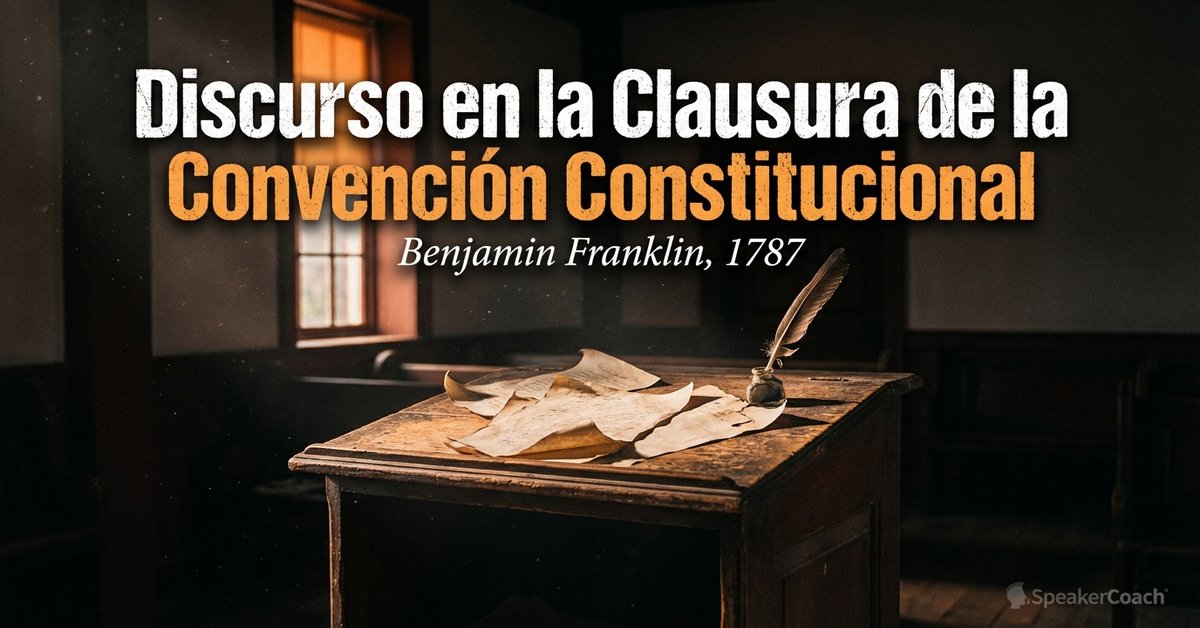
El discurso de clausura de Benjamin Franklin en la Convención Constitucional es una obra maestra de persuasión a través de la humildad. A los 81 años y siendo el delegado de mayor edad, Franklin reconoce que no aprueba completamente la Constitución pero argumenta que ninguna asamblea de hombres imperfectos podría producir un documento perfecto. Insta a sus compañeros delegados a dudar de su propia infalibilidad, sacrificar sus objeciones privadas por el bien público y firmar la Constitución para presentar un frente unido ante la nación y el mundo. El discurso transformó la potencial discordia en consenso, y todos menos tres delegados restantes firmaron el documento.
Contexto histórico
La Convención Constitucional se reunió en Filadelfia de mayo a septiembre de 1787 para abordar las debilidades de los Artículos de la Confederación. Después de meses de intenso debate sobre representación, esclavitud, poder ejecutivo y federalismo, los delegados habían producido un documento que nadie consideraba perfecto. Profundas divisiones permanecían entre estados grandes y pequeños, estados del norte y del sur, y defensores de un gobierno central fuerte versus limitado. Benjamin Franklin, a los 81 años el delegado más viejo y ya sufriendo de la gota y cálculos renales que lo matarían tres años después, estaba demasiado débil para pronunciar el discurso él mismo. Fue leído en voz alta por su compañero delegado de Pensilvania, James Wilson. La intervención de Franklin llegó en un momento crítico: varios delegados amenazaban con irse sin firmar, lo que podría haber condenado la ratificación. Su apelación a la humildad y el pragmatismo ayudó a asegurar las firmas de todos menos tres delegados restantes: Edmund Randolph, George Mason y Elbridge Gerry. Mientras los delegados se acercaban a firmar, Franklin supuestamente miró el sol tallado en la silla del presidente y dijo a los cercanos que durante mucho tiempo se había preguntado si era un sol naciente o poniente, y que ahora estaba satisfecho de que era un sol naciente.
Texto del discurso
Mr. President
I confess that there are several parts of this constitution which I do not at present approve, but I am not sure I shall never approve them: For having lived long, I have experienced many instances of being obliged by better information, or fuller consideration, to change opinions even on important subjects, which I once thought right, but found to be otherwise. It is therefore that the older I grow, the more apt I am to doubt my own judgment, and to pay more respect to the judgment of others. Most men indeed as well as most sects in Religion, think themselves in possession of all truth, and that wherever others differ from them it is so far error. Steele a Protestant in a Dedication tells the Pope, that the only difference between our Churches in their opinions of the certainty of their doctrines is, the Church of Rome is infallible and the Church of England is never in the wrong. But though many private persons think almost as highly of their own infallibility as of that of their sect, few express it so naturally as a certain french lady, who in a dispute with her sister, said "I don't know how it happens, Sister but I meet with no body but myself, that's always in the right -- Il n'y a que moi qui a toujours raison."
In these sentiments, Sir, I agree to this Constitution with all its faults, if they are such; because I think a general Government necessary for us, and there is no form of Government but what may be a blessing to the people if well administered, and believe farther that this is likely to be well administered for a course of years, and can only end in Despotism, as other forms have done before it, when the people shall become so corrupted as to need despotic Government, being incapable of any other. I doubt too whether any other Convention we can obtain, may be able to make a better Constitution. For when you assemble a number of men to have the advantage of their joint wisdom, you inevitably assemble with those men, all their prejudices, their passions, their errors of opinion, their local interests, and their selfish views. From such an assembly can a perfect production be expected? It therefore astonishes me, Sir, to find this system approaching so near to perfection as it does; and I think it will astonish our enemies, who are waiting with confidence to hear that our councils are confounded like those of the Builders of Babel; and that our States are on the point of separation, only to meet hereafter for the purpose of cutting one another's throats. Thus I consent, Sir, to this Constitution because I expect no better, and because I am not sure, that it is not the best. The opinions I have had of its errors, I sacrifice to the public good. I have never whispered a syllable of them abroad. Within these walls they were born, and here they shall die. If every one of us in returning to our Constituents were to report the objections he has had to it, and endeavor to gain partizans in support of them, we might prevent its being generally received, and thereby lose all the salutary effects & great advantages resulting naturally in our favor among foreign Nations as well as among ourselves, from our real or apparent unanimity. Much of the strength & efficiency of any Government in procuring and securing happiness to the people, depends, on opinion, on the general opinion of the goodness of the Government, as well as well as of the wisdom and integrity of its Governors. I hope therefore that for our own sakes as a part of the people, and for the sake of posterity, we shall act heartily and unanimously in recommending this Constitution (if approved by Congress & confirmed by the Conventions) wherever our influence may extend, and turn our future thoughts & endeavors to the means of having it well administred.
On the whole, Sir, I can not help expressing a wish that every member of the Convention who may still have objections to it, would with me, on this occasion doubt a little of his own infallibility, and to make manifest our unanimity, put his name to this instrument.
Análisis retórico
Franklin abre confesando sus propias dudas y enmarcando su disposición a cambiar de opinión como una marca de sabiduría en lugar de debilidad. Al modelar la humildad intelectual, facilita que otros delegados dejen de lado sus objeciones sin sentir que están traicionando sus principios.
cuanto más envejezco, más propenso soy a dudar de mi propio juicio y a prestar más respeto al juicio de los demás
Franklin compara el potencial fracaso de la Convención con la Torre de Babel, donde el castigo divino por la arrogancia humana resultó en confusión y división. La alusión advierte que la desunión confirmaría los peores temores de los enemigos de la nación.
nuestros consejos se han confundido como los de los Constructores de Babel, y que nuestros Estados están a punto de separarse, solo para reunirse en adelante con el propósito de cortarse mutuamente la garganta
La línea final de Franklin transforma la humildad intelectual en un desafío moral: pide a cada delegado que 'dude un poco de su propia infalibilidad' y firme la Constitución. La palabra 'infalibilidad' lleva el peso de su humor anterior sobre la certeza religiosa, haciendo que la negativa a firmar equivalga a una reclamación absurda de perfección personal.
no puedo evitar expresar el deseo de que cada miembro de la Convención que aún pueda tener objeciones, quiera conmigo, en esta ocasión, dudar un poco de su propia infalibilidad, y para hacer manifiesta nuestra unanimidad, ponga su nombre en este instrumento
Lecciones clave
- Usa el humor para hacer digeribles las verdades difíciles. Las anécdotas de Franklin sobre la infalibilidad religiosa hicieron reír a su audiencia antes de que se dieran cuenta de que se les pedía reconocer su propia falibilidad, una píldora mucho más difícil de tragar.
- Modela el comportamiento que deseas de tu audiencia. Al confesar abiertamente sus propias dudas sobre la Constitución, Franklin hizo psicológicamente seguro para otros delegados hacer lo mismo sin perder prestigio.
- Enmarca el compromiso como sabiduría, no como debilidad. Franklin redefine el acto de dejar de lado las objeciones no como capitulación sino como la forma más elevada de espíritu público y madurez intelectual.
- Cuando el consenso importa más que la perfección, dilo explícitamente. Al declarar 'no espero una mejor,' Franklin liberó a su audiencia de la paralizante búsqueda de un documento ideal y redirigió su energía hacia la unidad práctica.
- Termina con una solicitud única, clara y ejecutable. Después de un discurso rico en ideas y anécdotas, Franklin cierra con una directiva memorable: duda de tu infalibilidad y firma. La simplicidad del llamado a la acción hace imposible evadirlo.

Franklin demuestra una técnica indispensable en cualquier situación donde necesitas llevar a un grupo dividido al consenso: lidera con tus propias concesiones. Al ser el primero en admitir la imperfección -- en sí mismo, en el documento, en el proceso -- Franklin eliminó el estigma del compromiso. Cuando necesites el acuerdo de personas que tienen fuertes objeciones, no comiences descartando esas objeciones. Comienza compartiendo las tuyas. Luego reenmarca la pregunta de '¿Es esto perfecto?' a '¿Es esto lo mejor que podemos hacer juntos?' Ese cambio del idealismo individual al pragmatismo colectivo es a menudo la diferencia entre un acuerdo y un estancamiento.
Ver el programa