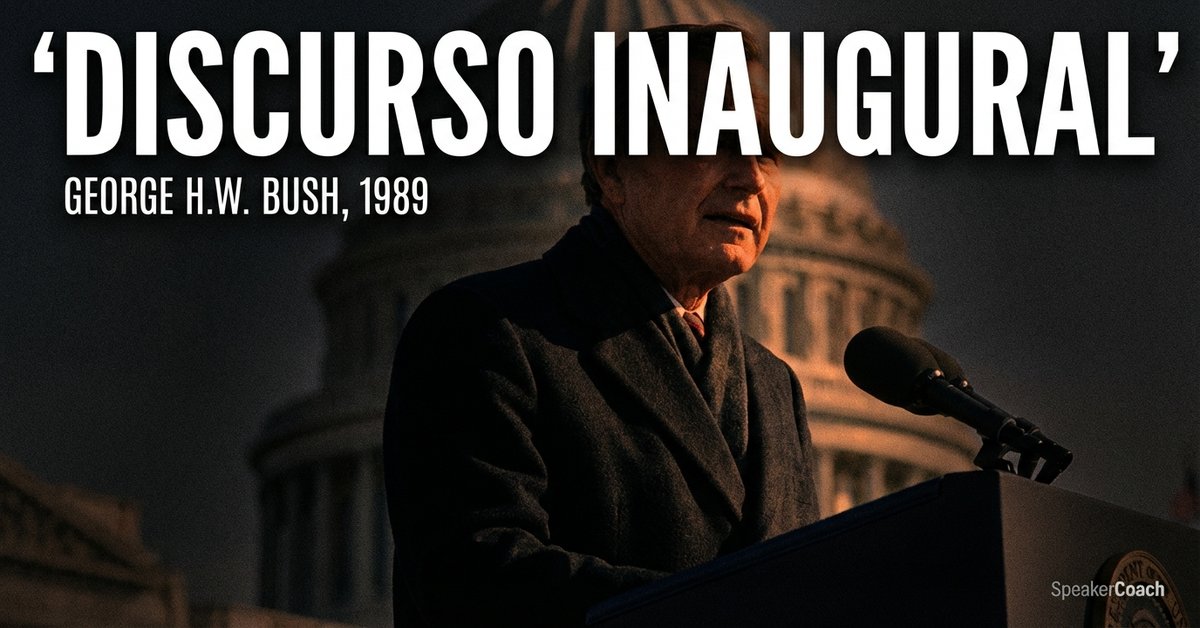
Pronunciado el 20 de enero de 1989 en el Frente Oeste del Capitolio, el discurso inaugural de George H.W. Bush introdujo la metafora central de su presidencia: 'mil puntos de luz' -- organizaciones comunitarias haciendo el bien en toda la nacion. El discurso es notable por su modestia deliberada, su enfasis en el voluntariado sobre los programas gubernamentales, y su mano extendida de cooperacion bipartidista hacia el Congreso controlado por los democratas. Bush abre con una oracion, invoca el bicentenario de Washington, y pide que America sea 'mas amable' y 'mas gentil.' Aborda el deficit, las drogas y la falta de vivienda, pero argumenta que 'tenemos mas voluntad que billetera' y que el verdadero recurso de la nacion es la bondad de su gente. El discurso tambien marca el fin de la era de la Guerra Fria, declarando que 'la era totalitaria esta pasando' y que la libertad ha demostrado ser el unico sistema viable.
Contexto histórico
Bush asumio el cargo en un momento crucial de la historia mundial. La Union Sovietica bajo Gorbachov se estaba liberalizando rapidamente; el Muro de Berlin caeria solo diez meses despues, en noviembre de 1989. En el ambito domestico, Bush heredo el legado de crecimiento economico de Reagan pero tambien un deficit federal creciente, una crisis de cajas de ahorro, un problema creciente de falta de vivienda y la epidemia de cocaina crack que devastaba las ciudades estadounidenses. El Partido Democrata controlaba tanto la Camara (bajo el Presidente Jim Wright) como el Senado (bajo el Lider de Mayoria George Mitchell), haciendo esencial la cooperacion bipartidista. El enfasis de Bush en el voluntariado y las organizaciones comunitarias reflejaba tanto su filosofia personal como la realidad fiscal de que grandes nuevos programas gubernamentales estaban descartados. Su llamado a una 'nacion mas amable y gentil' fue ampliamente interpretado como un sutil distanciamiento de la percibida dureza de la era Reagan.
Texto del discurso
Mr. Chief Justice, Mr. President, Vice President Quayle, Senator Mitchell, Speaker Wright, Senator Dole, Congressman Michel, and fellow citizens, neighbors, and friends: There is a man here who has earned a lasting place in our hearts and in our history. President Reagan, on behalf of our Nation, I thank you for the wonderful things that you have done for America. I have just repeated word for word the oath taken by George Washington 200 years ago, and the Bible on which I placed my hand is the Bible on which he placed his. It is right that the memory of Washington be with us today, not only because this is our Bicentennial Inauguration, but because Washington remains the Father of our Country. And he would, I think, be gladdened by this day; for today is the concrete expression of a stunning fact: our continuity these 200 years since our government began. We meet on democracy's front porch, a good place to talk as neighbors and as friends. For this is a day when our nation is made whole, when our differences, for a moment, are suspended. And my first act as President is a prayer. I ask you to bow your heads: Heavenly Father, we bow our heads and thank You for Your love. Accept our thanks for the peace that yields this day and the shared faith that makes its continuance likely. Make us strong to do Your work, willing to heed and hear Your will, and write on our hearts these words: "Use power to help people." For we are given power not to advance our own purposes, nor to make a great show in the world, nor a name. There is but one just use of power, and it is to serve people. Help us to remember it, Lord. Amen. I come before you and assume the Presidency at a moment rich with promise. We live in a peaceful, prosperous time, but we can make it better. For a new breeze is blowing, and a world refreshed by freedom seems reborn; for in man's heart, if not in fact, the day of the dictator is over. The totalitarian era is passing, its old ideas blown away like leaves from an ancient, lifeless tree. A new breeze is blowing, and a nation refreshed by freedom stands ready to push on. There is new ground to be broken, and new action to be taken. There are times when the future seems thick as a fog; you sit and wait, hoping the mists will lift and reveal the right path. But this is a time when the future seems a door you can walk right through into a room called tomorrow. Great nations of the world are moving toward democracy through the door to freedom. Men and women of the world move toward free markets through the door to prosperity. The people of the world agitate for free expression and free thought through the door to the moral and intellectual satisfactions that only liberty allows. We know what works: Freedom works. We know what's right: Freedom is right. We know how to secure a more just and prosperous life for man on Earth: through free markets, free speech, free elections, and the exercise of free will unhampered by the state. For the first time in this century, for the first time in perhaps all history, man does not have to invent a system by which to live. We don't have to talk late into the night about which form of government is better. We don't have to wrest justice from the kings. We only have to summon it from within ourselves. We must act on what we know. I take as my guide the hope of a saint: In crucial things, unity; in important things, diversity; in all things, generosity. America today is a proud, free nation, decent and civil, a place we cannot help but love. We know in our hearts, not loudly and proudly, but as a simple fact, that this country has meaning beyond what we see, and that our strength is a force for good. But have we changed as a nation even in our time? Are we enthralled with material things, less appreciative of the nobility of work and sacrifice? My friends, we are not the sum of our possessions. They are not the measure of our lives. In our hearts we know what matters. We cannot hope only to leave our children a bigger car, a bigger bank account. We must hope to give them a sense of what it means to be a loyal friend, a loving parent, a citizen who leaves his home, his neighborhood and town better than he found it. What do we want the men and women who work with us to say when we are no longer there? That we were more driven to succeed than anyone around us? Or that we stopped to ask if a sick child had gotten better, and stayed a moment there to trade a word of friendship? No President, no government, can teach us to remember what is best in what we are. But if the man you have chosen to lead this government can help make a difference; if he can celebrate the quieter, deeper successes that are made not of gold and silk, but of better hearts and finer souls; if he can do these things, then he must. America is never wholly herself unless she is engaged in high moral principle. We as a people have such a purpose today. It is to make kinder the face of the Nation and gentler the face of the world. My friends, we have work to do. There are the homeless, lost and roaming. There are the children who have nothing, no love, no normalcy. There are those who cannot free themselves of enslavement to whatever addiction--drugs, welfare, the demoralization that rules the slums. There is crime to be conquered, the rough crime of the streets. There are young women to be helped who are about to become mothers of children they can't care for and might not love. They need our care, our guidance, and our education, though we bless them for choosing life. The old solution, the old way, was to think that public money alone could end these problems. But we have learned that is not so. And in any case, our funds are low. We have a deficit to bring down. We have more will than wallet; but will is what we need. We will make the hard choices, looking at what we have and perhaps allocating it differently, making our decisions based on honest need and prudent safety. And then we will do the wisest thing of all: We will turn to the only resource we have that in times of need always grows--the goodness and the courage of the American people. I am speaking of a new engagement in the lives of others, a new activism, hands-on and involved, that gets the job done. We must bring in the generations, harnessing the unused talent of the elderly and the unfocused energy of the young. For not only leadership is passed from generation to generation, but so is stewardship. And the generation born after the Second World War has come of age. I have spoken of a thousand points of light, of all the community organizations that are spread like stars throughout the Nation, doing good. We will work hand in hand, encouraging, sometimes leading, sometimes being led, rewarding. We will work on this in the White House, in the Cabinet agencies. I will go to the people and the programs that are the brighter points of light, and I will ask every member of my government to become involved. The old ideas are new again because they are not old, they are timeless: duty, sacrifice, commitment, and a patriotism that finds its expression in taking part and pitching in. We need a new engagement, too, between the Executive and the Congress. The challenges before us will be thrashed out with the House and the Senate. We must bring the Federal budget into balance. And we must ensure that America stands before the world united, strong, at peace, and fiscally sound. But, of course, things may be difficult. We need compromise; we have had dissension. We need harmony; we have had a chorus of discordant voices. For Congress, too, has changed in our time. There has grown a certain divisiveness. We have seen the hard looks and heard the statements in which not each other's ideas are challenged, but each other's motives. And our great parties have too often been far apart and untrusting of each other. It has been this way since Vietnam. That war cleaves us still. But, friends, that war began in earnest a quarter of a century ago; and surely the statute of limitations has been reached. This is a fact: The final lesson of Vietnam is that no great nation can long afford to be sundered by a memory. A new breeze is blowing, and the old bipartisanship must be made new again. To my friends--and yes, I do mean friends--in the loyal opposition--and yes, I mean loyal: I put out my hand. I am putting out my hand to you, Mr. Speaker. I am putting out my hand to you Mr. Majority Leader. For this is the thing: This is the age of the offered hand. We can't turn back clocks, and I don't want to. But when our fathers were young, Mr. Speaker, our differences ended at the water's edge. And we don't wish to turn back time, but when our mothers were young, Mr. Majority Leader, the Congress and the Executive were capable of working together to produce a budget on which this nation could live. Let us negotiate soon and hard. But in the end, let us produce. The American people await action. They didn't send us here to bicker. They ask us to rise above the merely partisan. "In crucial things, unity"--and this, my friends, is crucial. To the world, too, we offer new engagement and a renewed vow: We will stay strong to protect the peace. The "offered hand" is a reluctant fist; but once made, strong, and can be used with great effect. There are today Americans who are held against their will in foreign lands, and Americans who are unaccounted for. Assistance can be shown here, and will be long remembered. Good will begets good will. Good faith can be a spiral that endlessly moves on. Great nations like great men must keep their word. When America says something, America means it, whether a treaty or an agreement or a vow made on marble steps. We will always try to speak clearly, for candor is a compliment, but subtlety, too, is good and has its place. While keeping our alliances and friendships around the world strong, ever strong, we will continue the new closeness with the Soviet Union, consistent both with our security and with progress. One might say that our new relationship in part reflects the triumph of hope and strength over experience. But hope is good, and so are strength and vigilance. Here today are tens of thousands of our citizens who feel the understandable satisfaction of those who have taken part in democracy and seen their hopes fulfilled. But my thoughts have been turning the past few days to those who would be watching at home to an older fellow who will throw a salute by himself when the flag goes by, and the women who will tell her sons the words of the battle hymns. I don't mean this to be sentimental. I mean that on days like this, we remember that we are all part of a continuum, inescapably connected by the ties that bind. Our children are watching in schools throughout our great land. And to them I say, thank you for watching democracy's big day. For democracy belongs to us all, and freedom is like a beautiful kite that can go higher and higher with the breeze. And to all I say: No matter what your circumstances or where you are, you are part of this day, you are part of the life of our great nation. A President is neither prince nor pope, and I don't seek a window on men's souls. In fact, I yearn for a greater tolerance, an easy- goingness about each other's attitudes and way of life. There are few clear areas in which we as a society must rise up united and express our intolerance. The most obvious now is drugs. And when that first cocaine was smuggled in on a ship, it may as well have been a deadly bacteria, so much has it hurt the body, the soul of our country. And there is much to be done and to be said, but take my word for it: This scourge will stop. And so, there is much to do; and tomorrow the work begins. I do not mistrust the future; I do not fear what is ahead. For our problems are large, but our heart is larger. Our challenges are great, but our will is greater. And if our flaws are endless, God's love is truly boundless. Some see leadership as high drama, and the sound of trumpets calling, and sometimes it is that. But I see history as a book with many pages, and each day we fill a page with acts of hopefulness and meaning. The new breeze blows, a page turns, the story unfolds. And so today a chapter begins, a small and stately story of unity, diversity, and generosity--shared, and written, together. Thank you. God bless you and God bless the United States of America. Inaugural Speeches Page
Análisis retórico
La metafora de la 'nueva brisa' recurre a lo largo del discurso, conectando la renovacion domestica con la revolucion democratica global. Al usar la misma imagen tanto para el voluntariado americano como para la caida del totalitarismo, Bush implica que ambos son parte del mismo viento historico de cambio.
Pues una nueva brisa esta soplando, y un mundo refrescado por la libertad parece renacer; pues en el corazon del hombre, si no en los hechos, el dia del dictador ha terminado. La era totalitaria esta pasando, sus viejas ideas arrastradas como hojas de un arbol antiguo y sin vida.
Bush rompe el protocolo al dirigirse directamente al Presidente de la Camara y al Lider de Mayoria del Senado por su titulo, extendiendo fisicamente su mano en un gesto de cooperacion bipartidista. La repeticion de 'estoy extendiendo mi mano' transforma una apelacion politica abstracta en un acto visible y fisico.
Extiendo mi mano. Le estoy extendiendo mi mano a usted, Senor Presidente de la Camara. Le estoy extendiendo mi mano a usted, Senor Lider de Mayoria. Porque esta es la cuestion: Esta es la era de la mano extendida.
Bush destila toda su filosofia politica en dos oraciones paralelas y concisas. La estructura quiastica -- 'Sabemos que funciona / Sabemos que es correcto' -- hace que una afirmacion ideologica compleja se sienta como sentido comun.
Sabemos que funciona: La libertad funciona. Sabemos que es correcto: La libertad es correcta.
Bush empareja conceptos contrastantes en clausulas paralelas ajustadas para crear lineas memorables y citables. 'Voluntad' y 'billetera' se oponen directamente, transformando una limitacion fiscal en una declaracion de caracter nacional. La construccion reenmarca la escasez como fortaleza moral.
Tenemos mas voluntad que billetera; pero voluntad es lo que necesitamos.
Bush usa la estructura repetida 'a traves de la puerta hacia...' tres veces sucesivas, aplicandola cada vez a un valor diferente -- libertad, prosperidad, satisfaccion moral. El tricolon crea impulso ritmico y refuerza la idea de que la democracia, los mercados libres y la libre expresion son caminos paralelos hacia el florecimiento humano.
Las grandes naciones del mundo avanzan hacia la democracia a traves de la puerta de la libertad. Los hombres y mujeres del mundo avanzan hacia los mercados libres a traves de la puerta de la prosperidad. Los pueblos del mundo exigen libre expresion y libre pensamiento a traves de la puerta de las satisfacciones morales e intelectuales que solo la libertad permite.
Bush refleja 'mas amable la faz de la Nacion' con 'mas gentil la faz del mundo,' usando un patron quiastico donde el emparejamiento adjetivo-sustantivo invierte el alcance de lo domestico a lo global. El paralelismo entre 'amable/gentil' y 'Nacion/mundo' crea una declaracion de mision compacta para su presidencia.
Es hacer mas amable la faz de la Nacion y mas gentil la faz del mundo.
Lecciones clave
- **Haz las apelaciones abstractas fisicas y concretas.** Bush no solo pide bipartidismo -- extiende fisicamente su mano y nombra a las personas a las que se dirige. Cuando pidas cooperacion, haz el gesto visible y especifico.
- **Usa una sola metafora como columna vertebral estructural.** La 'nueva brisa' recurre al menos cuatro veces, dando coherencia al discurso y haciendo sentir a la audiencia que la renovacion domestica e internacional son parte de la misma historia.
- **Reconoce las limitaciones honestamente.** 'Tenemos mas voluntad que billetera' es una admision desarmante que transforma una restriccion en una virtud. Cuando no puedas prometer recursos, promete compromiso.

Estudia la modestia deliberada de Bush como una eleccion estrategica. Donde Reagan era cinematografico y elevado, Bush es conversacional e intimo -- 'el porche de la democracia.' Esto no es un fracaso retorico; es una estrategia retorica diferente. Bush entendio que suceder a un predecesor carismatico requeria establecer una voz distinta, no imitar la anterior. Si sucedes a un orador poderoso en cualquier contexto, encuentra tu propio registro en lugar de intentar igualar el suyo.
Ver el programa