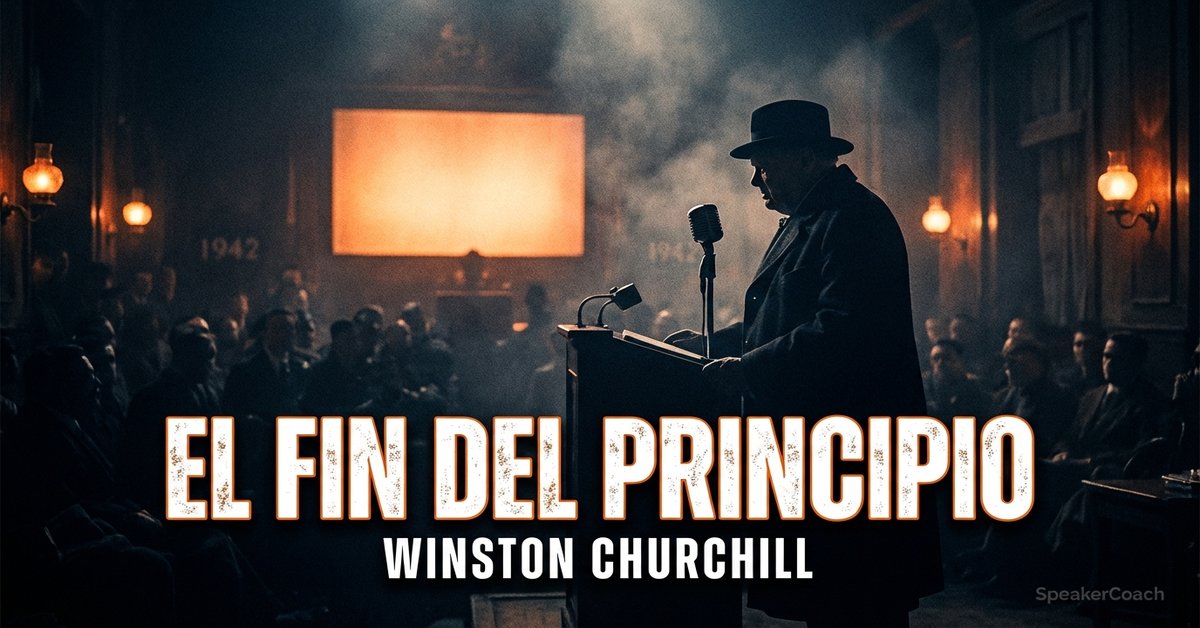
En "El Fin del Principio", Winston Churchill informa a la nación sobre la decisiva victoria aliada en El Alamein, Egipto -- la primera gran derrota terrestre del Afrika Korps de Rommel -- y los exitosos desembarcos de la Operación Antorcha en el norte de África francés. En lugar de permitir una euforia prematura, Churchill enmarca la victoria con precisión característica: no marca el fin, ni siquiera el principio del fin, sino quizás "el fin del principio". El discurso equilibra la celebración con un realismo sobrio, reconociendo el largo camino por delante mientras afirma que el poderío combinado de Gran Bretaña y Estados Unidos hace inevitable el resultado.
Contexto histórico
Pronunciado el 10 de noviembre de 1942, en el Almuerzo del Lord Alcalde en Mansion House en Londres, este discurso llegó en un punto de inflexión crucial de la Segunda Guerra Mundial. Solo días antes, el 2-3 de noviembre, el Octavo Ejército del General Montgomery había derrotado decisivamente al Afrika Korps de Rommel en la Segunda Batalla de El Alamein en Egipto, marcando la primera gran victoria terrestre aliada contra Alemania. Simultáneamente, el 8 de noviembre, la Operación Antorcha -- la invasión anglo-americana del norte de África francés bajo el General Eisenhower -- había desembarcado exitosamente tropas en Casablanca, Orán y Argel. Antes de El Alamein, Gran Bretaña había sufrido una cadena de derrotas devastadoras: la caída de Singapur, la pérdida de Tobruk y la amenaza al Canal de Suez. La victoria transformó la moral aliada y comenzó la campaña que eventualmente limpiaría el norte de África y abriría el camino a la invasión de Italia. La cuidadosa calibración de expectativas de Churchill -- "el fin del principio" -- reflejaba tanto prudencia militar como genialidad retórica, ya que la guerra continuaría por casi tres años más.
Texto del discurso
I have never promised anything but blood, tears, toil and sweat. Now, however, we have a new experience. We have victory -- a remarkable and definite victory. The bright gleam has caught the helmets of our soldiers, and warmed and cheered all our hearts.
The late M. Venizelos observed that in all her wars England -- he should have said Britain, of course -- always wins one battle -- the last. It would seem to have begun rather earlier this time. General Alexander, with his brilliant comrade and lieutenant, General Montgomery, has gained a glorious and decisive victory in what I think should be called the Battle of Egypt. Rommel's army has been defeated. It has been routed. It has been very largely destroyed as a fighting force.
This battle was not fought for the sake of gaining positions or so many square miles of desert territory. General Alexander and General Montgomery fought it with one single idea. They meant to destroy the armed force of the enemy and to destroy it at the place where the disaster would be most far-reaching and irrecoverable.
Now this is not the end. It is not even the beginning of the end. But it is, perhaps, the end of the beginning.
Henceforth Hitler's Nazis will meet equally well armed, and perhaps better armed troops. Hence forward they will have to face in many theatres of war that superiority in the air which they have so often used without mercy against others, of which they boasted all round the world, and which they intended to use as an instrument for convincing all other peoples that all resistance to them was hopeless.
When I read of the coastal road crammed with fleeing German vehicles under the blasting attacks of the Royal Air Force, I could not but remember those roads of France and Flanders, crowded, not with fighting men, but with helpless refugees -- Loss women and children -- fleeing with their pathetic bundles and household treasures, upon whom such merciless havoc was wreaked. I have, I trust, no vindictive feelings about the Germans as a people. I believe I have always been in favour of, if it could be managed, living in friendly neighbourliness with Germany. I am still hoping to see that day, but that day will only come when you have beaten them and broken them and brought home to them a sense of their own weakness and shortcomings.
When we consider the resources of the United States and her vast uninjured and unattackable territory, when we consider the Russian armies and their assurance of ample supplies of every kind, when we consider how the British sea-power and air-power is growing in every part of the globe, we may say that the time has come when jests about being the workshop of the world have passed away. The workshop of the world is the British Empire and the American Republic, working together in close association.
I must however admit that I was anxious about the opening stages of the battle. Most of our best tanks had been sent to Russia, and the newer patterns had not yet arrived in large numbers. We were short of ammunition. Our losses in the air were also severe; but the spirit of our men was splendid. General Alexander has told me that the morale of his men went up with each succeeding day of the battle, and that at the end they were at the highest pitch of keenness and confidence.
I was also anxious about the reaction of the enemy to our move into French North Africa. We had worked for months upon the greatest amphibious operation so far attempted in the history of war. It involved, in its first stage, sailing nearly eight hundred ships and finding safe lodgement at a dozen and more points of a coast two thousand miles long. The hazards of war at sea on such a scale are very great; I felt them most in the case of our very large, slow convoys proceeding from the Clyde and from other ports to North Africa; but all arrived safely, and the great enterprise was effectively and simultaneously achieved.
I must say I think the skill with which the original plan was shaped by Vice Admiral Lord Louis Mountbatten and the officers of Combined Operations Headquarters, the drive and vigour with which it was carried through by the Allied Commander-in-Chief, General Eisenhower, and the bravery with which the landings were effected by American and British forces working together -- all this constitutes a remarkable chapter in the annals of war.
I said some months ago that we do not win the war by evacuations. We have, in fact, landed armies in French North Africa and they are growing every day. We have the advantage of the French harbour at Algiers and other ports, and we propose to make good use of them. I give full acknowledgment to the part played by the United States and to the personal contribution of President Roosevelt, whose devoted efforts to bring about the Franco-American Settlement have been crowned with success.
I have been in close touch with the Commander-in-Chief, and our agreement upon all questions of policy and detail is complete. We mean to hold what we have got and to push forward where we can. For the rest, I will simply say this: The Germans have received back again that measure of fire and steel which they have so often meted out to others. Now they feel what it is like.
We intend to give them more, and we intend to give it to them in increasing measure. But there is one thing I would say: I never join in any rejoicing about the slaughter of human beings. I cannot go further than to say that the enemy has been, and is being, paid back in his own coin. The Germans have asked for total war. Let them make sure they do not get more than their fill.
I am confident of the future. Of course, we have a lot to endure yet. I expect fresh turns of ill-fortune, and I am quite sure of new and larger misfortunes still to come. But there is one solid, tested, and unbreakable fact: the power of the United States is coming into full play. The British Empire and the American Republic are working together. I do not think any reasonable man could doubt the outcome.
I notice, my Lord Mayor, by your speech you had reached the conclusion that the news from all theatres of war is very much better than we have had for a long time past. This is true, but it comes only as a stimulant to renewed exertions. I always hate to compare Napoleon with Hitler, as it seems an insult to the great Emperor and warrior to connect him in any way with a squalid caucus boss and butcher. But there is one respect in which I must draw a parallel. Both Napoleon and Hitler committed the supreme error of invading Russia. It is a wonderful thing that Russia is not only holding the line, but that her forces are gathering for a great counter-offensive.
I shall not attempt to set limits to the development of this war. I am not going to prophesy about what is going to happen. But I will venture to say this: We mean to hold our own. I have not become the King's First Minister in order to preside over the liquidation of the British Empire. For that task, if ever it were prescribed, someone else would have to be found, and, under democracy, I suppose the nation would have to be consulted.
I am proud to be a member of that vast commonwealth and society of nations and communities gathered in and around the ancient British monarchy, without which the good cause might well have perished from the face of the earth. Here we are, and here we stand, a veritable rock of salvation in this drifting world.
Análisis retórico
La yuxtaposición de ideas contrastantes en estructuras gramaticales equilibradas, creando tensión retórica y frases memorables.
Ahora bien, esto no es el fin. Ni siquiera es el principio del fin. Pero es, quizás, el fin del principio.
La minimización deliberada de la importancia para lograr un efecto más poderoso a través de la contención, un sello del estilo retórico de Churchill.
Pero es, quizás, el fin del principio.
El uso de humor agudo, a menudo sardónico, para hacer un punto serio, cautivando al público mientras se ofrece una evaluación devastadora.
Siempre detesto comparar a Napoleón con Hitler, pues parece un insulto al gran Emperador y guerrero conectarlo de cualquier manera con un sórdido jefe de camarilla y carnicero.
La repetición de una palabra o frase al inicio de cláusulas sucesivas para construir impulso retórico.
Cuando consideramos los recursos de Estados Unidos y su vasto territorio intacto e inatacable, cuando consideramos los ejércitos rusos y su seguridad de amplios suministros de todo tipo, cuando consideramos cómo el poderío naval y aéreo británico crece en cada parte del globo
El cuidadoso equilibrio entre determinación justa y contención ética, proyectando autoridad moral incluso en tiempos de guerra.
Nunca me uno a regocijo alguno por la matanza de seres humanos. No puedo ir más allá de decir que al enemigo se le ha pagado, y se le está pagando, con su propia moneda.
El uso de lenguaje sensorial rico para hacer tangibles y emocionalmente resonantes los eventos bélicos.
El resplandor brillante ha alcanzado los cascos de nuestros soldados, y ha calentado y alegrado todos nuestros corazones.
Declaraciones de determinación personal y nacional que proyectan firmeza y negativa a ceder, galvanizando al público a través de pura fuerza de voluntad.
No me he convertido en Primer Ministro del Rey para presidir la liquidación del Imperio Británico.
Lecciones clave
- **Calibra tu celebración con precisión.** La fórmula del "fin del principio" de Churchill muestra cómo reconocer el éxito sin prometer de más. Al reportar buenas noticias, enmárcalas dentro del viaje más amplio -- esto construye credibilidad y previene que la audiencia se vuelva complaciente.
- **Muestra vulnerabilidad para construir autoridad.** Al admitir que estaba "ansioso por las etapas iniciales", Churchill paradójicamente fortalece su credibilidad. Cuando un líder reconoce lo que le quitó el sueño, la audiencia confía más en el optimismo del líder.
- **Usa el ingenio como arma y escudo.** La comparación Napoleón-Hitler es tanto devastadoramente graciosa como políticamente letal. El humor desarma la resistencia y hace memorables las verdades duras. Practica incrustar tus argumentos más cortantes dentro de momentos de levedad.
- **Equilibra la claridad moral con la humanidad.** Churchill se niega a regocijarse por la matanza mientras insiste en que el enemigo reciba su pago completo. Esta doble postura -- contención ética combinada con resolución inquebrantable -- proyecta el tipo de autoridad moral que sostiene el apoyo a largo plazo.
- **Termina con una imagen, no con un argumento.** La línea final -- "una verdadera roca de salvación en este mundo a la deriva" -- es una imagen concreta que perdura en la mente mucho después de que los argumentos lógicos se desvanecen. Siempre cierra con algo que la audiencia pueda visualizar.

La línea más citada de Churchill en este discurso -- "Esto no es el fin. Ni siquiera es el principio del fin. Pero es, quizás, el fin del principio" -- es una clase magistral en la técnica retórica de la antimetábole (invertir el orden de palabras repetidas). La estructura triple crea suspenso: la primera cláusula niega, la segunda niega aún más, y la tercera invierte las expectativas con un giro. Practica este patrón: declara lo que algo NO es, niégalo aún con más fuerza, y luego gira hacia lo que SÍ es usando las mismas palabras reordenadas. Esta técnica funciona en cualquier contexto donde necesites gestionar expectativas -- informes trimestrales, actualizaciones de proyectos o hitos personales.
Ver el programa