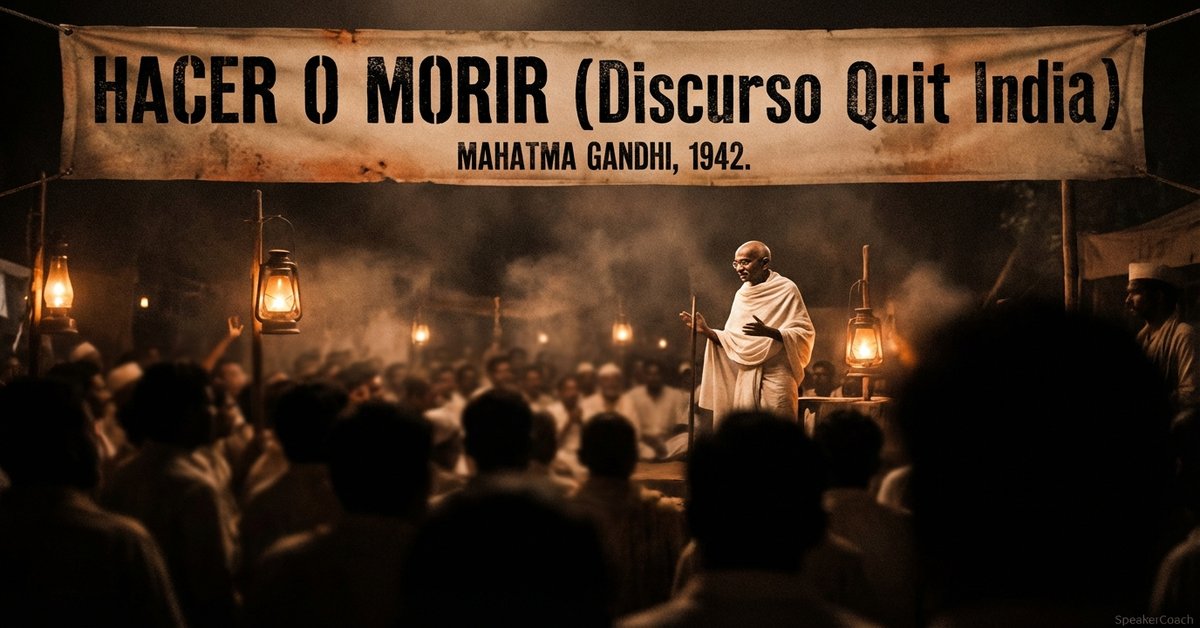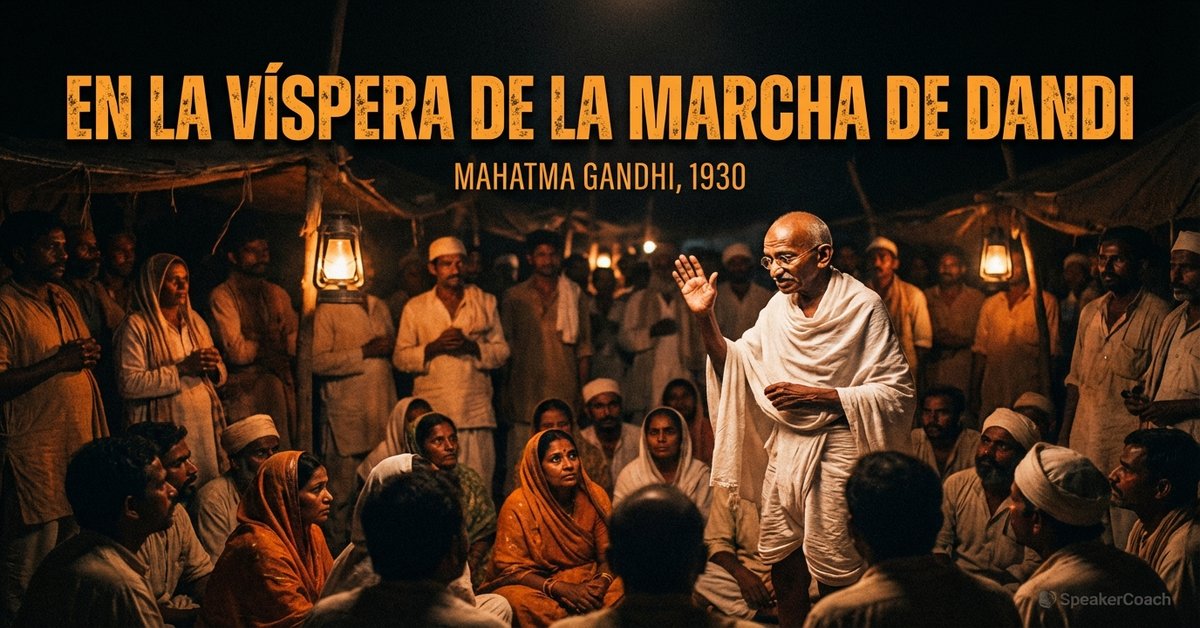
En la víspera de la histórica Marcha de la Sal, Gandhi pronuncia lo que cree puede ser su último discurso -- una clase magistral de despedida estratégica. En lugar de animar a las tropas con retórica ardiente, da instrucciones operativas precisas y serenas sobre cómo el movimiento debe continuar después de su arresto. El poder del discurso radica en su contención: Gandhi habla con la claridad de un general emitiendo las últimas órdenes antes de la batalla, detallando exactamente cómo romper las leyes de la sal, quién debe liderar en su ausencia, y qué constituye desobediencia civil legítima. La fuerza emocional no viene de grandes declaraciones sino de la certeza tranquila de que puede morir, y la insistencia absoluta en que el movimiento debe sobrevivirle. Es uno de los ejemplos más efectivos de retórica de contingencia en la historia moderna.
Contexto histórico
Pronunciado la noche del 11 de marzo de 1930 ante aproximadamente 10.000 personas reunidas en las arenas del río Sabarmati en Ahmedabad, este discurso lanzó uno de los actos de desobediencia civil más icónicos de la historia. A la mañana siguiente, Gandhi y 78 seguidores comenzaron la marcha de 386 kilómetros desde el Ashram Sabarmati hasta el pueblo costero de Dandi, donde el 6 de abril Gandhi recogería un trozo de sal natural de la orilla del mar -- rompiendo simbólicamente las leyes del impuesto a la sal británico. El monopolio británico de la sal gravaba una necesidad básica utilizada por todo indio, convirtiéndola en el símbolo perfecto de la explotación colonial. La marcha electrificó a la nación: para cuando Gandhi llegó a Dandi, miles se habían unido, y la campaña de desobediencia civil que siguió vio a más de 60.000 indios encarcelados. La Marcha de la Sal transformó el movimiento independentista indio de un movimiento político de élites a una lucha popular masiva y atrajo la atención internacional a la causa de la India.
Texto del discurso
In all probability this will be my last speech to you. Even if the Government allow me to march tomorrow morning, this will be my last speech on the sacred banks of the Sabarmati. Possibly these may be the last words of my life here.
I have already told you yesterday what I had to say. Today I shall confine myself to what you should do after my companions and I are arrested. The programme of the march to Jalalpur must be fulfilled as originally settled. The enlistment of volunteers for this purpose should be confined to Gujarat. From what I have seen and heard during the last fortnight I am inclined to believe that the stream of civil resisters will flow unbroken.
But let there be not a semblance of breach of peace even after all of us have been arrested. We have resolved to utilize all our resources in the pursuit of an exclusively non-violent struggle. Let no one commit a wrong in anger. This is my hope and prayer. I wish these words of mine reached every nook and corner of the land.
My task shall be done if I perish and so do my comrades. It will then be for the Working Committee of the Congress to show the way, and it will be the duty of every one to cooperate with the Congress and not to go beyond the limits set by the Congress.
Those only can take up civil disobedience who believe in willing obedience even to irksome laws imposed by the state so long as they do not hurt their conscience, and are prepared equally to suffer the penalties of civil disobedience. Disobedience to be civil has to be open and non-violent.
I stress only one condition, namely, let our pledge of truth and non-violence as the only means for the attainment of swaraj be faithfully kept. For the rest, every one has a free hand. But that does not give a license to all and sundry to carry on their own responsibility. Wherever there are local leaders, their orders should be obeyed by the people. Where there are no leaders and only a handful of men have faith in the programme, they may do what they can, if they have enough self-confidence. They have a right, nay it is their duty, to do so. The rest must watch and pray.
The salt tax affects the poorest of the poor. The salt tax constitutes, therefore, the most inhuman poll tax that ingenuity of man can devise. These laws can be violated in three ways. It is an offence to manufacture salt wherever there are facilities for doing so. The possession and sale of contraband salt, which includes natural salt or salt earth, is also an offence. The purchasers of such salt will be equally guilty. To carry away the natural salt deposits on the seashore is likewise violation of law. So is the hawking of such salt. In short, you may choose any one or all of these devices to break the salt monopoly.
We are however not to be content with merely breaking the salt laws. There is no doubt that it is at present the widest in scope, but the issue is India's freedom. There are women who can stand shoulder to shoulder with men in this struggle.
Let no one imagine that it will be over when the march is completed. There will be as much to do after the march as before. I shall then only have given a signal. But I am sure the people will act in proper response to the signal.
A Satyagrahi, whether free or incarcerated, is ever victorious. He is vanquished only when he forsakes truth and non-violence and turns a deaf ear to the inner voice. If, therefore, there is such a thing as defeat for even a Satyagrahi, he alone is the cause of it. God bless you all and keep up your courage till the end.
Análisis retórico
Abrir con la posibilidad de muerte para elevar inmediatamente lo que está en juego y darle al discurso el peso de un último testamento.
Con toda probabilidad este será mi último discurso ante ustedes. Incluso si el Gobierno me permite marchar mañana por la mañana, este será mi último discurso en las orillas sagradas del Sabarmati. Posiblemente estas sean las últimas palabras de mi vida aquí.
Transferir explícitamente la responsabilidad de liderazgo para asegurar que el movimiento sobreviva a la remoción del líder, creando propiedad distribuida.
Mi tarea estará cumplida si perezco y así también mis camaradas. Entonces corresponderá al Comité de Trabajo del Congreso mostrar el camino, y será el deber de cada uno cooperar con el Congreso.
Definir cuidadosamente qué califica y descalifica a alguien para la participación, estableciendo límites éticos para la acción.
Solo pueden emprender la desobediencia civil quienes creen en la obediencia voluntaria incluso a leyes molestas impuestas por el estado mientras no hieran su conciencia, y están igualmente preparados para sufrir las consecuencias de la desobediencia civil.
Expandir deliberadamente el alcance de quiénes son invitados a unirse a la lucha, rompiendo barreras sociales.
Hay mujeres que pueden estar hombro con hombro con los hombres en esta lucha.
Redefinir la victoria para hacerla incondicional -- eliminando la capacidad del oponente de derrotar verdaderamente al movimiento.
Un Satyagrahi, ya sea libre o encarcelado, es siempre victorioso. Es vencido solo cuando abandona la verdad y la no violencia y hace oídos sordos a la voz interior.
Lecciones clave
- **Abre con vulnerabilidad para comandar autoridad.** Gandhi comienza admitiendo que puede morir. Paradójicamente, este reconocimiento de la mortalidad hace todo lo que dice después más poderoso, no menos. Cuando lo que está en juego es real, nombrarlo honestamente construye confianza.
- **Da instrucciones específicas, no solo inspiración.** El pasaje de la ley de la sal detalla exactamente tres métodos de desobediencia civil. Las audiencias necesitan saber no solo por qué actuar, sino cómo. Los discursos más efectivos son también manuales de operaciones.
- **Construye un movimiento que sobreviva a tu remoción.** Los pasajes de delegación de Gandhi aseguran que el movimiento no dependa de ningún líder individual. Cuando construyes algo duradero, tu discurso debe empoderar a otros para continuar sin ti.
- **Redefine los términos de la victoria.** 'Un Satyagrahi, ya sea libre o encarcelado, es siempre victorioso' hace la derrota imposible al redefinir qué significa ganar. Cuando tu oponente controla los resultados físicos, reenmarca el éxito en términos morales o espirituales.
- **Incluye a quienes típicamente están excluidos.** La mención explícita de Gandhi de las mujeres 'hombro con hombro con los hombres' era radical para la India de 1930. Expandir tu audiencia más allá de sus límites asumidos señala que la causa es universal.

El discurso de la Marcha de la Sal de Gandhi enseña una lección contraintuitiva: a veces el discurso más poderoso es el más operativo. En lugar de retórica elevada, Gandhi da un manual paso a paso para la desobediencia civil, pronunciado con la calma de un hombre que ya ha aceptado la muerte. Cuando enfrentes un momento crucial, resiste el impulso de inflar tu lenguaje. En su lugar, sé tan específico que tu audiencia pueda actuar sin ti. Practica escribiendo un discurso que pueda usarse como manual de instrucciones: si tu audiencia lee solo la transcripción, ¿puede ejecutar el plan?
Ver el programa