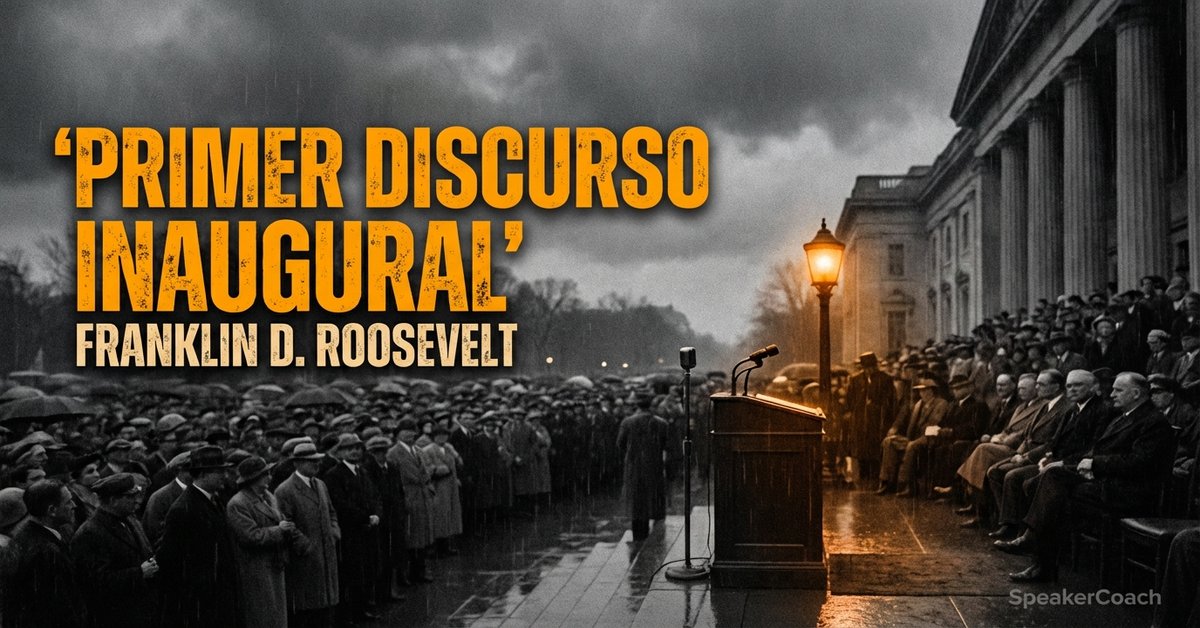
En su Primer Discurso Inaugural, Franklin D. Roosevelt confronta a una nación paralizada por la Gran Depresión con un mensaje de confianza resuelta y acción urgente. Abriendo con la icónica declaración de que "lo único que debemos temer es al temor mismo", Roosevelt diagnostica la crisis como un fracaso moral del liderazgo financiero -- presentando a Wall Street como los "cambistas" bíblicos expulsados del templo -- y prescribe un amplio programa de recuperación liderado por el gobierno. El discurso transforma una ceremonia inaugural en un llamado a las armas en tiempo de guerra, con Roosevelt enmarcando la emergencia económica como equivalente a una invasión extranjera y solicitando amplios poderes ejecutivos para combatirla. A través de alusiones bíblicas, antítesis y retórica imperativa, Roosevelt redefine la relación entre gobierno y ciudadano, sentando las bases retóricas del New Deal.
Contexto histórico
Pronunciado el 4 de marzo de 1933, este discurso llegó en el punto más bajo de la Gran Depresión. El desempleo se situaba en aproximadamente el 25%, miles de bancos habían quebrado, la producción industrial había caído casi a la mitad y los precios agrícolas se habían desplomado. El presidente anterior, Herbert Hoover, había sido ampliamente percibido como ineficaz, y la nación estaba atrapada en una crisis de confianza que amenazaba la estabilidad del propio sistema democrático. Roosevelt había ganado las elecciones de 1932 de manera aplastante, obteniendo 42 de los 48 estados, y el público estadounidense estaba desesperado por un nuevo liderazgo. La mañana de la investidura, los gobernadores de varios estados habían declarado feriados bancarios para prevenir más corridas. Roosevelt usó el discurso no solo para delinear políticas sino para reafirmar la autoridad ejecutiva y restaurar la moral pública, preparando el escenario para los vertiginosos "Primeros Cien Días" de legislación del New Deal que remodelarían fundamentalmente el papel del gobierno federal en la vida estadounidense.
Texto del discurso
First Inaugural Address of Franklin D. Roosevelt SATURDAY, MARCH 4, 1933 I am certain that my fellow Americans expect that on my induction into the Presidency I will address them with a candor and a decision which the present situation of our Nation impels. This is preeminently the time to speak the truth, the whole truth, frankly and boldly. Nor need we shrink from honestly facing conditions in our country today. This great Nation will endure as it has endured, will revive and will prosper. So, first of all, let me assert my firm belief that the only thing we have to fear is fear itself--nameless, unreasoning, unjustified terror which paralyzes needed efforts to convert retreat into advance. In every dark hour of our national life a leadership of frankness and vigor has met with that understanding and support of the people themselves which is essential to victory. I am convinced that you will again give that support to leadership in these critical days. In such a spirit on my part and on yours we face our common difficulties. They concern, thank God, only material things. Values have shrunken to fantastic levels; taxes have risen; our ability to pay has fallen; government of all kinds is faced by serious curtailment of income; the means of exchange are frozen in the currents of trade; the withered leaves of industrial enterprise lie on every side; farmers find no markets for their produce; the savings of many years in thousands of families are gone. More important, a host of unemployed citizens face the grim problem of existence, and an equally great number toil with little return. Only a foolish optimist can deny the dark realities of the moment. Yet our distress comes from no failure of substance. We are stricken by no plague of locusts. Compared with the perils which our forefathers conquered because they believed and were not afraid, we have still much to be thankful for. Nature still offers her bounty and human efforts have multiplied it. Plenty is at our doorstep, but a generous use of it languishes in the very sight of the supply. Primarily this is because the rulers of the exchange of mankind's goods have failed, through their own stubbornness and their own incompetence, have admitted their failure, and abdicated. Practices of the unscrupulous money changers stand indicted in the court of public opinion, rejected by the hearts and minds of men. True they have tried, but their efforts have been cast in the pattern of an outworn tradition. Faced by failure of credit they have proposed only the lending of more money. Stripped of the lure of profit by which to induce our people to follow their false leadership, they have resorted to exhortations, pleading tearfully for restored confidence. They know only the rules of a generation of self-seekers. They have no vision, and when there is no vision the people perish. The money changers have fled from their high seats in the temple of our civilization. We may now restore that temple to the ancient truths. The measure of the restoration lies in the extent to which we apply social values more noble than mere monetary profit. Happiness lies not in the mere possession of money; it lies in the joy of achievement, in the thrill of creative effort. The joy and moral stimulation of work no longer must be forgotten in the mad chase of evanescent profits. These dark days will be worth all they cost us if they teach us that our true destiny is not to be ministered unto but to minister to ourselves and to our fellow men. Recognition of the falsity of material wealth as the standard of success goes hand in hand with the abandonment of the false belief that public office and high political position are to be valued only by the standards of pride of place and personal profit; and there must be an end to a conduct in banking and in business which too often has given to a sacred trust the likeness of callous and selfish wrongdoing. Small wonder that confidence languishes, for it thrives only on honesty, on honor, on the sacredness of obligations, on faithful protection, on unselfish performance; without them it cannot live. Restoration calls, however, not for changes in ethics alone. This Nation asks for action, and action now. Our greatest primary task is to put people to work. This is no unsolvable problem if we face it wisely and courageously. It can be accomplished in part by direct recruiting by the Government itself, treating the task as we would treat the emergency of a war, but at the same time, through this employment, accomplishing greatly needed projects to stimulate and reorganize the use of our natural resources. Hand in hand with this we must frankly recognize the overbalance of population in our industrial centers and, by engaging on a national scale in a redistribution, endeavor to provide a better use of the land for those best fitted for the land. The task can be helped by definite efforts to raise the values of agricultural products and with this the power to purchase the output of our cities. It can be helped by preventing realistically the tragedy of the growing loss through foreclosure of our small homes and our farms. It can be helped by insistence that the Federal, State, and local governments act forthwith on the demand that their cost be drastically reduced. It can be helped by the unifying of relief activities which today are often scattered, uneconomical, and unequal. It can be helped by national planning for and supervision of all forms of transportation and of communications and other utilities which have a definitely public character. There are many ways in which it can be helped, but it can never be helped merely by talking about it. We must act and act quickly. Finally, in our progress toward a resumption of work we require two safeguards against a return of the evils of the old order; there must be a strict supervision of all banking and credits and investments; there must be an end to speculation with other people's money, and there must be provision for an adequate but sound currency. There are the lines of attack. I shall presently urge upon a new Congress in special session detailed measures for their fulfillment, and I shall seek the immediate assistance of the several States. Through this program of action we address ourselves to putting our own national house in order and making income balance outgo. Our international trade relations, though vastly important, are in point of time and necessity secondary to the establishment of a sound national economy. I favor as a practical policy the putting of first things first. I shall spare no effort to restore world trade by international economic readjustment, but the emergency at home cannot wait on that accomplishment. The basic thought that guides these specific means of national recovery is not narrowly nationalistic. It is the insistence, as a first consideration, upon the interdependence of the various elements in all parts of the United States--a recognition of the old and permanently important manifestation of the American spirit of the pioneer. It is the way to recovery. It is the immediate way. It is the strongest assurance that the recovery will endure. In the field of world policy I would dedicate this Nation to the policy of the good neighbor--the neighbor who resolutely respects himself and, because he does so, respects the rights of others-- the neighbor who respects his obligations and respects the sanctity of his agreements in and with a world of neighbors. If I read the temper of our people correctly, we now realize as we have never realized before our interdependence on each other; that we can not merely take but we must give as well; that if we are to go forward, we must move as a trained and loyal army willing to sacrifice for the good of a common discipline, because without such discipline no progress is made, no leadership becomes effective. We are, I know, ready and willing to submit our lives and property to such discipline, because it makes possible a leadership which aims at a larger good. This I propose to offer, pledging that the larger purposes will bind upon us all as a sacred obligation with a unity of duty hitherto evoked only in time of armed strife. With this pledge taken, I assume unhesitatingly the leadership of this great army of our people dedicated to a disciplined attack upon our common problems. Action in this image and to this end is feasible under the form of government which we have inherited from our ancestors. Our Constitution is so simple and practical that it is possible always to meet extraordinary needs by changes in emphasis and arrangement without loss of essential form. That is why our constitutional system has proved itself the most superbly enduring political mechanism the modern world has produced. It has met every stress of vast expansion of territory, of foreign wars, of bitter internal strife, of world relations. It is to be hoped that the normal balance of executive and legislative authority may be wholly adequate to meet the unprecedented task before us. But it may be that an unprecedented demand and need for undelayed action may call for temporary departure from that normal balance of public procedure. I am prepared under my constitutional duty to recommend the measures that a stricken nation in the midst of a stricken world may require. These measures, or such other measures as the Congress may build out of its experience and wisdom, I shall seek, within my constitutional authority, to bring to speedy adoption. But in the event that the Congress shall fail to take one of these two courses, and in the event that the national emergency is still critical, I shall not evade the clear course of duty that will then confront me. I shall ask the Congress for the one remaining instrument to meet the crisis--broad Executive power to wage a war against the emergency, as great as the power that would be given to me if we were in fact invaded by a foreign foe. For the trust reposed in me I will return the courage and the devotion that befit the time. I can do no less. We face the arduous days that lie before us in the warm courage of the national unity; with the clear consciousness of seeking old and precious moral values; with the clean satisfaction that comes from the stem performance of duty by old and young alike. We aim at the assurance of a rounded and permanent national life. We do not distrust the future of essential democracy. The people of the United States have not failed. In their need they have registered a mandate that they want direct, vigorous action. They have asked for discipline and direction under leadership. They have made me the present instrument of their wishes. In the spirit of the gift I take it. In this dedication of a Nation we humbly ask the blessing of God. May He protect each and every one of us. May He guide me in the days to come. Inaugural Speeches Page
Análisis retórico
Referencias a textos e imágenes bíblicas para otorgar autoridad moral al argumento, presentando la crisis económica en términos de corrupción espiritual y redención.
Las prácticas de los inescrupulosos cambistas están acusadas en el tribunal de la opinión pública, rechazadas por los corazones y las mentes de los hombres.
La yuxtaposición de ideas contrastantes en estructuras gramaticales equilibradas, agudizando la comprensión del público al colocar opuestos lado a lado.
lo único que debemos temer es al temor mismo: terror sin nombre, irracional, injustificado, que paraliza los esfuerzos necesarios para convertir la retirada en avance.
El uso de comparaciones figurativas para hacer vívidos y emocionalmente resonantes los conceptos económicos y políticos abstractos, recurriendo a imágenes de la naturaleza, la enfermedad y la guerra.
las hojas marchitas de la empresa industrial yacen por todas partes
La repetición deliberada de una frase al inicio de cláusulas sucesivas para construir impulso retórico, crear ritmo y enfatizar un argumento acumulativo.
La tarea puede ser facilitada por esfuerzos concretos para elevar el valor de los productos agrícolas y con ello el poder de compra de la producción de nuestras ciudades. Puede ser facilitada previniendo de manera realista la tragedia de la creciente pérdida por ejecución hipotecaria de nuestros pequeños hogares y nuestras granjas. Puede ser facilitada insistiendo en que los gobiernos federal, estatal y local actúen de inmediato ante la demanda de que sus costos se reduzcan drásticamente. Puede ser facilitada mediante la unificación de las actividades de asistencia que hoy son a menudo dispersas, antieconómicas y desiguales. Puede ser facilitada mediante la planificación nacional y la supervisión de todas las formas de transporte, comunicaciones y otros servicios públicos de carácter definidamente público.
Mandatos directos y exhortaciones urgentes que exigen acción inmediata del público y la nación, creando un sentido de impulso impulsado por la crisis.
Esta Nación pide acción, y acción ahora.
El uso de estructuras gramaticales equivalentes en frases o cláusulas sucesivas, creando una cadencia rítmica que refuerza la progresión lógica de las ideas.
Los valores se han reducido a niveles fantásticos; los impuestos han subido; nuestra capacidad de pago ha caído; los gobiernos de todo tipo enfrentan una seria reducción de ingresos; los medios de intercambio están congelados en las corrientes del comercio; las hojas marchitas de la empresa industrial yacen por todas partes; los agricultores no encuentran mercados para sus productos; los ahorros de muchos años en miles de familias han desaparecido.
La afirmación deliberada de autoridad constitucional y determinación personal para establecer credibilidad y asegurar al público que ha llegado un liderazgo firme.
Estoy preparado, bajo mi deber constitucional, para recomendar las medidas que una nación afligida en medio de un mundo afligido pueda requerir.
Lecciones clave
- **Nombra el miedo para neutralizarlo.** La genialidad inicial de Roosevelt es que no niega la crisis -- la reenmarca. Al identificar al temor mismo como el verdadero enemigo, separa la parálisis emocional del problema material, haciendo ambos más manejables. Cuando enfrentes a una audiencia desmoralizada, diagnostica la psicología antes que el problema.
- **Usa el encuadre moral para redefinir la narrativa.** Roosevelt no dice simplemente que la economía fracasó; lo presenta como una parábola moral de "cambistas" expulsados del "templo". Al tomar prestada la autoridad de la narrativa bíblica, transforma un argumento político en una historia de pecado y redención que exige acción como imperativo moral.
- **Escala del consuelo al mando.** La estructura del discurso -- tranquilización, diagnóstico, valores, acción, poder -- refleja la psicología del liderazgo en crisis. Roosevelt primero calma, luego explica, luego inspira, luego actúa. Esta progresión gana la confianza del público antes de pedir una autoridad extraordinaria.
- **Transforma las listas de políticas en impulso rítmico.** La sección de anáfora "Puede ser facilitada" convierte un catálogo seco de políticas en un redoble de posibilidad. Al presentar múltiples iniciativas, usa la estructura paralela para crear energía acumulativa en lugar de enumerar elementos de forma plana.
- **Enmarca lo sin precedentes como lo constitucional.** La solicitud de Roosevelt de poder ejecutivo casi dictatorial es el momento más audaz del discurso, pero lo enmarca como deber, no como ambición. Al invocar simultáneamente la Constitución, el precedente bélico y el mandato del pueblo, hace que lo extraordinario parezca no solo justificado sino inevitable.

La técnica más poderosa de Roosevelt es lo que podría llamarse 'reencuadre moral' -- tomar una situación compleja y desalentadora y replantearla a través de un lente que exige acción en lugar de desesperación. Nótese cómo no dice 'la economía colapsó'; dice 'los cambistas han huido de sus altos asientos en el templo'. Este reencuadre logra tres cosas simultáneamente: asigna culpa (eliminando la culpa del público), invoca autoridad moral (imágenes bíblicas) y crea un camino claro hacia adelante (restaurar el templo). Cuando enfrentes a una audiencia desmoralizada, resiste el impulso de minimizar el problema o saltar a las soluciones. En cambio, encuentra la metáfora que replantee la crisis como una narrativa moral con un villano claro, una causa justa y una restauración alcanzable. Tu audiencia necesita entender no solo qué hacer, sino por qué la situación actual es moralmente intolerable -- esa urgencia es lo que convierte a oyentes pasivos en participantes activos.
Ver el programa