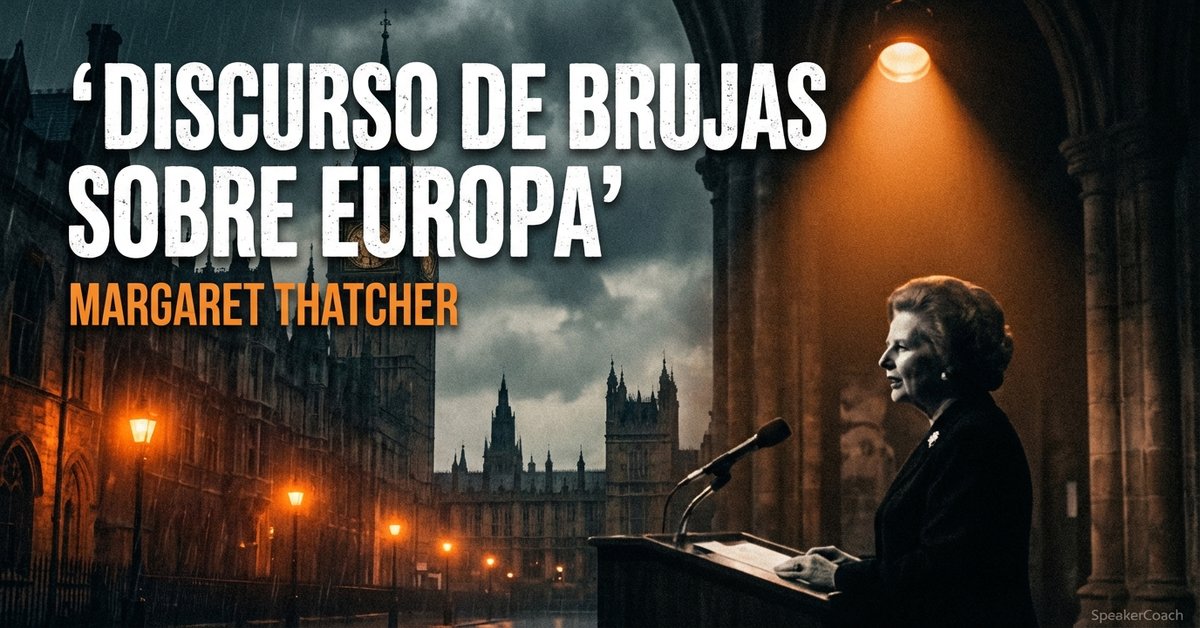
El Discurso de Brujas de Margaret Thatcher es una de las intervenciones políticas más trascendentales de la historia europea moderna. Pronunciado en el Colegio de Europa el 20 de septiembre de 1988, estableció cinco principios rectores para la cooperación europea basados en la soberanía nacional, los mercados libres y la defensa de la OTAN. Thatcher rechazó firmemente la visión de un superestado europeo, abogando en cambio por una 'familia de naciones' que coopera voluntariamente preservando identidades nacionales distintas. El discurso galvanizó el movimiento euroescéptico en Gran Bretaña y toda Europa, y su marco intelectual sigue moldeando los debates sobre la integración europea hasta hoy. Su poder retórico reside en su estructura sistemática, sus vívidas alusiones históricas y el despliegue de un ingenio devastador junto a una argumentación política seria.
Contexto histórico
Pronunciado el 20 de septiembre de 1988, en el Colegio de Europa en Brujas, Bélgica, este discurso llegó en un momento crucial de la integración europea. El presidente de la Comisión Europea, Jacques Delors, había estado impulsando una unión política y económica más profunda, incluyendo una moneda única y una política social centralizada. El discurso de Thatcher fue una respuesta directa a esta visión centralizadora. Gran Bretaña bajo Thatcher ya había chocado con la CEE por el descuento presupuestario británico en 1984 y desconfiaba de las propuestas surgidas del Acta Única Europea de 1986. El discurso cristalizó una división filosófica que definiría la política europea durante décadas: supranacionalismo frente a intergubernamentalismo. Dio origen al Grupo de Brujas, un think tank euroescéptico, y plantó las semillas intelectuales que eventualmente crecerían hasta el referéndum del Brexit de 2016 en el Reino Unido. El contexto de la Guerra Fría también fue significativo: Thatcher posicionó la OTAN y la defensa transatlántica como inseparables de la identidad europea.
Texto del discurso
Prime Minister, Rector, Your Excellencies, Ladies and Gentlemen:
First, may I thank you for giving me the opportunity to return to Bruges and in very different circumstances from my last visit shortly after the Falklands conflict, when I came here to receive the honorary citizenship of Bruges, which I accepted as recognition of the special ties of friendship between the people of Bruges and of the United Kingdom.
Mr Chairman, you have invited me to speak on the subject of Britain and Europe. Perhaps I should congratulate you on your courage. If you believe some of the things said and written about my views on Europe, it must seem rather like inviting Genghis Khan to speak on the virtues of peaceful coexistence!
I want to start by disposing of some myths about my country, Britain, and its relationship with Europe and to do that, I must say something about the identity of Europe itself.
Europe is not the creation of the Treaty of Rome. Nor is the European idea the property of any group or institution. We British are as much heirs to the legacy of European culture as any other nation. Our links to the rest of Europe, the continent of Europe, have been the dominant factor in our history.
For three hundred years, we were part of the Roman Empire and our forebears played their full part in the life of that Empire. Our ancestors--Celts, Saxons, Danes--came from the Continent. Our nation was -- in that favourite Community word -- 'restructured' under Norman and Angevin rule in the 11th and 12th Centuries.
This year, we celebrate the three hundredth anniversary of the Glorious Revolution in which the weights of the Crown and Parliament were re-adjusted. What happened was, in fact, quintessentially European. For it was the Dutch William of Orange and his English wife, Mary, who now jointly assumed the Throne.
Visit the great churches and cathedrals of Britain, read our literature and our laws, study the development of our language, and you will find all the richness and diversity of European culture in our history.
We in Britain are rightly proud of the way in which, since Magna Carta in the year 1215, we have pioneered and developed representative institutions to stand as bastions of freedom. And proud too of the way in which for centuries Britain was a safe haven for people from the rest of Europe who sought sanctuary from tyranny.
But we know that without the law of Roman Justinian, developed in the Middle Ages by scholars at Bologna and Padua, without the theology and philosophy of Aquinas, without the influence of the Renaissance, which came to England through scholars like Erasmus, without the ideas of the Reformation and the Counter-Reformation that swept the countries of Europe, the British version of civilisation would have been quite different.
Britain does not dream of some cosy, isolated existence on the fringes of the European Community. Our destiny is in Europe, as part of the Community.
That is not to say that our future lies only in Europe, but nor does that of France or Spain or, indeed, of any other member.
The Community is not an end in itself. Nor is it an institutional device to be constantly modified according to the dictates of some abstract intellectual concept. Nor must it be ossified by endless regulation.
The European Community is a practical means by which Europe can ensure the future prosperity and security of its people in a world in which there are many other powerful nations and groups of nations.
We Europeans cannot afford to waste our energies on internal disputes or arcane institutional debates. They are no substitute for effective action.
Let Europe be a family of nations, understanding each other better, appreciating each other more, doing more together but relishing our national identity no less than our common European endeavour.
Let me turn now to what I see as the guiding principles which should govern the approach of the member states.
My first guiding principle is this: willing and active cooperation between independent sovereign states is the best way to build a successful European Community.
To try to suppress nationhood and concentrate power at the centre of a European conglomerate would be highly damaging and would jeopardise the objectives we seek to achieve.
Europe will be stronger precisely because it has France as France, Spain as Spain, Britain as Britain, each with its own customs, traditions and identity. It would be folly to try to fit them into some sort of identikit European personality.
Some of the founding fathers of the Community thought that the United States of America might be its model. But the whole history of America is quite different from Europe. People went there to get away from the intolerance and constraints of life in Europe. They sought liberty and opportunity; and their occurred made a nation -- a new nation -- out of many nationalities.
Indeed, it is ironic that just when those countries such as the Soviet Union, which have tried to run everything from the centre, are learning that success depends on dispersing power and decisions away from the centre, there are some in the Community who seem to want to move in the opposite direction.
We have not successfully rolled back the frontiers of the state in Britain, only to see them re-imposed at a European level with a European super-state exercising a new dominance from Brussels.
Certainly we want to see Europe more united and with a greater sense of common purpose. But it must be in a way which preserves the different traditions, parliamentary powers and sense of national pride in one's own country; for these have been the source of Europe's vitality through the centuries.
My second guiding principle is this: Community policies must tackle present problems in a practical way, however difficult that may be.
If we cannot reform those Community policies which are manifestly wrong or ineffective and which are rightly criticised by people who pay for them, we shall not get the public's support for the Community's future development.
My third guiding principle is the need for Community policies which encourage enterprise.
The basic framework is there: the Treaty of Rome itself was intended as a Charter for Economic Liberty. But that it is not how it has always been read, still less applied.
The lesson of the economic history of Europe in the 70's and 80's is that central planning and detailed control do not work and that personal endeavour and initiative do. That a State-Loss economy is not the way to run an economy.
My fourth guiding principle is that Europe should not be protectionist.
The expansion of the world economy requires us to continue the process of removing barriers to trade, and to do so in the multilateral negotiations in the GATT.
It would be a betrayal if, while breaking down constraints on trade within Europe, the Community were to erect greater external protection.
We must ensure that our approach to world trade is consistent with the liberalisation we preach at home.
My fifth guiding principle.
Europe must continue to maintain a sure defence through NATO.
There can be no question of relaxing our efforts, even though it means that we pay a price for freedom. The fact is things are going our way: the democratic model of a free-enterprise economy has proved itself superior; freedom is on the march.
We must strive to maintain the United States' commitment to Europe's defence. And that means recognising the burden on their resources of the defence of freedom, particularly in the context of the negotiations on strategic nuclear weapons, and of the Intermediate Nuclear Forces treaty.
Let me be quite clear. Britain does not dream of some cosy, isolated existence on the fringes of the European Community. Our destiny is in Europe, as part of the Community.
Mr Chairman, I believe it is not enough just to talk in general terms about a European vision or ideal. If we believe in it, we must chart the way ahead and identify the next steps.
That is what I have tried to do this evening.
This approach does not require new documents: they are already there, the North Atlantic Treaty, the revised Brussels Treaty and the Treaty of Rome, texts written by far-sighted men. However far we may wish to go, the truth is that we can only get there one step at a time.
And what we need now is to take decisions on the next steps forward, rather than let ourselves be distracted by Utopian goals. Utopia never comes, because we know we should not like it if it did.
Let us work together to make this practical proposal -- a reality.
Let Europe be a family of nations, understanding each other better, appreciating each other more, doing more together but relishing our national identity no less than our common European endeavour.
Thank you and good evening.
Análisis retórico
Thatcher abre con un humor autocrítico que simultáneamente reconoce y desarma su temible reputación. Al compararse con Genghis Khan, hace reír a la audiencia mientras sugiere sutilmente que sus críticos han exagerado su euroescepticismo. La broma también señala confianza: no está a la defensiva sobre sus opiniones, sino más bien divertida por la caricatura. Esta técnica establece rapport y hace a la audiencia más receptiva a los argumentos serios que siguen.
Si usted cree algunas de las cosas que se dicen y escriben sobre mis opiniones sobre Europa, debe parecer algo así como invitar a Genghis Khan a hablar sobre las virtudes de la coexistencia pacífica.
La columna vertebral del discurso es una enumeración de cinco principios rectores, cada uno introducido con la fórmula 'Mi [ordinal] principio rector es...' Esta estructura da al discurso la calidad de un tratado lógico: sistemático, claro e imposible de tergiversar. Cada principio se construye sobre el anterior, creando un argumento acumulativo desde la soberanía pasando por los mercados libres hasta la defensa de la OTAN. La enumeración también sirve una función mnemotécnica, haciendo el discurso fácil de resumir y citar en el debate político.
Mi primer principio rector es este: la cooperación voluntaria y activa entre estados soberanos independientes es la mejor manera de construir una Comunidad Europea exitosa.
Thatcher despliega una aguda antítesis para enmarcar la integración europea como una elección entre dos modelos fundamentalmente opuestos. El caso más poderoso contrasta el retroceso del Estado en casa con su reimposición desde Bruselas. Esto crea una trampa lógica devastadora: si el gobierno centralizado fracasó a nivel doméstico (una premisa que su audiencia de europeos promercado aceptaría), ¿cómo podría tener éxito a nivel europeo? La antítesis obliga a la audiencia a elegir entre la coherencia y la hipocresía.
No hemos retrocedido con éxito las fronteras del Estado en Gran Bretaña, solo para verlas reimponerse a nivel europeo con un superestado europeo ejerciendo un nuevo dominio desde Bruselas.
Thatcher despliega sistemáticamente referencias históricas que abarcan desde el Imperio Romano hasta la Carta Magna, la Revolución Gloriosa y la Guerra Fría para establecer las profundas raíces europeas de Gran Bretaña. Al citar a Justiniano, Aquino, Erasmo y la Reforma, contrarresta preventivamente el argumento de que el euroescepticismo equivale a sentimiento antieuropeo. Es una maniobra retórica sofisticada: supera en europeísmo a los europeístas demostrando mayor alfabetización histórica que sus oponentes federalistas, y luego usa esa credibilidad para argumentar contra su visión de la integración.
Pero sabemos que sin el derecho del romano Justiniano, desarrollado en la Edad Media por eruditos en Bolonia y Padua, sin la teología y filosofía de Aquino, sin la influencia del Renacimiento, que llegó a Inglaterra a través de eruditos como Erasmo, sin las ideas de la Reforma y la Contrarreforma que recorrieron los países de Europa, la versión británica de la civilización habría sido bastante diferente.
Thatcher utiliza un poderoso estribillo que aparece dos veces en el discurso, enmarcando todo el argumento: 'Que Europa sea una familia de naciones, entendiéndose mejor unas a otras, apreciándose más, haciendo más juntas pero disfrutando de nuestra identidad nacional no menos que de nuestro esfuerzo europeo común.' Al abrir y cerrar el argumento conceptual con esta misma frase, crea un marco retórico que encapsula toda su visión. El estribillo también sirve como contrapunto a las acusaciones de aislacionismo: es explícitamente una visión de unidad, pero en sus términos.
Que Europa sea una familia de naciones, entendiéndose mejor unas a otras, apreciándose más, haciendo más juntas pero disfrutando de nuestra identidad nacional no menos que de nuestro esfuerzo europeo común.
Thatcher utiliza una triple construcción negativa para definir la Comunidad Europea por lo que NO es antes de afirmar lo que SÍ es. Esta técnica despeja malentendidos antes de construir su propio argumento, y la triple negación rítmica tiene una fuerza de martillo. Cada 'Ni' derriba una suposición federalista diferente, dejando a la audiencia solo con la definición práctica de Thatcher en pie.
La Comunidad no es un fin en sí misma. Ni es un dispositivo institucional que deba modificarse constantemente según los dictados de algún concepto intelectual abstracto. Ni debe osificarse mediante una regulación interminable.
Thatcher puntúa el discurso con formulaciones concisas y citables que destilan argumentos complejos en frases memorables. Su línea final sobre la Utopía es un epigrama magistral: paradójico, ingenioso y profundamente conservador en su escepticismo hacia las grandes visiones. Captura en una sola frase toda la filosofía burkeana que subyace al discurso: que la reforma incremental y práctica es preferible al idealismo revolucionario.
La utopía nunca llega, porque sabemos que no nos gustaría si llegara.
Lecciones clave
- Establece tus credenciales antes de hacer tu argumento. Thatcher dedicó un cuarto completo del discurso a probar las credenciales europeas de Gran Bretaña antes de criticar la integración europea. Cuando tu posición podría ser tergiversada, invierte primero en construir credibilidad.
- Usa una estructura numerada para argumentos políticos complejos. Los cinco principios rectores dan a la audiencia un mapa mental claro y hacen que incluso un discurso de 40 minutos sea fácil de seguir y resumir. Cuando tengas múltiples puntos, numéralos explícitamente.
- Desarma a los críticos con humor. La broma de Genghis Khan reconoció su reputación y disipó la tensión en una sola frase. El humor autocrítico señala confianza y hace a las audiencias adversas más receptivas.
- Define lo que te opones antes de afirmar lo que propones. El tricolon negativo de Thatcher ('no un fin en sí misma, ni un dispositivo institucional, ni osificada por la regulación') despeja el terreno para su visión positiva. Derriba el marco de la oposición antes de construir el tuyo.
- Termina con un estribillo que encapsule tu visión. Al repetir 'una familia de naciones' al principio y al final, Thatcher aseguró que una sola frase se convirtiera en sinónimo del discurso. Dale a tu audiencia una única oración para llevarse.

Estudia cómo Thatcher usa la técnica de 'principios numerados' para hacer que un discurso político largo y complejo sea tanto memorable como imposible de tergiversar. Al decir 'Mi primer principio rector,' 'Mi segundo principio rector,' y así sucesivamente, da a periodistas y críticos una estructura lista para citarla con precisión. Cuando necesites dar un discurso con múltiples puntos políticos, numéralos explícitamente y enuncia cada uno como una oración declarativa clara antes de elaborar. Esto obliga a la claridad en tu propio pensamiento y da a tu audiencia anclas a las que aferrarse. Practica enunciar cada principio en menos de 15 palabras; si no puedes, tu punto no es lo suficientemente claro.
Ver el programa