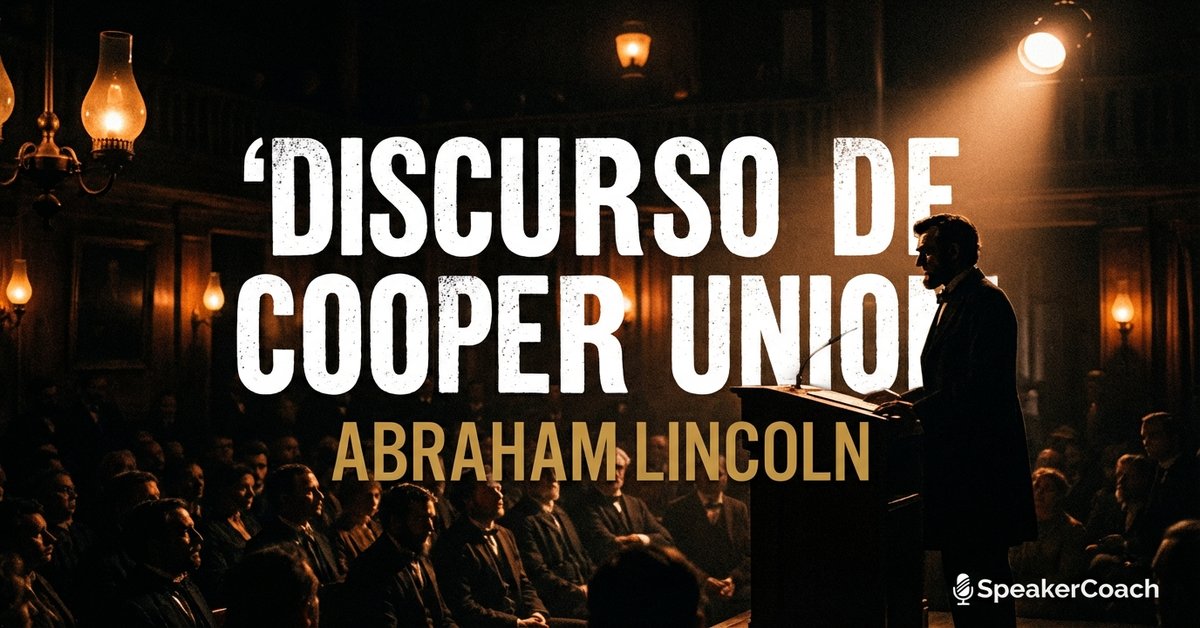
El Discurso de Cooper Union es un argumento legal e histórico meticulosamente investigado en el que Lincoln demuestra sistemáticamente que una clara mayoría de los Padres Fundadores que redactaron la Constitución creían que el gobierno federal tenía el poder de restringir la esclavitud en los territorios. Al volver la propia apelación del senador Douglas a los fundadores en su contra, Lincoln establece la posición republicana como la verdaderamente conservadora y expone el expansionismo proesclavista como la innovación radical. La combinación del discurso de evidencia exhaustiva, lógica demoledora y una conmovedora conclusión moral lanzó efectivamente la campaña presidencial de Lincoln y lo estableció como el líder intelectual del Partido Republicano.
Contexto histórico
Pronunciado el 27 de febrero de 1860 en el Instituto Cooper (ahora Cooper Union) en la ciudad de Nueva York, este discurso llegó en un momento crítico en el período previo a la elección presidencial de 1860. Lincoln, entonces un excongresista de un solo mandato y abogado de Illinois relativamente desconocido, fue invitado a hablar por un grupo de republicanos neoyorquinos que querían evaluarlo como potencial candidato presidencial. La nación estaba profundamente dividida por la cuestión de la expansión de la esclavitud hacia los territorios del oeste, inflamada por la Ley Kansas-Nebraska de 1854, la sangrienta violencia en "Kansas Sangrante," la decisión Dred Scott de 1857 y la incursión de John Brown en Harpers Ferry en octubre de 1859. El senador Stephen Douglas, rival de Lincoln desde la carrera senatorial de Illinois de 1858, había abogado por la "soberanía popular" -- dejar que los colonos de los territorios decidieran la cuestión de la esclavitud -- y afirmaba que los Padres Fundadores apoyaban su posición. El discurso de Lincoln fue una refutación directa de esta afirmación. El público de aproximadamente 1,500 prominentes neoyorquinos recibió el discurso con tremendo entusiasmo, y fue reimpreso íntegro por los principales periódicos del Norte. El discurso es ampliamente reconocido por haber transformado a Lincoln de una figura regional en un candidato nacional viable, conduciendo directamente a su nominación en la convención republicana en Chicago tres meses después.
Texto del discurso
Mr. President and fellow citizens of New York:
The facts with which I shall deal this evening are mainly old and familiar; nor is there anything new in the general use I shall make of them. If there shall be any novelty, it will be in the mode of presenting the facts, and the inferences and observations following that presentation.
In his speech last autumn, at Columbus, Ohio, as reported in "The New-York Times," Senator Douglas said:
"Our fathers, when they framed the Government under which we live, understood this question just as well, and even better, than we do now."
I fully indorse this, and I adopt it as a text for this discourse. I so adopt it because it furnishes a precise and an agreed starting point for a discussion between Republicans and that wing of the Democracy headed by Senator Douglas. It simply leaves the inquiry: "What was the understanding those fathers had of the question mentioned?"
What is the frame of government under which we live?
The answer must be: "The Constitution of the United States." That Constitution consists of the original, framed in 1787, (and under which the present government first went into operation,) and twelve subsequently framed amendments, the first ten of which were framed in 1789.
Who were our fathers that framed the Constitution? I suppose the "thirty-nine" who signed the original instrument may be fairly called our fathers who framed that part of the present Government. It is almost exactly true to say they framed it, and it is altogether true to say they fairly represented the opinion and sentiment of the whole nation at that time. Their names, being familiar to nearly all, and accessible to quite all, need not now be repeated.
I take these "thirty-nine," for the present, as being "our fathers who framed the Government under which we live."
What is the question which, according to the text, those fathers understood "just as well, and even better than we do now?"
It is this: Does the proper division of local from federal authority, or anything in the Constitution, forbid our Federal Government to control as to slavery in our Federal Territories?
Upon this, Senator Douglas holds the affirmative, and Republicans the negative. This affirmation and denial form an issue; and this issue - this question - is precisely what the text declares our fathers understood "better than we."
Let us now inquire whether the "thirty-nine," or any of them, ever acted upon this question; and if they did, how they acted upon it - how they expressed that better understanding?
In 1784, three years before the Constitution - the United States then owning the Northwestern Territory, and no other, the Congress of the Confederation had before them the question of prohibiting slavery in that Territory; and four of the "thirty-nine" who afterward framed the Constitution, were in that Congress, and voted on that question. Of these, Roger Sherman, Thomas Mifflin, and Hugh Williamson voted for the prohibition, thus showing that, in their understanding, no line dividing local from federal authority, nor anything else, properly forbade the Federal Government to control as to slavery in federal territory. The other of the four - James M'Henry - voted against the prohibition, showing that, for some cause, he thought it improper to vote for it.
[...]
The sum of the whole is, that of our thirty-nine fathers who framed the original Constitution, twenty-one - a clear majority of the whole - certainly understood that no proper division of local from federal authority, nor any part of the Constitution, forbade the Federal Government to control slavery in the federal territories; while all the rest probably had the same understanding. Such, unquestionably, was the understanding of our fathers who framed the original Constitution; and the text affirms that they understood the question "better than we."
[...]
I defy any man to show that any one of them ever, in his whole life, declared that, in his understanding, any proper division of local from federal authority, or any part of the Constitution, forbade the Federal Government to control as to slavery in the federal territories. I go a step further. I defy any one to show that any living man in the whole world ever did, prior to the beginning of the present century, (and I might almost say prior to the beginning of the last half of the present century,) declare that, in his understanding, any proper division of local from federal authority, or any part of the Constitution, forbade the Federal Government to control as to slavery in the federal territories. To those who now so declare, I give, not only "our fathers who framed the Government under which we live," but with them all other living men within the century in which it was framed, among whom to search, and they shall not be able to find the evidence of a single man agreeing with them.
[...]
But enough! Let all who believe that "our fathers, who framed the Government under which we live, understood this question just as well, and even better, than we do now," speak as they spoke, and act as they acted upon it. This is all Republicans ask - all Republicans desire - in relation to slavery. As those fathers marked it, so let it be again marked, as an evil not to be extended, but to be tolerated and protected only because of and so far as its actual presence among us makes that toleration and protection a necessity. Let all the guarantees those fathers gave it, be, not grudgingly, but fully and fairly, maintained. For this Republicans contend, and with this, so far as I know or believe, they will be content.
And now, if they would listen - as I suppose they will not - I would address a few words to the Southern people.
I would say to them: - You consider yourselves a reasonable and a just people; and I consider that in the general qualities of reason and justice you are not inferior to any other people. Still, when you speak of us Republicans, you do so only to denounce us a reptiles, or, at the best, as no better than outlaws. You will grant a hearing to pirates or murderers, but nothing like it to "Black Republicans." In all your contentions with one another, each of you deems an unconditional condemnation of "Black Republicanism" as the first thing to be attended to. Indeed, such condemnation of us seems to be an indispensable prerequisite - license, so to speak - among you to be admitted or permitted to speak at all. Now, can you, or not, be prevailed upon to pause and to consider whether this is quite just to us, or even to yourselves? Bring forward your charges and specifications, and then be patient long enough to hear us deny or justify.
You say we are sectional. We deny it. That makes an issue; and the burden of proof is upon you.
[...]
But you say you are conservative - eminently conservative - while we are revolutionary, destructive, or something of the sort. What is conservatism? Is it not adherence to the old and tried, against the new and untried? We stick to, contend for, the identical old policy on the point in controversy which was adopted by "our fathers who framed the Government under which we live;" while you with one accord reject, and scout, and spit upon that old policy, and insist upon substituting something new.
[...]
Your purpose, then, plainly stated, is that you will destroy the Government, unless you be allowed to construe and enforce the Constitution as you please, on all points in dispute between you and us. You will rule or ruin in all events.
[...]
Under all these circumstances, do you really feel yourselves justified to break up this Government unless such a court decision as yours is, shall be at once submitted to as a conclusive and final rule of political action? But you will not abide the election of a Republican president! In that supposed event, you say, you will destroy the Union; and then, you say, the great crime of having destroyed it will be upon us! That is cool. A highwayman holds a pistol to my ear, and mutters through his teeth, "Stand and deliver, or I shall kill you, and then you will be a murderer!"
To be sure, what the robber demanded of me - my money - was my own; and I had a clear right to keep it; but it was no more my own than my vote is my own; and the threat of death to me, to extort my money, and the threat of destruction to the Union, to extort my vote, can scarcely be distinguished in principle.
A few words now to Republicans. It is exceedingly desirable that all parts of this great Confederacy shall be at peace, and in harmony, one with another. Let us Republicans do our part to have it so. Even though much provoked, let us do nothing through passion and ill temper. Even though the southern people will not so much as listen to us, let us calmly consider their demands, and yield to them if, in our deliberate view of our duty, we possibly can. Judging by all they say and do, and by the subject and nature of their controversy with us, let us determine, if we can, what will satisfy them.
[...]
These natural, and apparently adequate means all failing, what will convince them? This, and this only: cease to call slavery wrong, and join them in calling it right. And this must be done thoroughly - done in acts as well as in words. Silence will not be tolerated - we must place ourselves avowedly with them.
[...]
Nor can we justifiably withhold this, on any ground save our conviction that slavery is wrong. If slavery is right, all words, acts, laws, and constitutions against it, are themselves wrong, and should be silenced, and swept away. If it is right, we cannot justly object to its nationality - its universality; if it is wrong, they cannot justly insist upon its extension - its enlargement. All they ask, we could readily grant, if we thought slavery right; all we ask, they could as readily grant, if they thought it wrong. Their thinking it right, and our thinking it wrong, is the precise fact upon which depends the whole controversy. Thinking it right, as they do, they are not to blame for desiring its full recognition, as being right; but, thinking it wrong, as we do, can we yield to them? Can we cast our votes with their view, and against our own? In view of our moral, social, and political responsibilities, can we do this?
Wrong as we think slavery is, we can yet afford to let it alone where it is, because that much is due to the necessity arising from its actual presence in the nation; but can we, while our votes will prevent it, allow it to spread into the National Territories, and to overrun us here in these Free States? If our sense of duty forbids this, then let us stand by our duty, fearlessly and effectively. Let us be diverted by none of those sophistical contrivances wherewith we are so industriously plied and belabored - contrivances such as groping for some middle ground between the right and the wrong, vain as the search for a man who should be neither a living man nor a dead man - such as a policy of "don't care" on a question about which all true men do care - such as Union appeals beseeching true Union men to yield to Disunionists, reversing the divine rule, and calling, not the sinners, but the righteous to repentance - such as invocations to Washington, imploring men to unsay what Washington said, and undo what Washington did.
Neither let us be slandered from our duty by false accusations against us, nor frightened from it by menaces of destruction to the Government nor of dungeons to ourselves. LET US HAVE FAITH THAT RIGHT MAKES MIGHT, AND IN THAT FAITH, LET US, TO THE END, DARE TO DO OUR DUTY AS WE UNDERSTAND IT.
Análisis retórico
Toda la primera sección del discurso es una clase magistral de logos -- persuasión mediante evidencia lógica. Lincoln examina metódicamente los registros de votación de cada uno de los 39 firmantes de la Constitución a lo largo de múltiples sesiones del Congreso (1784, 1787, 1789, 1798, 1804, 1819-20), contando exactamente cuántos actuaron para restringir la esclavitud en los territorios federales. Construye un caso numérico irrefutable: 21 de 39 redactores -- una clara mayoría -- votaron para otorgar al Congreso poder sobre la esclavitud en los territorios. Esta acumulación forense de evidencia transforma lo que podría ser un debate constitucional abstracto en una demostración factual abrumadora.
La suma del todo es que, de nuestros treinta y nueve padres que redactaron la Constitución original, veintiuno - una clara mayoría del total - ciertamente entendieron que ninguna división apropiada entre autoridad local y federal, ni parte alguna de la Constitución, prohibía al Gobierno Federal controlar la esclavitud en los territorios federales; mientras que todos los demás probablemente tenían el mismo entendimiento.
La maniobra estratégica más brillante de Lincoln es adoptar las propias palabras de Douglas como 'texto' para su discurso, y luego usar evidencia histórica exhaustiva para probar que la apelación de Douglas a los fundadores en realidad apoya la posición republicana, no la del propio Douglas. Esta técnica de volver el argumento más fuerte del oponente en su contra es devastadoramente efectiva porque obliga al público a aceptar la conclusión de Lincoln en los términos que el propio Douglas estableció. Lincoln hace esto repetidamente a lo largo del discurso: cuando los sureños reclaman ser conservadores, Lincoln demuestra que los republicanos son los verdaderos conservadores; cuando acusan a los republicanos de seccionalismo, Lincoln muestra que la acusación se aplica a ellos mismos.
¿Qué es el conservadurismo? ¿No es la adhesión a lo viejo y probado, frente a lo nuevo y no probado? Nosotros nos aferramos, luchamos por, la idéntica vieja política sobre el punto en controversia que fue adoptada por "nuestros padres que crearon el Gobierno bajo el cual vivimos;" mientras que ustedes unánimemente rechazan, desprecian y escupen sobre esa vieja política, e insisten en sustituirla por algo nuevo.
Lincoln despliega preguntas retóricas como pilares estructurales a lo largo del discurso. La sección inicial se organiza alrededor de una serie de preguntas -- '¿Cuál es la forma de gobierno bajo la cual vivimos?', '¿Quiénes fueron nuestros padres que redactaron la Constitución?', '¿Cuál es la cuestión que, según el texto, aquellos padres entendieron?' -- que guían al público paso a paso a través de su argumento lógico. En la sección dirigida a los sureños, las preguntas se convierten en armas de desafío moral: '¿Podemos emitir nuestros votos según su punto de vista y contra el nuestro? En vista de nuestras responsabilidades morales, sociales y políticas, ¿podemos hacer esto?' Estas preguntas obligan al público a llegar a la conclusión de Lincoln a través de su propio razonamiento.
¿Podemos emitir nuestros votos según su punto de vista y contra el nuestro? En vista de nuestras responsabilidades morales, sociales y políticas, ¿podemos hacer esto?
Lincoln utiliza analogías vívidas para hacer que los argumentos políticos abstractos sean instantáneamente tangibles. La más famosa es su comparación de las amenazas sureñas con un salteador de caminos: el Sur amenazando con destruir la Unión si un republicano es elegido se compara con un asaltante que apunta con una pistola al oído de alguien y declara que si la víctima se resiste, la víctima será el asesino. Esta analogía arranca los eufemismos políticos que rodean las amenazas de secesión y expone su cruda lógica coercitiva. Lincoln también compara la búsqueda de un 'terreno intermedio' entre lo correcto y lo incorrecto con 'la búsqueda de un hombre que no fuera ni un hombre vivo ni un hombre muerto' -- una imagen absurdista que hace visceralmente clara la imposibilidad del compromiso moral.
Un salteador de caminos me apunta con una pistola al oído y murmura entre dientes: "¡La bolsa o la vida, o te mato, y entonces tú serás el asesino!"
Lincoln utiliza la antítesis -- la yuxtaposición de ideas contrastantes en estructuras equilibradas -- para cristalizar las implicaciones morales del debate sobre la esclavitud en opciones claras y binarias. El ejemplo más poderoso es su construcción paralela sobre la naturaleza fundamental de la controversia: 'Si la esclavitud está bien, todas las palabras, actos, leyes y constituciones contra ella están ellas mismas mal... si está mal, ellos no pueden justamente insistir en su extensión.' Al reducir todo el debate político a una sola cuestión moral -- ¿está bien o mal la esclavitud? -- Lincoln atraviesa los compromisos y tecnicismos legales que habían oscurecido el asunto durante décadas. La estructura gramatical equilibrada hace que la conclusión lógica sea ineludible.
Si la esclavitud está bien, todas las palabras, actos, leyes y constituciones contra ella están ellas mismas mal, y deberían ser silenciadas y barridas. Si está bien, no podemos objetar justamente su nacionalidad - su universalidad; si está mal, ellos no pueden justamente insistir en su extensión - su expansión.
La línea más famosa del discurso -- 'Tengamos fe en que el derecho hace la fuerza' -- es una inversión deliberada del dicho común 'la fuerza hace el derecho.' Al invertir el orden esperado de las palabras, Lincoln transforma una máxima cínica sobre el poder en un imperativo moral sobre la justicia. Este quiasmo es aún más poderoso porque el público habría reconocido la frase original, haciendo que la inversión sea un momento de sorpresa intelectual y elevación moral. Lincoln coloca esta máxima invertida en el clímax absoluto del discurso, en letras mayúsculas, asegurando que sea la frase que el público se lleve a casa.
TENGAMOS FE EN QUE EL DERECHO HACE LA FUERZA, Y EN ESA FE, HASTA EL FINAL, ATREVÁMONOS A CUMPLIR CON NUESTRO DEBER TAL COMO LO ENTENDEMOS.
Lincoln utiliza repetidamente grupos de tres para construir impulso retórico. En su crítica a los falsos compromisos, cataloga 'artificios sofísticos' en una acumulación devastadora: buscar a tientas un terreno intermedio 'entre lo correcto y lo incorrecto,' una política de 'no importa' sobre cuestiones que importan, apelaciones a la Unión que llaman 'no a los pecadores, sino a los justos al arrepentimiento,' e invocaciones a Washington implorando a los hombres 'que desdigan lo que Washington dijo y deshagan lo que Washington hizo.' Cada elemento de la serie escala la absurdidad de la posición de compromiso, con la estructura paralela impulsando al público hacia la conclusión de Lincoln de que no hay terreno intermedio en una cuestión moral.
No nos dejemos desviar por ninguno de esos artificios sofísticos con los que tan industriosamente se nos acosa - artificios como buscar a tientas algún terreno intermedio entre lo correcto y lo incorrecto, tan vano como la búsqueda de un hombre que no fuera ni un hombre vivo ni un hombre muerto - como una política de "no importa" sobre una cuestión que a todos los hombres verdaderos les importa
Lecciones clave
- Haz la tarea de tu oponente mejor que él. Lincoln adoptó la propia premisa de Douglas -- que los fundadores entendieron mejor la cuestión de la esclavitud -- y luego probó con investigación exhaustiva que las acciones de los fundadores apoyaban la posición republicana. Cuando aceptas el marco de tu oponente y luego lo desmontas desde dentro, tu argumento se vuelve casi inexpugnable.
- Construye tu caso como abogado, luego cierra como predicador. La primera mitad del Discurso de Cooper Union se lee como un escrito legal, acumulando evidencia voto por voto. Los párrafos finales se elevan con pasión moral. Esta combinación de evidencia rigurosa y convicción emocional es mucho más persuasiva que cualquiera de las dos por separado. Comienza con hechos, termina con sentimiento.
- Dirígete a tus oponentes directa y justamente antes de demoler sus argumentos. Lincoln reconoció las quejas sureñas y elogió sus 'cualidades de razón y justicia' antes de refutar sistemáticamente cada una de sus afirmaciones. Esto muestra generosidad intelectual y hace que la demolición posterior sea aún más convincente.
- Usa analogías vívidas para hacer los argumentos complejos instantáneamente claros. La metáfora del salteador de caminos de Lincoln destiló todo el debate constitucional sobre la secesión en una sola imagen inolvidable. Una analogía concreta puede hacer más trabajo persuasivo que páginas de argumentos abstractos.
- Termina con una línea que invierta las expectativas. 'El derecho hace la fuerza' invierte el cínico 'la fuerza hace el derecho' de una manera que sorprende y eleva. Cuando puedes tomar una frase conocida e invertirla para revelar una verdad más profunda, creas un momento que el público recuerda mucho después de que el discurso termina.

Estudia cómo Lincoln estructura un discurso de 90 minutos que nunca pierde a su audiencia. El secreto es su arquitectura en tres partes: abre con una investigación factual que construye credibilidad y autoridad intelectual (logos), gira hacia un discurso directo a sus oponentes que demuestra justicia y coraje (ethos), y cierra con un llamado moral a sus propios seguidores que los mueve a la acción (pathos). Observa cómo Lincoln señala cada transición claramente -- '¡Pero basta!', 'Y ahora, si quisieran escuchar', 'Unas palabras ahora a los republicanos' -- dando al público puntos de referencia mentales en un discurso largo. Al preparar una presentación extensa, divídela en movimientos distintos con transiciones claras orientadas al público. Construye tu evidencia metódicamente antes de recurrir a apelaciones emocionales. Y siempre reserva tu línea más poderosa, más citable, para el último aliento absoluto del discurso.
Ver el programa