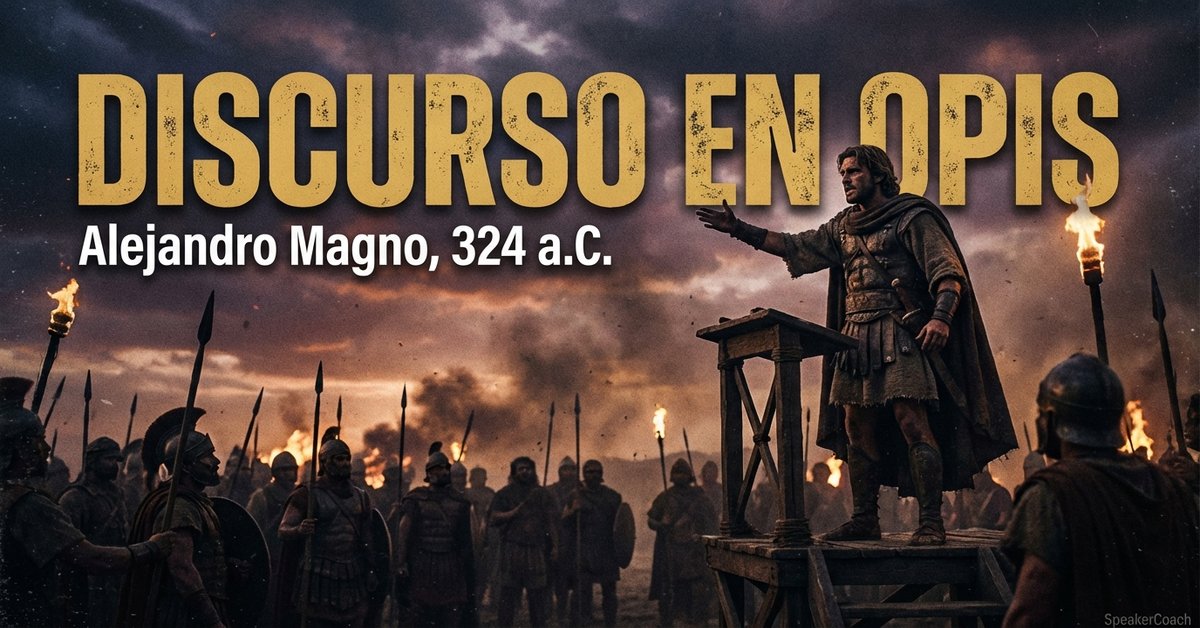
A orillas del Hifasis (hoy Beas), en el Punjab, el ejército macedonio se negó por primera vez a seguir a Alejandro. Arriano (Anábasis V.25–26) recoge el discurso con que el rey intentó convencer a sus oficiales de avanzar hasta el Ganges: un catálogo de todo lo conquistado desde Jonia hasta el Indo, la promesa de que el fin del mundo estaba cerca, la comparación con Heracles y Dioniso y el argumento de que él compartía cada peligro y repartía cada recompensa. El discurso fracasó: Ceno respondió en nombre de la tropa, Alejandro se encerró tres días en su tienda, los sacrificios salieron desfavorables y ordenó el regreso. Es una pieza clásica de ethos militar y también una lección sobre los límites de la persuasión cuando la audiencia ya ha decidido.
Contexto histórico
En el verano de 326 a.C., tras vencer a Poro en el Hidaspes, Alejandro llegó al Hifasis (hoy río Beas, en el Punjab), el más oriental de los ríos que cruzó su ejército. Corrían noticias de tierras fértiles, pueblos guerreros y muchos elefantes más allá del río, y Alejandro quería seguir hasta el Ganges y el «mar Oriental», que creía cercano. Pero, según Arriano, «el espíritu de los macedonios comenzó a flaquear» tras ocho años de campaña continua desde Grecia; en el campamento se decía abiertamente que no seguirían más lejos aunque el rey encabezara la marcha.
Alejandro reunió a los comandantes de brigada y pronunció este discurso (Anábasis V.25–26). Siguió un largo silencio. Finalmente Ceno, hijo de Polemócrates, habló en nombre de la tropa (V.27): los que salieron de Macedonia eran ya pocos, heridos o enfermos, y añoraban a sus padres, esposas e hijos; «la moderación en el éxito es la más noble de las virtudes». Alejandro, irritado, se retiró a su tienda y no recibió a nadie durante tres días esperando un cambio de ánimo que no llegó; ofreció sacrificios por el cruce del río y los presagios fueron desfavorables. Entonces anunció el regreso (V.28). El ejército gritó de alegría, erigió doce altares a orillas del Hifasis y emprendió la vuelta por el Indo (V.29).
El texto que se reproduce es la traducción inglesa de E. J. Chinnock (1884), de dominio público. Arriano escribió casi cinco siglos después de los hechos, a partir de las memorias de Ptolomeo y Aristóbulo, testigos de la campaña; el discurso es, como todos los de la historiografía antigua, una reconstrucción del historiador. No debe confundirse con el discurso de Opis (Anábasis VII.9–10), pronunciado dos años después ante el motín de los veteranos en Mesopotamia.
Texto del discurso
O Macedonians and Grecian allies, seeing that you no longer follow me into dangerous enterprises with a resolution equal to that which formerly animated you, I have collected you together into the same spot, so that I may either persuade you to march forward with me, or may be persuaded by you to return. If indeed the labours which you have already undergone up to our present position seem to you worthy of disapprobation, and if you do not approve of my leading you into them, there can be no advantage in my speaking any further.
But, if as the result of these labours, you hold possession of Ionia, the Hellespont, both the Phrygias, Cappadocia, Paphlagonia, Lydia, Caria, Lycia, Pamphylia, Phoenicia, Egypt together with Grecian Libya, as well as part of Arabia, Hollow Syria, Syria between the rivers, Babylon, the nation of the Susians, Persia, Media, besides all the nations which the Persians and the Medes ruled, and many of those which they did not rule, the land beyond the Caspian Gates, the country beyond the Caucasus, the Tanais, as well as the land beyond that river, Bactria, Hyrcania, and the Hyrcanian Sea; if we have also subdued the Scythians as far as the desert; if, in addition to these, the river Indus flows through our territory, as do also the Hydaspes, the Acesines, and the Hydraotes, why do ye shrink from adding the Hyphasis also, and the nations beyond this river, to your empire of Macedonia?
Do ye fear that your advance will be stopped in the future by any other barbarians? Of whom some submit to us of their own accord, and others are captured in the act of fleeing, while others, succeeding in their efforts to escape, hand over to us their deserted land, which we add to that of our allies, or to that of those who have voluntarily submitted to us.
I, for my part, think, that to a brave man there is no end to labours except the labours themselves, provided they lead to glorious achievements. But if any one desires to hear what will be the end to the warfare itself, let him learn that the distance still remaining before we reach the river Ganges and the Eastern Sea is not great; and I inform you that the Hyrcanian Sea will be seen to be united with this, because the Great Sea encircles the whole earth. I will also demonstrate both to the Macedonians and to the Grecian allies, that the Indian Gulf is confluent with the Persian, and the Hyrcanian Sea with the Indian Gulf. From the Persian Gulf our expedition will sail round into Libya as far as the Pillars of Heracles. From the pillars all the interior of Libya becomes ours, and so the whole of Asia will belong to us, and the limits of our empire, in that direction, will be those which God has made also the limits of the earth.
But, if we now return, many warlike nations are left unconquered beyond the Hyphasis as far as the Eastern Sea, and many besides between these and Hyrcania in the direction of the north wind, and not far from these the Scythian races. Wherefore, if we go back, there is reason to fear that the races which are now held in subjection, not being firm in their allegiance, may be excited to revolt by those who are not yet subdued. Then our many labours will prove to have been in vain; or it will be necessary for us to incur over again fresh labours and dangers, as at the beginning.
But, O Macedonians and Grecian allies, stand firm! Glorious are the deeds of those who undergo labour and run the risk of danger; and it is delightful to live a life of valour and to die leaving behind immortal glory. Do ye not know that our ancestor reached so great a height of glory as from being a man to become a god, or to seem to become one, not by remaining in Tiryns or Argos, or even in the Peloponnese or at Thebes? The labours of Dionysus were not few, and he was too exalted a deity to be compared with Heracles. But we, indeed, have penetrated into regions beyond Nysa; and the rock of Aornus, which Heracles was unable to capture, is in our possession. Do ye also add the parts of Asia still left unsubdued to those already acquired, the few to the many.
But what great or glorious deed could we have performed, if, sitting at ease in Macedonia, we had thought it sufficient to preserve our own country without any labour, simply repelling the attacks of the nations on our frontiers, the Thracians, Illyrians, and Triballians, or even those Greeks who were unfriendly to our interests? If, indeed, without undergoing labour and being free from danger I were acting as your commander, while you were undergoing labour and incurring danger, not without reason would you be growing faint in spirit and resolution, because you alone would be sharing the labours, while procuring the rewards of them for others.
But now the labours are common to you and me, we have an equal share of the dangers, and the rewards are open to the free competition of all. For the land is yours, and you act as its viceroys. The greater part also of the money now comes to you; and when we have traversed the whole of Asia, then, by Zeus, not merely having satisfied your expectations, but having even exceeded the advantages which each man hopes to receive, those of you who wish to return home I will send back to their own land, or I will myself lead them back; while those who remain here, I will make objects of envy to those who go back.
Análisis retórico
El rasgo más llamativo del discurso es el catálogo de territorios conquistados: más de veinte regiones y pueblos en una sola frase, de Jonia al Indo. La extensión misma de la lista es el argumento: lo que falta es poco comparado con lo hecho, y detenerse ahora desperdiciaría todo lo ganado.
tienen en su poder Jonia, el Helesponto, las dos Frigias, Capadocia, Paflagonia, Lidia, Caria, Licia, Panfilia, Fenicia, Egipto junto con la Libia griega
Tras el catálogo, la pregunta convierte el avance en la conclusión obvia y traslada a la audiencia la carga de explicar por qué se resiste.
¿por qué se resisten a añadir también el Hifasis, y las naciones más allá de este río, a su imperio de Macedonia?
Alejandro invoca a Heracles, antepasado de la casa real macedonia, y a Dioniso, para elevar la campaña de marcha militar a gesta mítica; y recuerda que su ejército ya superó al héroe en Aorno.
la roca de Aorno, que Heracles no pudo tomar, está en nuestro poder
El rey construye su credibilidad no desde el título sino desde el riesgo compartido: trabajos comunes, peligros iguales, recompensas abiertas. Es la base moral desde la que puede pedir más.
Pero ahora los trabajos son comunes a ustedes y a mí, tenemos una parte igual en los peligros, y las recompensas están abiertas a la libre competencia de todos.
Contrapone al comandante que no arriesga nada con la tropa que lo arriesga todo, para negar que ese sea su caso. La oposición hace más visible la igualdad que reclama.
Si, en verdad, yo actuara como su comandante sin soportar trabajo alguno y libre de peligro, mientras ustedes soportan el trabajo y afrontan el peligro
Una sentencia breve y memorable que redefine la meta: el esfuerzo no termina cuando se agota, sino cuando produce gloria.
para un hombre valiente no hay más fin de los trabajos que los trabajos mismos, con tal de que conduzcan a hazañas gloriosas
Alejandro redefine el regreso a casa: no como descanso sino como el inicio de nuevas rebeliones y nuevas guerras. Si retirarse es más peligroso que avanzar, la opción «segura» deja de serlo.
si volvemos atrás, hay razón para temer que las razas que hoy tenemos sometidas, no siendo firmes en su lealtad, sean incitadas a la rebelión por las que aún no han sido sometidas
El único imperativo directo del discurso, colocado en el centro, justo antes de la sección mítica: un mandato breve que cambia el tono argumentativo por el exhortativo.
Pero, oh macedonios y aliados griegos, ¡manténganse firmes!
Lecciones clave
- Catalogue lo ya logrado antes de pedir más. Alejandro enumera más de veinte regiones conquistadas antes de mencionar el Hifasis. Frente a un equipo agotado, el inventario de victorias hace que el tramo restante parezca pequeño y que detenerse parezca un desperdicio.
- Reencuadre la retirada como el riesgo mayor. «si volvemos atrás, hay razón para temer que las razas que hoy tenemos sometidas… sean incitadas a la rebelión»: regresar no es descansar, es empezar de nuevo. Cuando la audiencia quiere parar, muestre lo que cuesta parar.
- Conecte la tarea con una historia mayor. Heracles, Dioniso, la roca de Aorno: la marcha deja de ser logística y se vuelve gesta. Un equipo soporta más cuando entiende su trabajo como parte de algo que lo trasciende.
- El ethos se demuestra compartiendo el riesgo. «los trabajos son comunes a ustedes y a mí, tenemos una parte igual en los peligros»: Alejandro no pide lo que él mismo no hace. Es el argumento más transferible del discurso.
- Y aun así puede fallar. El discurso es técnicamente impecable y no convenció a nadie: la audiencia había decidido antes de escucharlo. Ceno gana con un argumento más corto y más humano (padres, esposas, hijos). La retórica no sustituye la lectura del estado real de la gente.

Fíjese en el orden: Alejandro no pide nada hasta el último tramo. Primero inventaría lo conquistado (enumeración), luego responde la objeción implícita («¿temen que su avance sea detenido…?»), después eleva el sentido (Heracles, Dioniso) y solo al final ofrece el trato (recompensas, regreso para quien lo quiera). Copie esa secuencia cuando tenga que pedir un esfuerzo extra: logros, objeción, sentido, oferta. Y aprenda también del fracaso: el discurso no funcionó porque no escuchó antes de hablar. Antes de un discurso de motivación, pregunte; Ceno habló de padres, esposas e hijos, y ganó.
Ver el programa