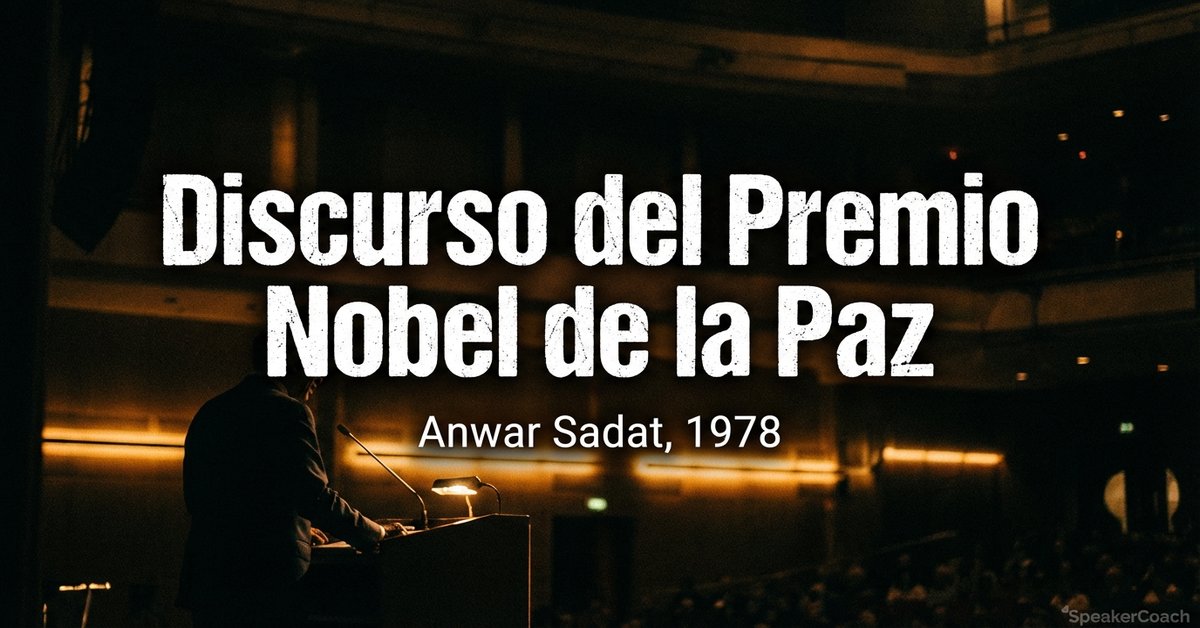
Sadat no viajó a Oslo: su Conferencia Nobel la leyó Sayed Marei el 10 de diciembre de 1978, en la ceremonia en que Menachem Begin recibió el premio compartido. El texto presenta a Egipto como un pueblo de vocación pacífica desde el tratado entre Ramsés II y los hititas, agradece a Jimmy Carter, y explica el viaje a Jerusalén de 1977 como un deber hacia las generaciones venideras, citando dos pasajes de su propio discurso ante la Knéset. Luego enumera su concepción de la paz en cuatro puntos: justicia como esencia (una paz sin justicia sería «una estructura de arena»), indivisibilidad, paz ligada a la prosperidad, y paz como construcción dinámica a la que todos aportan un ladrillo. Cierra con una promesa de perseverancia y una oración por el día en que prevalezca la paz.
Contexto histórico
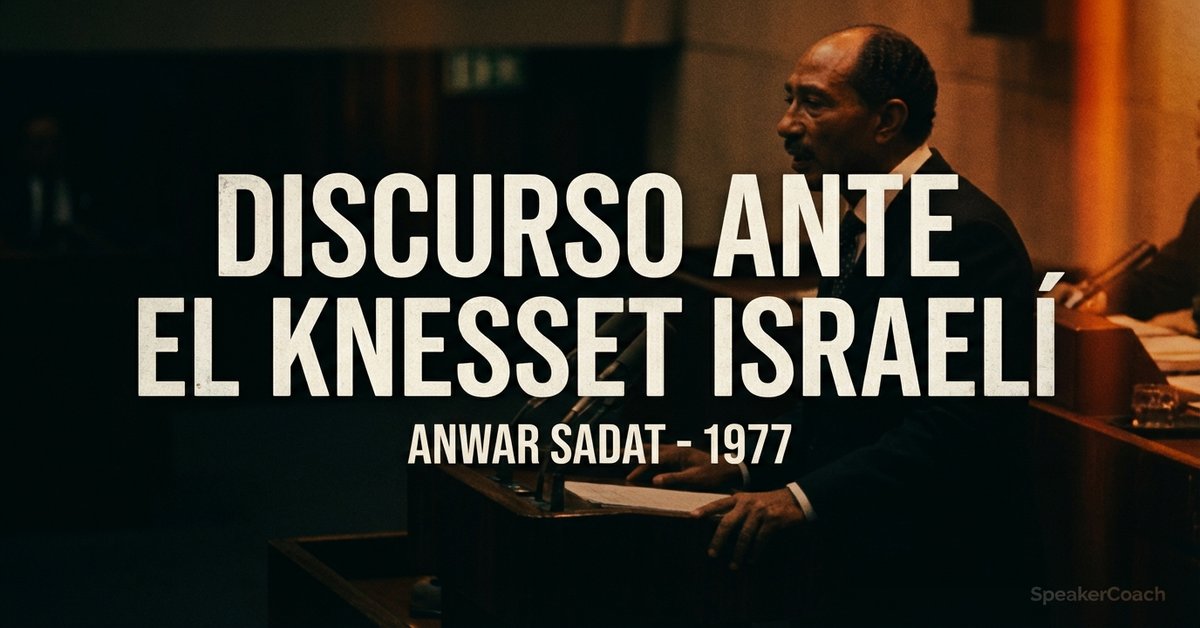
El Comité Nobel noruego otorgó el Premio de la Paz de 1978 a Anwar al-Sadat y a Menachem Begin por los acuerdos marco firmados en Camp David el 17 de septiembre de 1978, tras la visita de Sadat a Jerusalén y su discurso ante la Knéset (20 de noviembre de 1977). Sadat no asistió a la ceremonia del 10 de diciembre de 1978 en Oslo: su conferencia fue leída por Sayed Marei en su nombre, como registra la propia Fundación Nobel. Begin sí viajó y pronunció la suya.
El texto habla de «un momento de la verdad» en el proceso de paz: los acuerdos de Camp David eran solo marcos, y el tratado de paz egipcio-israelí se firmaría recién el 26 de marzo de 1979. La insistencia en la justicia, en la indivisibilidad de la paz y en los derechos de los palestinos responde al aislamiento de Egipto en el mundo árabe: en 1979 la Liga Árabe suspendió su membresía y la mayoría de los Estados árabes rompió relaciones. El marco palestino de Camp David nunca se aplicó plenamente. Sadat fue asesinado el 6 de octubre de 1981.
La referencia al tratado entre Ramsés II y Hattusil, príncipe de los hititas, remite al primer tratado de paz conservado, del siglo XIII a. C.; la frase «el Día de los Derechos Humanos» alude a que la ceremonia Nobel coincide cada año con el 10 de diciembre, aniversario de la Declaración Universal.
Texto del discurso
Your Majesty, Your Royal Highnesses, Mr. Prime Minister of Israel, Madame Chairman and Members of The Nobel Peace Prize Committee, Excellencies, Distinguished Guests, Ladies and Gentlemen,
Peace be upon you. This is the traditional way in which, everyday, we greet one another. It reflects our deepest feelings and hopes. We always say it and we mean it.
Your Majesty, Ladies and Gentlemen,
The decision of the Nobel Prize Committee to bestow upon me the Peace Award has been received by the people of Egypt not only as an honor, but also as a confirmation of the universal recognition of our relentless efforts to achieve peace in an area in which God has chosen to bring to mankind, through Moses, Jesus and Mohamed, His message of wisdom and light.
Your Majesty, Ladies and Gentlemen,
Recognition is due to a man of the highest integrity: President Jimmy Carter whose signal efforts to overcome obstacles in the way of peace deserves our keenest appreciation.
The road to peace is one which, throughout its history which coincides with the dawn of human civilization, the people of Egypt have considered as befitting their genius, and their vocation. No people on earth have been more steadfastly faithful to the cause of peace, and none more attached to the principles of justice which constitute the cornerstone of any real and lasting peace.
Do I need to remind such an august and distinguished gathering, that the first recorded peace treaty in history was concluded more than three thousand years ago between Ramses the Great and Hattusilis, Prince of the Hittites, who resolved to establish “good peace and good brotherhood?”1
And since then, through the ages, even when wars appeared as a necessary evil the real genius of Egypt has been one of peace… and its ambition has been to build not to destroy, to create not to annihilate, to coexist not to eliminate. Thus, the land of Egypt has always been cherished by God Almighty: Moses lived there, Jesus fled to it from injustice and foreign domination, and the Holy Koran has blessed it. And Islam, which is the religion of justice, equality and moral values, has added new dimensions to the eternal spirit of Egypt.
We have always realized that the qualities of chivalry, courage, faith and discipline that were characteristic of a romantic concept of war, should, in an era where war has become only synonymous with devastation to all, be a means of enriching life, not generating death.
It is in this spirit that Alfred Nobel created the prize which bears his name and which is aimed at encouraging mankind to follow the path of peace, development, progress and prosperity.
Ladies and Gentlemen,
It is in the light of all this, that I embarked a year ago upon my initiative aimed at restoring peace in an area where man received the words of God.
Through me it was the eternal Egypt that was expressing itself: Let us put an end to wars, let us reshape life on the solid basis of equity and truth. And it is this call, which reflected the will of the Egyptian people, of the great majority of the Arab and Israeli peoples, and indeed of millions of men, women, and children around the world that you are today honoring. And these hundreds of millions will judge to what extent every responsible leader in the Middle East has responded to the hopes of mankind.
We have now come, in the peace process, to a moment of truth which requires each one of us to take a new look at the situation. I trust that you all know that when I made my historic trip to Jerusalem my aim was not to strike a deal as some politicians do.
I made my trip because I am convinced that we owe it to this generation and the generations to come, not to leave a stone unturned in our pursuit of peace. The ideal is the greatest one in the history of man, and we have accepted the challenge to translate it from a cherished hope into a living reality, and to win through vision and imagination, the hearts and minds of our peoples and enable them to look beyond the unhappy past.
Let me remind you of what I said in the Knesset, more than one year ago; I said:
“Let me tell you truthfully: Today we have a good chance for peace, an opportunity that cannot be repeated, if we are really serious in the quest for peace. If we throw or fritter away this chance, the curse of mankind and the curse of history will befall the one who plots against it”.
I would like now, on this most solemn and moving occasion, to pledge again that we in Egypt – with the future rather than the past in mind – are determined to pursue in good faith, as we have always done, the road to peace, and to leave no avenue unexplored to reach this cherished goal, and to reconcile the sons of Ismail and the sons of Isaac. In renewing this pledge, which I hope that the other parties will also adhere to, I again repeat what I said in the Knesset more than a year ago:
“Any life lost in war is the life of a human being, irrespective of whether it is an Arab or an Israeli.
The wife who becomes widowed is a human being, entitled to live in a happy family, Arab or Israeli.
Innocent children, deprived of paternal care and sympathy are all our children, whether they live on Arab or Israeli soil and, we owe them the biggest responsibility of providing them with a happy present and bright future.
For the sake of all this, for the sake of protecting the lives of all our sons and brothers;
For our societies to produce in security and confidence; For the development of man, his well-being and his right to share in an honorable life;
For our responsibility toward the coming generations; For the smile of every child born on our land”.
This is our conception of peace which I repeat today… The Day of Human Rights.
In the light of this let me share with you our conception of peace:
First, the true essence of peace which ensures its stability and durability, is justice. Any peace not built on justice and on the recognition of the rights of the peoples, would be a structure of sand which would crumble under the first blow.
The peace process comprises a beginning and steps towards an end. In reaching this end the process must achieve its projected goal. That goal is to bring security to the peoples of the area, and the Palestinians in particular, restoring to them all their right to a life of liberty and dignity. We are moving steadily towards this goal for all the peoples of the region. This is what I stand for. This is the letter and the spirit of Camp David.
Second, peace is indivisible. To endure, it should be comprehensive and involve all the parties in the conflict.
Third, peace and prosperity in our area are closely linked and interrelated. Our efforts should aim at achieving both, because it is as important to save man from death by destructive weapons, as it is not to abandon him to the evils of want and misery. And war is no cure for the problems of our area. And last, but not least, peace is a dynamic construction to which all should contribute, each adding a new brick. It goes far beyond a formal agreement or treaty, it transcends a word here or there. That is why it requires politicians who enjoy vision and imagination and who, beyond the present, look towards the future.
It is with this conviction, deeply rooted in our history and our faith, that the people of Egypt have embarked upon a major effort to achieve peace in the Middle East, an area of paramount importance to the whole world. We will spare no effort, we will not tire or despair, we will not lose faith, and we are confident that, in the end, our aim will be achieved.
I will ask you all to join me in a prayer that the day may soon come when peace will prevail, on the basis of justice and the recognition of the rights of all the peoples to shape their own life, to determine their own future, and to contribute to building a world of prosperity for all mankind.
Análisis retórico
El núcleo del discurso es una definición de la paz en cuatro puntos numerados (primero, segundo, tercero, por último). La enumeración ordena el argumento y le da a la audiencia un esquema que puede retener.
Primero, la verdadera esencia de la paz, la que asegura su estabilidad y su duración, es la justicia.
Una paz sin justicia es una estructura de arena: la imagen física hace tangible la fragilidad de un acuerdo que ignore los derechos de los pueblos.
Toda paz que no esté construida sobre la justicia y sobre el reconocimiento de los derechos de los pueblos sería una estructura de arena que se desmoronaría al primer golpe.
Tres pares opuestos en paralelo (construir/destruir, crear/aniquilar, coexistir/eliminar) definen el «genio» de Egipto por contraste con la guerra.
su ambición ha sido construir, no destruir; crear, no aniquilar; coexistir, no eliminar.
La pregunta «¿Necesito recordar…?» introduce el dato histórico (el tratado de Ramsés II con los hititas) como algo que la audiencia culta ya debería saber, reforzando la tesis de la vocación pacífica de Egipto.
¿Necesito recordar a una asamblea tan augusta y distinguida que el primer tratado de paz registrado en la historia se concluyó hace más de tres mil años entre Ramsés el Grande y Hattusil, príncipe de los hititas, quienes resolvieron establecer «buena paz y buena hermandad»?
Invoca a Moisés, Jesús y el Corán para presentar a Egipto como tierra bendecida por las tres religiones, un marco compartido con la audiencia israelí y occidental.
Moisés vivió allí, Jesús huyó a ella de la injusticia y de la dominación extranjera, y el Sagrado Corán la ha bendecido.
El orador no habla en nombre propio sino como voz de «el Egipto eterno» y de la voluntad de su pueblo: la autoridad se traslada de la persona a la historia y a la nación.
A través de mí era el Egipto eterno el que se expresaba: pongamos fin a las guerras, reconstruyamos la vida sobre la base sólida de la equidad y la verdad.
Sadat cita dos veces, de forma explícita, sus propias palabras ante la Knéset de noviembre de 1977. Repetir una promesa anterior ante otra audiencia la convierte en compromiso verificable.
Al renovar esta promesa, a la que espero que las otras partes también se adhieran, repito de nuevo lo que dije en la Knéset hace más de un año:
La promesa final se construye en tres negaciones encadenadas que escalan de la acción al ánimo y a la fe, antes de la afirmación de confianza.
No escatimaremos esfuerzos, no nos cansaremos ni desesperaremos, no perderemos la fe, y confiamos en que, al final, nuestro objetivo se alcanzará.
Lecciones clave
- Define tu término clave con una lista breve y numerada. Sadat no deja «paz» como abstracción: la descompone en cuatro puntos (justicia, indivisibilidad, prosperidad, construcción dinámica). Una definición enumerada es fácil de seguir y de recordar.
- Ancla una idea abstracta en una imagen física. «Una estructura de arena que se desmoronaría al primer golpe» dice más sobre una paz sin justicia que cualquier argumento jurídico.
- Cita tus propias palabras anteriores para mostrar coherencia. Al repetir lo dicho en la Knéset un año antes, convierte una promesa pasada en compromiso presente y demuestra que no cambió de posición.
- Habla desde una identidad más grande que tú. «A través de mí era el Egipto eterno el que se expresaba» traslada la autoridad del orador a la historia de su pueblo.
- Cierra con un compromiso en cadena y una invitación. La serie «no escatimaremos esfuerzos, no nos cansaremos ni desesperaremos, no perderemos la fe» y la oración final dejan a la audiencia con una acción compartida, no con una conclusión cerrada.

Observa cómo un discurso leído por otra persona sigue funcionando: Sadat compensa la ausencia física con una voz institucional («el pueblo de Egipto», «el Egipto eterno») y con estructura muy marcada (saludos, historia, promesa, cuatro puntos, cierre). Cuando no puedas estar presente, o cuando tu texto vaya a leerlo otro, sustituye el carisma por arquitectura: apóstrofes claros a la audiencia, una enumeración numerada que el lector pueda marcar con la voz, y una imagen central (la estructura de arena) que sobreviva a cualquier entonación. Practica leyendo tu propio discurso en voz alta como si fueras un tercero: lo que se pierda en esa lectura es lo que depende demasiado de ti.
Ver el programa