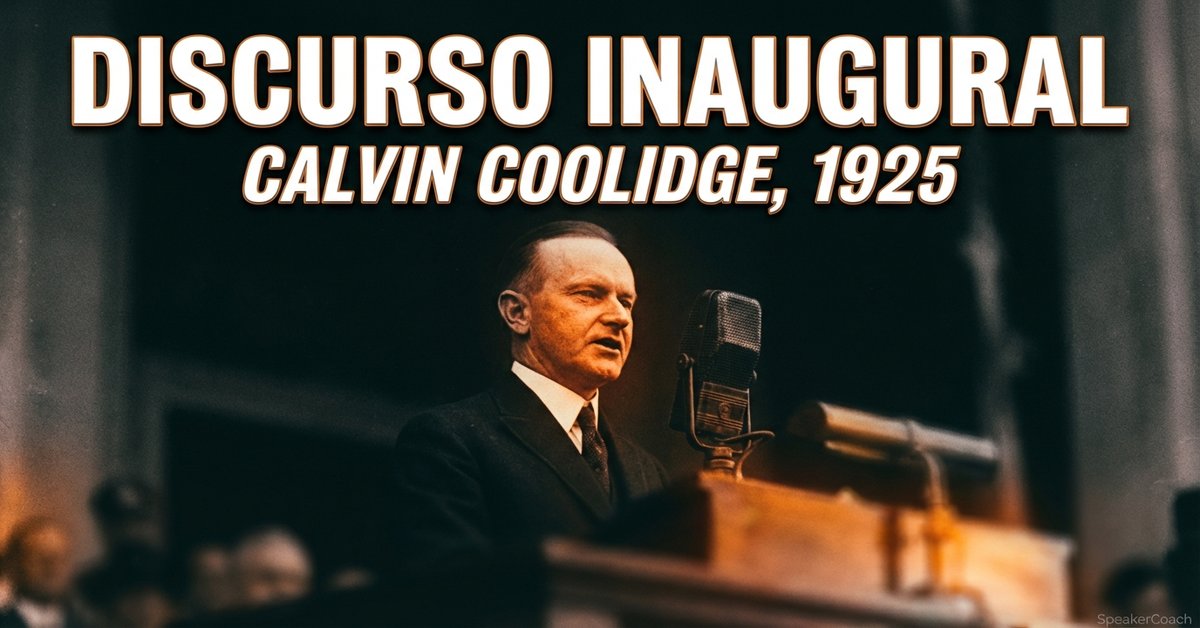
En su Discurso Inaugural de 1925, Calvin Coolidge articula una vision conservadora de la gobernanza estadounidense centrada en la austeridad fiscal, el gobierno limitado, el caracter moral y la paz. Pronunciado tras ganar la eleccion de 1924 por derecho propio (habiendo asumido la presidencia tras la muerte de Warren G. Harding en 1923), el discurso expone la filosofia de Coolidge de que la prosperidad fluye de la frugalidad, la baja tributacion y la empresa individual en lugar de la intervencion gubernamental. Argumenta que la tributacion excesiva es 'hurto legalizado', que la economia en el gobierno es 'el idealismo en su forma mas practica', y que la nacion necesita desarrollo espiritual y moral mas que progreso material. El discurso es notable por su disciplina retorica: construcciones paralelas ajustadas, formulaciones epigramaticas y un tono contenido que coincidia con la reputacion de Coolidge como 'Silent Cal.'
Contexto histórico
Calvin Coolidge pronuncio este discurso inaugural el 4 de marzo de 1925, tras ganar la eleccion presidencial de 1924 con el 54% del voto popular. Habia sido presidente por primera vez desde el 2 de agosto de 1923, cuando el presidente Warren G. Harding murio repentinamente de un ataque cardiaco en San Francisco. Coolidge fue juramentado por su padre, un notario publico, a la luz de una lampara de queroseno en su hogar familiar en Plymouth Notch, Vermont, una imagen que reforzo su reputacion de simplicidad e integridad. El discurso llego durante los Felices Anos Veinte, un periodo de rapido crecimiento economico, innovacion tecnologica (automoviles, radio, electrificacion), transformacion cultural (jazz, flappers, el Renacimiento de Harlem) y especulacion bursatil. La filosofia pro-empresa y de bajos impuestos de Coolidge -- encapsulada en su frase atribuida 'el negocio de Estados Unidos es los negocios' (en realidad 'el negocio principal del pueblo estadounidense es los negocios', de un discurso de enero de 1925 a editores de periodicos) -- definio las politicas economicas de la era. Su discurso inaugural reflejo el optimismo de un pais que se habia recuperado de la Primera Guerra Mundial y la recesion de 1920-21, aunque el auge economico que defendio terminaria en el catastrofico desplome bursatil de 1929, cuatro anos despues.
Texto del discurso
My Countrymen:
No one can contemplate current conditions without finding much that is satisfying and still more that is encouraging. Our own country is leading the world in the general readjustment to the results of the great conflict. Ours is a country where many enjoy the advantages of wealth. Ours is a country where the weights are somewhat evenly distributed, where the many partake of the general good, rather than the few.
Revolution has come to other countries, but we who have maintained a stable government, under representative institutions, have shown ourselves competent to deal with the problems of modern civilization in a way that accords with the genius of our institutions.
Here stands our country, an example of tranquility at home, a patron of tranquility abroad. Here stands its Government, aware of its might but obedient to its conscience. Here it will continue to stand, seeking peace and prosperity, solicitous for the welfare of the wage earner, promoting enterprise, developing waterways and natural resources, attentive to the intuitive counsel of womanhood, encouraging education, desiring the advancement of religion, supporting the cause of justice and honor among the nations. America seeks no earthly empire built on blood and force. No such combative spirit as that animates us. We cherish peace and good will, and pledge ourselves to the maintenance of the rights of man.
The collection of any taxes which are not absolutely required, which do not beyond reasonable doubt contribute to the public welfare, is only a species of legalized larceny. Under this republic the rewards of industry belong to those who earn them. The only constitutional tax is the tax that is levied for the purpose of supporting the Government in the discharge of its proper functions. Whenever the taxation of the people is in excess of the needs of Government, a condition is created that is dangerous to representative institutions.
The wise and correct course to follow in taxation and all other economic legislation is not to destroy those who have already secured success but to create conditions under which every one will have a better chance to be successful. The verdict of the country has been given on this question. That verdict stands. We shall not try the experiment of discouraging business prosperity. We shall continue to encourage it.
The method of raising revenue ought not to impede the transaction of business; it ought to encourage it. I am opposed to extremely high rates, because they produce little or no revenue, because they are bad for the country, and, finally, because they are wrong. We can not finance the country, we can not improve social conditions, through any system of injustice, even if we attempt to inflict it upon the rich. Those who suffer the most harm will be the poor. This country believes in prosperity. It is absurd to suppose that it is envious of those who are already prosperous. The wise and correct course to follow in taxation is not to destroy those who have already secured success but to create conditions under which every one will have a better chance to be successful.
We want idealism. We want that vision and courage which casts off all selfishness and all cowardice and proclaims the world for what it is -- a place of opportunity and of service. The foundations of our society and our government rest so much on the teachings of the Bible that it would be difficult to support them if faith in these teachings should cease to be practically universal in our country.
In all our dealings the guiding principle should be that we do nothing to injure any other country, while at the same time we make ourselves secure and promote our own prosperity. We should not allow this nation to drift into trouble. We should protect ourselves from it. But we should not seek quarrels. Peace is our ideal.
If we wish to erect new structures, we must have a definite knowledge of the old foundations. We must realize that human nature is about the most constant thing in the universe and that the essentials of human relationship do not change. We must frequently take our bearings from these fixed stars of our political firmament if we expect to hold a true course.
If we expect to maintain our prosperity we must be vigilant, we must be industrious, and we must be economical. Thrift and self-denial are not obsolete. We can not spend more than we earn. We can not consume more than we produce. We must realize that the age of extravagance has not arrived, and is not likely to arrive, in this or any other country.
The country needs every ounce of its energy to overcome the obstacles which still stand in the way of its progress. It needs the combined effort of the whole nation, in industry and in government, in education and in morals. We need to feel that behind the Government there is the power of the whole people.
The nation has placed on us the responsibility. We shall try to meet it. In the discharge of our duty we shall try to be fair to all men, and we shall try to be true to the principles of our own Government. We must do our best. We must meet our problems, solve them, master them. That is not only our duty; it is our destiny.
We do not need more material development, we need more spiritual development. We do not need more intellectual power, we need more moral power. We do not need more knowledge, we need more character. We do not need more government, we need more culture. We do not need more law, we need more religion. We do not need more of the things that are seen, we need more of the things that are unseen.
If the spirit be right, the form of government, the details of the Constitution, the nature of legislation, will of themselves be right. If the spirit of the people be wrong, no government can permanently save them. If the spirit be right, the government will flourish. It is from that spirit that our Government draws its strength. It is to that spirit that we must look for its permanence.
It is characteristic of our institution that its source of power rests in the people. We must realize that it is the people who are supreme. They have established the Government and they alone can reform it. It is their voice that speaks in every law. If their voice speaks unwisely, the remedy is not to condemn them, but to educate them.
Our Government rests upon religion. It is from that source that we derive our reverence for truth and justice, for equality and liberty, and for the rights of mankind. Unless the people believe in these principles they cannot believe in our Government.
I wish to be one of those Presidents who give the country a feeling of security, rather than of uneasiness. I wish to give the people a sense of permanence, of stability, of something they can depend on. I wish to give them a leader they can believe in, a Government that stands for the right.
Here in America we have been creating a new order and a new civilization. May we be faithful to the traditions of the past and to the new ideals that call us to the future. In this hour of rededication, let us renew our confidence and strengthen our faith. Here we stand, a nation of idealists, marching forward in the service of mankind.
The Government of the United States is a device for maintaining in perpetuity the rights of the people, with the ultimate extinction of all privileged classes. I favor the policy of economy, not because I wish to save money, but because I wish to save people. The men and women of this country who toil are the ones who bear the cost of the Government. Every dollar that we carelessly waste means that their life will be so much the more meager. Every dollar that we prudently save means that their life will be so much the more abundant. Economy is idealism in its most practical form.
The requirements of existence have passed beyond the standard of necessity into the region of luxury. Enlarged needs have come into being which need to be met. And the demand for things is no less strong than the demand for rights. But these needs cannot be met unless we maintain an industrial system and an economic order that is adequate to meet them.
I want the people of America to be able to work less for the Government and more for themselves. I want them to have the rewards of their own industry. This is the chief meaning of freedom. Until we can reestablish a condition under which the earnings of the people can be kept by the people, we are bound to suffer a very distinct curtailment of our liberty.
This is not the time to criticize but to construct. Let us build up. Let us move forward. Let us look to the future. America is not finished. It is not completed. There is much yet to be done. I believe that the idealism of America is not dead. I believe that the greatest days of this republic are yet to come.
Here we stand, united, facing the dawn of a new day, determined to march forward with courage and faith, dedicated to the great principles which have made America the hope of the world.
Análisis retórico
La repeticion deliberada de una palabra o frase al inicio de clausulas sucesivas para crear ritmo, enfasis y fuerza retorica acumulativa.
No necesitamos mas desarrollo material, necesitamos mas desarrollo espiritual. No necesitamos mas poder intelectual, necesitamos mas poder moral. No necesitamos mas conocimiento, necesitamos mas caracter. No necesitamos mas gobierno, necesitamos mas cultura. No necesitamos mas ley, necesitamos mas religion. No necesitamos mas de las cosas que se ven, necesitamos mas de las cosas que no se ven.
La yuxtaposicion de ideas contrastantes en estructuras gramaticales equilibradas para agudizar el argumento y hacer memorable la posicion del orador.
No necesitamos mas desarrollo material, necesitamos mas desarrollo espiritual. No necesitamos mas poder intelectual, necesitamos mas poder moral.
La construccion de declaraciones concisas, ingeniosas y paradojicas que comprimen un argumento complejo en una frase memorable, dando al discurso anclas citables.
La recaudacion de cualquier impuesto que no sea absolutamente necesario, que no contribuya mas alla de toda duda razonable al bienestar publico, es solo una especie de hurto legalizado.
El uso de estructuras gramaticales equivalentes en frases o clausulas sucesivas para crear ritmo, equilibrio y enfasis retorico.
No podemos financiar el pais, no podemos mejorar las condiciones sociales, a traves de ningun sistema de injusticia, incluso si intentamos infligirlo sobre los ricos.
Elevar argumentos economicos y de politica publica al ambito del principio moral, presentando el conservadurismo fiscal como un imperativo etico en lugar de una mera eleccion pragmatica.
Me opongo a tasas extremadamente altas porque producen poca o ninguna recaudacion, porque son malas para el pais y, finalmente, porque son injustas.
El uso de lenguaje figurado para representar conceptos politicos y filosoficos abstractos a traves de imagenes concretas, haciendo ideas complejas vividas y accesibles.
Debemos tomar frecuentemente nuestras referencias de estas estrellas fijas de nuestro firmamento politico si esperamos mantener un rumbo verdadero.
Un recurso retorico que consiste en tres clausulas o frases paralelas de longitud y estructura similar, creando un patron ritmico satisfactorio que refuerza el argumento mediante la acumulacion.
Si esperamos mantener nuestra prosperidad, debemos ser vigilantes, debemos ser industriosos y debemos ser economicos.
Lecciones clave
- **Eleva los argumentos de politica a principios morales.** Coolidge no solo argumenta que los impuestos bajos son eficientes -- llama a la tributacion excesiva 'hurto legalizado' y a la economia 'el idealismo en su forma mas practica.' Al presentar una posicion pragmatica, encuentra el principio moral que sirve y lidera con eso.
- **Usa la construccion 'no X sino Y' para replantear expectativas.** La secuencia 'No necesitamos mas desarrollo material, necesitamos mas desarrollo espiritual' es poderosa porque reemplaza sistematicamente lo que la audiencia espera escuchar con algo inesperado. Esta tecnica funciona en cualquier contexto donde quieras redirigir la atencion de lo obvio a lo esencial.
- **Haz coincidir tu estilo retorico con tu persona.** Coolidge era conocido como 'Silent Cal' por su economia de palabras. Su discurso inaugural lo refleja: oraciones ajustadas, sin ornamentacion, precision epigramatica. Los oradores mas efectivos no adoptan un estilo ajeno a su personalidad -- refinan su voz natural en un instrumento retorico.
- **Enmarca la austeridad fiscal como compasion por los trabajadores.** El movimiento retorico mas innovador de Coolidge es argumentar que ahorrar dinero salva personas. Al conectar el desperdicio gubernamental con las vidas escasas de las familias trabajadoras, transforma el recorte presupuestario de una abstraccion fria en un imperativo moral. Siempre conecta la politica con las vidas humanas que afecta.
- **Cierra con optimismo orientado al futuro.** Despues de un discurso basado en la moderacion y la disciplina, Coolidge termina con 'los mas grandes dias de esta republica aun estan por venir.' Un discurso sobre limites gana fuerza cuando concluye con posibilidad.

El discurso inaugural de Coolidge demuestra el poder retorico de la moderacion. En una era cuando la mayoria de la oratoria politica era florida y expansiva, el estilo ajustado y epigramatico de Coolidge destacaba precisamente porque era tan comprimido. Su secuencia 'No necesitamos mas' es una clase magistral en la tecnica de negacion sistematica seguida de afirmacion: al decirle a la audiencia lo que NO necesitan antes de decirles lo que SI necesitan, crea sorpresa y replantea la conversacion. Practica esta tecnica: toma cualquier argumento que quieras hacer y escribelo primero como 'No necesitamos X, necesitamos Y.' Hazlo cinco o seis veces en paralelo. Encontraras que el patron crea su propio impulso y autoridad.
Ver el programa