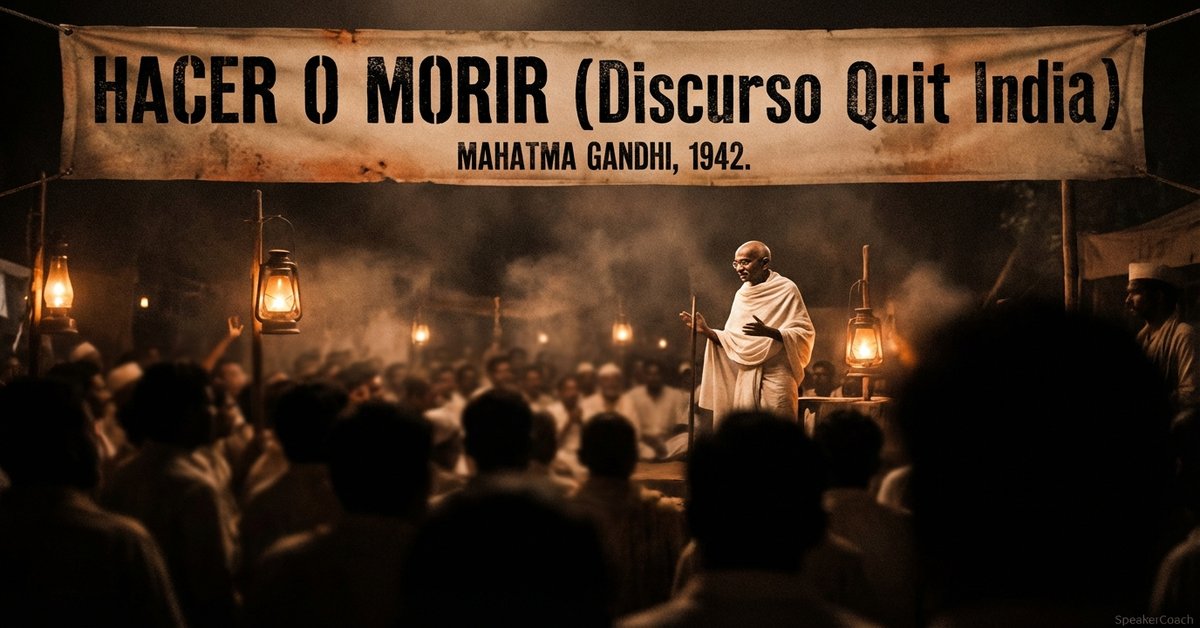
En su discurso 'Hacer o Morir' en la sesión del Comité del Congreso de Toda la India en Bombay, Gandhi lanza el Movimiento Quit India -- la campaña masiva final por la independencia india del dominio colonial británico. El discurso es una obra maestra de la escalada: Gandhi comienza con filosofía democrática razonada, avanza a través de una declaración personal de deber espiritual, y culmina en el electrizante mantra 'Hacer o Morir'. Lo que hace al discurso notable es cómo Gandhi simultáneamente llama a la acción más radical -- la disposición a morir por la libertad -- mientras insiste en la no violencia absoluta. Enmarca la lucha independentista de la India como superior a las revoluciones francesa y rusa precisamente porque rechaza la violencia. El discurso terminó una era: en menos de 24 horas, Gandhi y toda la dirigencia del Congreso fueron arrestados, pero el movimiento que encendió duró dos años y cambió irreversiblemente el equilibrio hacia la independencia.
Contexto histórico
Pronunciado el 8 de agosto de 1942 en Gowalia Tank Maidan (ahora August Kranti Maidan) en Bombay, este discurso lanzó el Movimiento Quit India, la mayor campaña de desobediencia civil masiva contra el dominio británico. La Segunda Guerra Mundial rugía, y Japón había conquistado Birmania y amenazaba las fronteras orientales de la India. El gobierno británico bajo Churchill se negaba a considerar la independencia india, incluso mientras exigía que soldados indios lucharan por la libertad aliada. Gandhi vio la contradicción como moralmente intolerable: la India no podía luchar por la libertad de otros mientras estaba esclavizada. El Comité del Congreso de Toda la India aprobó la 'Resolución Quit India' esa noche. En pocas horas, el gobierno colonial británico lanzó la Operación Hora Cero, arrestando a Gandhi, Nehru y prácticamente toda la dirigencia del Congreso. A pesar de la decapitación de su liderazgo, el movimiento se extendió por toda la India con huelgas, manifestaciones y gobiernos paralelos en algunos distritos, durando hasta 1944. Fue el último clavo en el ataúd del dominio colonial británico en la India, que logró la independencia el 15 de agosto de 1947.
Texto del discurso
Before you discuss the resolution, let me place before you one or two things. I want you to understand two things very clearly and to consider them from the same point of view from which I am placing them before you. I ask you to consider it from my point of view, because if you approve of it, you will be (..) taking it in (..) the (..) same sense in which I am placing it before you.
I believe that in the history of the world, there has not been a more genuinely democratic struggle for freedom than ours. I read Carlyle's French Revolution while I was in prison, and Pandit Jawaharlal has told me something about the Russian Revolution. But it is my conviction that inasmuch as these struggles were fought with the weapon of violence they failed to realize the democratic ideal. In the democracy which I have envisaged, a democracy established by non-violence, there will be equal freedom for all. Everybody will be his own master. It is to join a struggle for such democracy that I invite you today. Once you realize this you will forget the differences between the Hindus and Muslims, and think of yourselves as Indians only, engaged in the common struggle for independence.
Then, there is the question of determination. I say that the determination of the people should be such that we do not wait for the rights to come. That will constitute a very bad state of affairs. I have no doubt that if the people join this struggle with a fixed determination, it will be over in no time. I say, therefore, that it is a universal cause, and the responsibility lies with all of us.
I believe I am the shrewdest and most cunning man in the world if that is what you want. But I disown that role. I have said again and again that I will never be party to a fraud. I am not here to play games with the British. I am here to ask them in all humility to leave our country.
Let me explain my position clearly. God has vouchsafed to me a priceless gift in the weapon of ahimsa. I and my ahimsa are on our trial today. If in the present crisis, when the earth is being scorched by the flames of himsa and crying for deliverance, I failed to make use of the God-given talent, God will not forgive me and I shall be judged unworthily of the great gift. I must act now. I may not hesitate and merely look on, when Russia and China are threatened.
Ours is not a drive for power, but purely a non-violent fight for India's independence. In a violent struggle, a successful general has been often known to effect a military coup and to set up a dictatorship. But under the Congress scheme of things, essentially non-violent as it is, there can be no room for dictatorship. A non-violent soldier of freedom will covet nothing for himself, he fights only for the freedom of his country.
The Congress is unconcerned as to who will rule, when freedom is attained. The power, when it comes, will belong to the people of India, and it will be for them to decide to whom it placed in the entrusted. May be that the reins will be placed in the hands of the Parsis, for instance, as combating nobody combats India, or be it Muslim or Hindu or anybody; the right to rule will lie in their hands.
I have pledged the Congress and the Congress will do every thing that is right. Every one of you should, from this moment onwards, consider yourself a free man or woman, and act as if you are free and are no longer under the heel of this imperialism.
It is not a happy thing that there is today war in my country, that we are today thinking of the Japanese invaders. But the Japanese will not be combated by our accepting slavery. On the contrary, we shall resist the Japanese invaders with the strength given to us by freedom.
Here is a mantra, a short one, that I give you. You may imprint it on your hearts and let every breath of yours give expression to it. The mantra is: 'Do or Die.' We shall either free India or die in the attempt; we shall not live to see the perpetuation of our slavery. Every true Congressman or woman will join the struggle with an inflexible determination not to remain alive to see the country in bondage and slavery. Let that be your pledge.
Take a pledge, with God and your own conscience as witness, that you will no longer rest till freedom is achieved and will be prepared to lay down your lives in the attempt to achieve it. He who loses his life will gain it; he who will seek to save it shall lose it. Freedom is not for the coward or the faint-hearted.
A word to the journalists. I congratulate you on the work you have been doing. I know that the light of your patriotism has not burnt out. I know it cannot go out, so long as the sun and the moon last. In this hour I ask you to be with us in this great struggle, and I trust that you will not fail us.
Go and tell the world that Gandhi rose, that Gandhi and the whole of India with him decided that they would see their country free, or die in the attempt. Let no one commit a wrong in anger. This is my last message. Let every man and woman live every moment of his or her life hereafter in the consciousness that he or she eats or lives for achieving freedom and will die, if need be, to attain that goal.
Análisis retórico
Una serie de mandatos que aumentan en intensidad, llevando a la audiencia de la comprensión al compromiso a la acción.
Aquí hay un mantra, uno breve, que les doy. Pueden imprimirlo en sus corazones y dejar que cada aliento suyo le dé expresión. El mantra es: 'Hacer o Morir.'
Presentar la acción política como un imperativo espiritual y moral en lugar de una mera elección estratégica, elevando lo que está en juego más allá de la política.
Dios me ha concedido un don invaluable en el arma del ahimsa. Yo y mi ahimsa estamos en juicio hoy. Si en la crisis actual, cuando la tierra está siendo abrasada por las llamas del himsa y clama por liberación, fracaso en usar el talento dado por Dios, Dios no me perdonará.
Referenciar textos sagrados para prestar autoridad divina y resonancia universal al mensaje del orador.
El que pierda su vida la ganará; el que busque salvarla la perderá. La libertad no es para el cobarde ni para el pusilánime.
Yuxtaponer ideas contrastantes para clarificar la posición del orador y agudizar la elección moral que enfrenta la audiencia.
La nuestra no es una búsqueda de poder, sino puramente una lucha no violenta por la independencia de la India.
Dirigirse a segmentos específicos de la audiencia por nombre o rol para crear responsabilidad personal.
Una palabra a los periodistas. Los felicito por el trabajo que han estado haciendo. Sé que la luz de su patriotismo no se ha extinguido.
Lecciones clave
- **Comprime tu mensaje central en una frase portátil.** 'Hacer o Morir' se convirtió en el grito de guerra de todo un movimiento. Después de construir tu argumento con lógica y emoción, destílalo en palabras que puedan ser llevadas fuera de la sala y repetidas por millones.
- **Enmarca tu causa como moralmente superior a todas las alternativas.** Gandhi no solo argumenta por la independencia -- argumenta que el enfoque no violento de la India es la única revolución verdaderamente democrática en la historia. Elevar tu enfoque por encima de todos los precedentes le da a la audiencia orgullo en unirse.
- **Dirígete a la audiencia a la que no tendrás acceso.** Gandhi habló a los periodistas porque sabía que sería arrestado en pocas horas. Cuando tu ventana de influencia es limitada, identifica quién llevará tu mensaje adelante y háblale directamente.
- **Haz de la libertad un acto en tiempo presente, no una esperanza futura.** 'Considérense hombres o mujeres libres desde este momento' transforma la libertad de una meta en una realidad psicológica inmediata. Los llamados a la acción más poderosos cambian la identidad de la audiencia, no solo su comportamiento.
- **Usa la autoridad espiritual y religiosa para trascender las objeciones políticas.** Al enmarcar la lucha como un juicio divino -- 'Dios no me perdonará' -- Gandhi la coloca más allá del alcance del compromiso político, haciendo que la retirada se sienta como blasfemia.

El discurso 'Hacer o Morir' de Gandhi enseña el arte del mantra portátil. Después de construir un argumento sofisticado que abarca la teoría democrática, el deber espiritual y el contexto geopolítico, lo comprime todo en tres sílabas que cualquiera puede recordar y repetir. Al preparar un discurso para una gran audiencia o un momento crucial, dedica tanto tiempo a elaborar tu mensaje de tres palabras como al cuerpo del discurso. Pruébalo: ¿puede una persona que escuchó tu discurso repetir tu mensaje central a alguien que no lo escuchó? Si no, tu argumento no ha sido comprimido lo suficiente.
Ver el programa