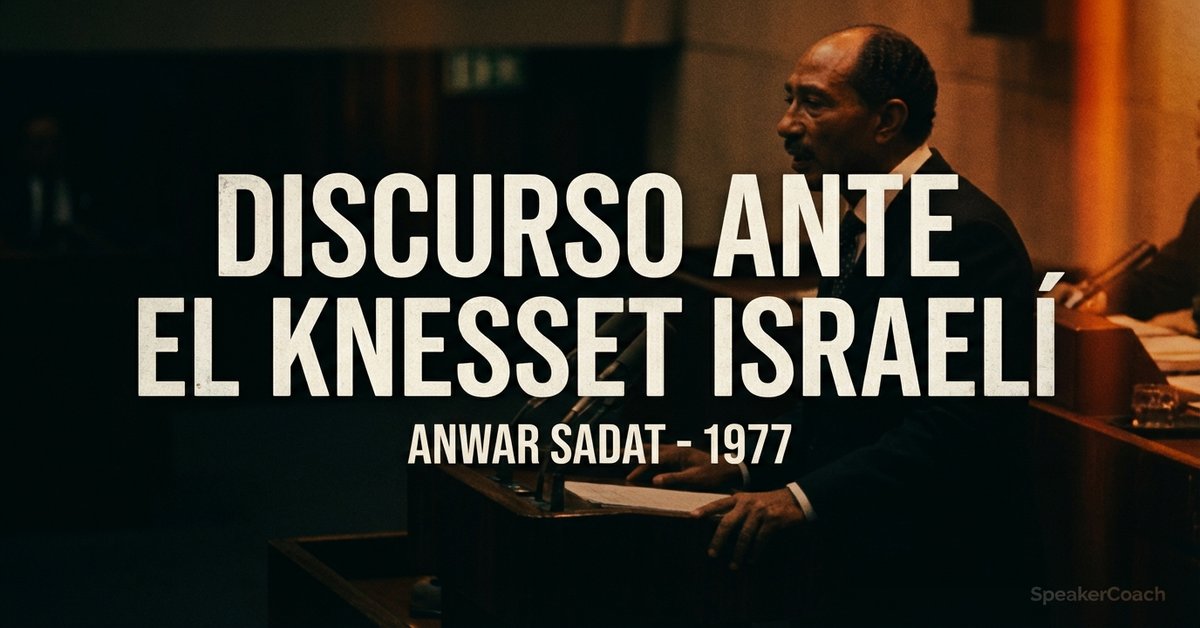
En este discurso sin precedentes, el Presidente egipcio Anwar Sadat se convierte en el primer lider arabe en visitar Israel y hablar ante el Knesset. Pronunciado en arabe ante un parlamento israeli atonito, el discurso es una obra maestra de la retorica de la paz que equilibra gestos audaces con posiciones firmes. Sadat invoca a su Dios compartido, su tierra compartida y su humanidad compartida para argumentar que la paz es tanto un imperativo moral como una necesidad practica. Deja claro que esto no es una capitulacion -- exige el retiro completo de los territorios ocupados y la autodeterminacion palestina -- pero envuelve estas demandas en un marco de respeto mutuo y destino comun. El movimiento retorico mas poderoso del discurso es su propia existencia: al venir a Jerusalen, Sadat ejecuta la paz que esta defendiendo.
Contexto histórico
El 19 de noviembre de 1977, el Presidente egipcio Anwar Sadat hizo lo que ningun lider arabe habia hecho antes: volo a Israel. Desde la creacion de Israel en 1948, Egipto e Israel habian luchado cuatro guerras (1948, 1956, 1967, 1973). El mundo arabe mantenia una politica de no reconocimiento: ni paz, ni negociacion, ni reconocimiento. La visita de Sadat rompio este consenso de la noche a la manana. Su discurso ante el Knesset el 20 de noviembre fue transmitido en vivo por todo el Medio Oriente y el mundo. El discurso y el proceso diplomatico que inicio llevaron a los Acuerdos de Camp David en septiembre de 1978, el Premio Nobel de la Paz para Sadat y el Primer Ministro israeli Menachem Begin, y el Tratado de Paz Egipto-Israel firmado el 26 de marzo de 1979 -- el primer tratado de paz entre Israel y un estado arabe. El coraje de Sadat le costo la vida: fue asesinado el 6 de octubre de 1981 por extremistas islamistas que se oponian al acuerdo de paz.
Texto del discurso
In the name of God, the Gracious and Merciful.
Mr. Speaker, Ladies and Gentlemen:
Peace and the mercy of God Almighty be upon you. God willing, peace for us all, on the Arab land, on the land of Israel, and in every part of the world where the face of man is found.
I come to you today on solid ground to shape a new life and to establish peace. We all love this land, the land of God. We all, Muslims, Christians, and Jews, all worship God.
No one can build his happiness at the expense of the misery of others.
I have come to you so that together we should build a durable peace based on justice, to avoid the shedding of even a single drop of blood from either side. It is for this reason that I have proclaimed my readiness to go to the farthest corner of the earth.
I have not come here for a separate agreement between Egypt and Israel. This is not part of the policy of Egypt. The problem is not merely that of Egypt and Israel. Any separate peace between Egypt and Israel, or between any Arab confrontation state and Israel, will not bring permanent peace based on justice in the entire region.
I have come to Jerusalem, the City of Peace, which will always remain as a living embodiment of coexistence among believers of the three great religions. It is inadmissible that anyone should conceive the special status of the city of Jerusalem within the framework of annexation or expansionism.
I tell you truly, today there is a chance for peace -- an historic opportunity that may never come again. We must seize it, and we must find the courage to transcend our old patterns of conflict.
You want to live with us, part of the world. In all sincerity I tell you we welcome you among us with full security and safety. This in itself is a tremendous turning point, one of the landmarks of a decisive historical change.
Today, through my visit to you, I ask you: Why don't we stretch out our hands with faith and sincerity so that together we might build peace? Why shouldn't our and your will meet with faith and sincerity so that together we might build a towering edifice of peace?
There is no happiness for some at the expense of the misery of others. Direct confrontation and a straight line are the nearest and most successful methods to reach a clear objective.
I have come to you to deliver a message of peace. A message from the Egyptian people, who do not know fanaticism and whose sons, Muslims, Christians, and Jews, live together in a state of cordiality, love, and tolerance.
Let me tell you without the slightest hesitation that I have not come to you under this roof to make a request that your troops evacuate the occupied territories. Complete withdrawal from the Arab territories occupied after 1967 is a logical and undisputed fact. Nobody should plead for that.
Likewise, I have not come to you to seek a partial settlement. I have come to you so that together we can build a durable peace, a peace that lives in the hearts and minds of people and not in documents alone.
As we really and truly seek peace, let us really and truly want peace.
We agree on all the international rules and principles. We agree on withdrawal from the occupied territories. We agree on the Palestinian people's right to self-determination. We agree on the right of all states in the area to live in peace within their recognized, secure boundaries.
Any life that is lost in war is a human life, be it that of an Arab or an Israeli. A wife who becomes a widow is a human being entitled to a happy family life, whether she be an Arab or an Israeli. Innocent children who are deprived of the care and compassion of their parents are ours. They are ours, be they living on Arab or Israeli land.
I hail the Israeli people from this rostrum to tell them: We do not want to encircle you or be encircled ourselves by destructive missiles ready for launching, nor by the shells of grudges and hatred.
Ring the bells for your sons. Tell them that those wars were the last of wars and the end of sorrows. Tell them that we are entering upon a new beginning, a new life -- a life of love, prosperity, freedom, and peace.
Peace be upon you.
Análisis retórico
Invocar tradiciones religiosas compartidas por el orador y la audiencia para establecer una humanidad comun y una base moral antes de abordar desacuerdos politicos.
Todos amamos esta tierra, la tierra de Dios. Todos nosotros, musulmanes, cristianos y judios, todos adoramos a Dios.
Usar preguntas no para desafiar sino para invitar, enmarcando la paz como una posibilidad compartida que solo requiere voluntad mutua.
Por que no extendemos nuestras manos con fe y sinceridad para que juntos podamos construir la paz? Por que no deberian nuestra voluntad y la suya encontrarse con fe y sinceridad para que juntos podamos construir un imponente edificio de paz?
Lecciones clave
- **A veces el medio ES el mensaje.** El argumento mas poderoso de Sadat no fue ninguna frase del discurso -- fue el acto de estar alli. Cuando tu posicion requiere coraje, a veces lo mas persuasivo que puedes hacer es simplemente presentarte donde nadie te esperaba.
- **Encuentra terreno sagrado comun antes del terreno politico.** Al abrir con la adoracion compartida de Dios y el amor compartido por la tierra, Sadat establece un marco moral que hace que rechazar la paz se sienta como rechazar a Dios.
- **Declara demandas como hechos, no como peticiones.** 'El retiro completo... es un hecho logico e indiscutible. Nadie deberia suplicar por eso.' Al negarse a enmarcar su demanda como una suplica, Sadat mantiene dignidad y fortaleza.
- **Humaniza mediante la simetria.** 'Una esposa que se convierte en viuda es un ser humano, sea arabe o israeli' usa la estructura paralela para disolver el binario nosotros-ellos.
- **Cierra con lo personal, no con lo politico.** 'Hagan sonar las campanas por sus hijos' no es una declaracion politica -- es el deseo de un padre.

El discurso de Sadat ante el Knesset ensena la leccion definitiva en ethos: credibilidad a traves de la accion, no las palabras. Todo orador habla de coraje; Sadat camino hacia el parlamento del enemigo de su nacion. Pero observa como el discurso refuerza este ethos a traves de una tecnica que puedes adaptar: la estructura 'No he venido a... He venido a...' Al declarar explicitamente lo que NO esta haciendo, Sadat define la conversacion en sus terminos. Prueba esto en tu proxima presentacion dificil: antes de declarar tu proposito, nombra claramente dos o tres cosas que NO estas alli para hacer.
Ver el programa