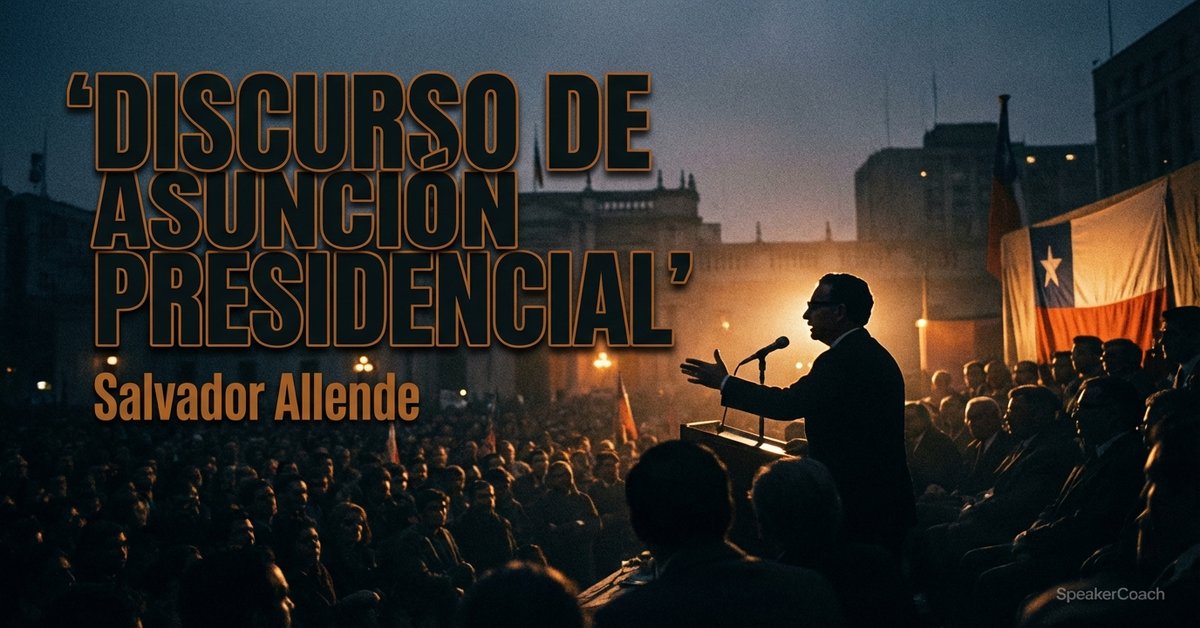
El discurso de asunción presidencial de Salvador Allende del 3 de noviembre de 1970 marcó un hito histórico: el primer jefe de Estado marxista democráticamente elegido en América Latina. Hablando ante el Congreso Pleno en Santiago, Allende delineó su visión de una 'vía chilena al socialismo' -- una transición pacífica y constitucional hacia una sociedad socialista que nacionalizaría las industrias clave, profundizaría la reforma agraria y ampliaría la educación, todo preservando las instituciones democráticas, el pluralismo y las libertades civiles. El discurso se estructura como una serie de apelaciones directas a diferentes sectores de la sociedad chilena -- trabajadores, empresarios, militares, juventud, mujeres -- buscando construir una amplia coalición nacional. Su poder retórico reside en su optimismo mesurado y su insistencia en que socialismo y democracia no son contradictorios sino complementarios.
Contexto histórico
Salvador Allende ganó la elección presidencial chilena el 4 de septiembre de 1970, como candidato de la coalición Unidad Popular, obteniendo el 36,3% de los votos en una contienda a tres bandas. Como ningún candidato alcanzó mayoría absoluta, el Congreso debió ratificar el resultado, lo que hizo el 24 de octubre después de que Allende firmara el 'Estatuto de Garantías Constitucionales' prometiendo respetar las instituciones democráticas. Su asunción el 3 de noviembre llegó tras décadas de activismo político: Allende se había postulado a la presidencia tres veces antes (1952, 1958, 1964). La elección provocó una conmoción en Washington; la administración Nixon y la CIA ya habían intentado impedir que Allende asumiera mediante operaciones encubiertas. Chile en 1970 era una sociedad profundamente polarizada con desigualdad masiva: una pequeña oligarquía controlaba la mayor parte de la tierra y los recursos, mientras una gran clase obrera y campesinado vivía en la pobreza. El programa de Allende de nacionalización, reforma agraria y redistribución fue tanto su mandato como lo que finalmente provocaría la reacción violenta que culminó en el golpe de 1973.
Texto del discurso
I assume the responsibility of the highest office of Chile, with my gaze fixed on the destiny of my homeland and the will of my people. Today, November 3, 1970, a new period begins in the history of Chile: the transition to socialism through the democratic path.
I would not have arrived here were it not for the will of the Chilean people. This moment would not be possible without the decision of thousands and thousands of men and women who believed that another path was possible; that Chile could move toward a more just society without renouncing its democratic tradition.
Chile has a long constitutional tradition. We are a country that has known how to resolve its conflicts within the framework of the law. And today that tradition is enriched: for the first time, a government proposes to build a socialist society within the framework of political democracy, pluralism, and liberty.
We have not come to destroy. We have come to build. We have not come to impose. We have come to propose. The path we have chosen is that of democracy, and in democracy we shall continue.
Copper, saltpeter, iron, the basic wealth of Chile, must belong to Chile and to Chileans. We will nationalize the country's basic resources. We will nationalize copper. We will do so within the Constitution, with full respect for legality.
The agrarian reform will be deepened to make Chile a country where the land belongs to those who work it. There shall be no more idle latifundios while there are peasants without land.
The State will assume control of banking and foreign trade. The financial resources of the country cannot continue to serve a privileged minority. They must serve all the people.
Education will be a priority of this government. No Chilean child shall be left without a school, no young person without access to university. Culture and knowledge cannot be the privilege of the few.
I wish to address myself especially to the workers of Chile. You are the backbone of this process. Without your effort, without your sacrifice, nothing would be possible. I ask you for discipline, I ask you for responsibility, I ask you to produce more. Chile needs you.
To the patriotic entrepreneurs I say: we are not your enemies. We invite you to participate in building a new economy. We do not wish to destroy private initiative, but to place it at the service of national development.
To the Armed Forces I express my institutional respect. You are the guarantors of sovereignty and of the popular will expressed at the ballot box. Chile trusts in your constitutionalist tradition.
To the youth I say: you are the hope of this process. I do not offer you an easy path. I offer you the path of dignity. I ask you to study, to work, to prepare yourselves for the society we are going to build together.
To the women of Chile, who have been the silent protagonists of history: this government will also be your government. The equality of women will not be merely a declaration, but a daily practice.
Our revolution is not made with rifles but with reason, with conscience, with the will of the people. Our revolution is built in freedom. This is our originality and this shall be our strength.
I know the road will be difficult. I know there will be enormous obstacles. The forces of privilege will not easily resign themselves to losing their positions. But we have on our side the most powerful force: the will of the Chilean people.
Chile opens itself to hope. With our heads held high and our conscience clear, with the strength of a people that chose its destiny, today we begin the construction of a more just, more humane, more dignified society.
Long live Chile! Long live the people! Long live the workers!
Análisis retórico
Yuxtaposición de ideas contrastantes en estructura paralela para agudizar el mensaje político y anticiparse a las críticas.
No venimos a destruir. Venimos a construir. No venimos a imponer. Venimos a proponer.
Allende se dirige sistemáticamente a cada sector de la sociedad -- trabajadores, empresarios, militares, juventud, mujeres -- creando una coalición nacional inclusiva mediante el reconocimiento personal.
Quiero dirigirme especialmente a los trabajadores de Chile. Ustedes son la columna vertebral de este proceso.
La repetición de frases al inicio de cláusulas sucesivas crea ritmo, énfasis y un sentido de determinación creciente.
Sé que el camino será difícil. Sé que habrá obstáculos enormes.
Allende ancla repetidamente su programa revolucionario en la tradición constitucional de Chile, estableciendo legitimidad y desactivando temores de exceso autoritario.
Chile tiene una larga tradición constitucional. Somos un país que ha sabido resolver sus conflictos dentro del marco de la ley.
Grupos de tres elementos utilizados para crear ritmo y completitud, un recurso retórico clásico que hace que las ideas se sientan definitivas.
la construcción de una sociedad más justa, más humana, más digna.
Uso estratégico de pronombres inclusivos e invitaciones directas a grupos adversarios para construir la coalición política más amplia posible.
A los empresarios patriotas les digo: no somos sus enemigos. Los invitamos a participar en la construcción de una nueva economía.
Lecciones clave
- **Ancla las propuestas radicales en la tradición.** Allende enmarca el cambio político más dramático de la historia chilena como una extensión natural de la herencia constitucional del país. Cuando propones algo sin precedentes, conéctalo con valores que tu audiencia ya sostiene.
- **Dirígete a tus oponentes directa y respetuosamente.** Al hablar a los 'empresarios patriotas' y a las Fuerzas Armadas con respeto, Allende busca neutralizar la oposición. Incluir audiencias escépticas en tu visión es más efectivo que ignorarlas o atacarlas.
- **Usa la antítesis para anticipar críticas.** 'No venimos a destruir. Venimos a construir' responde al temor no dicho antes de que pueda articularse. Anticipar objeciones y abordarlas estructuralmente es una técnica persuasiva poderosa.
- **Sé honesto sobre la dificultad.** Allende no promete un camino fácil. Su franco 'Sé que el camino será difícil' construye credibilidad. Las audiencias confían más en oradores que reconocen desafíos que en quienes prometen solo éxito.
- **Cierra con emoción concreta, no con política abstracta.** Después de extensa discusión programática, Allende cierra con imágenes vívidas de esperanza y dignidad. Siempre lleva un discurso de vuelta de la cabeza al corazón en el cierre.

El discurso inaugural de Allende demuestra una técnica magistral de retórica inclusiva: la 'apelación panorámica'. En lugar de hablar a una audiencia genérica, la divide en segmentos específicos -- trabajadores, empresarios, militares, juventud, mujeres -- y da a cada uno un mensaje a medida. Esta técnica funciona porque hace que cada oyente se sienta individualmente reconocido. Practica esto: antes de tu próximo discurso, enumera los tres a cinco grupos distintos en tu audiencia. Escribe un mensaje específico de dos oraciones para cada uno. Ordénalos en secuencia lógica, empezando por tus partidarios principales hasta tus escépticos. Nota cómo la suma de estas apelaciones específicas crea una unidad más poderosa que cualquier genérico 'todos estamos juntos en esto'.
Ver el programa