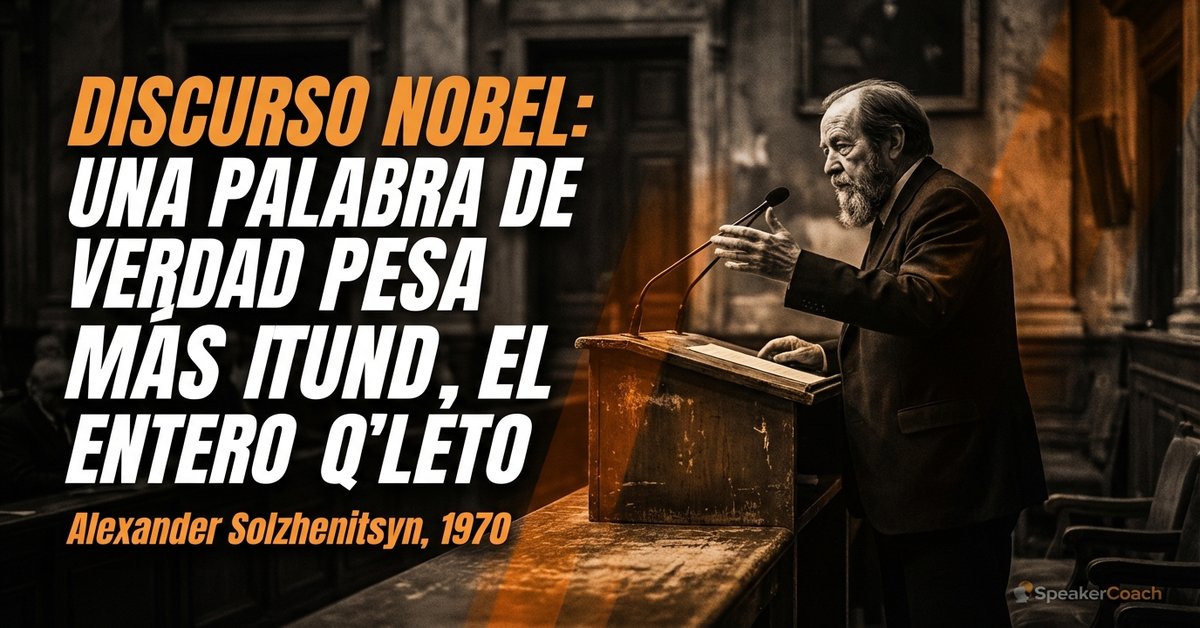
El Discurso Nobel de Solzhenitsyn es una profunda meditacion sobre la responsabilidad moral del arte y del artista en un mundo dominado por la violencia y la falsedad. Incapaz de viajar a Estocolmo debido a restricciones sovieticas, entrego el texto en 1972, transformando lo que podria haber sido un discurso ceremonial en un abrasador manifiesto filosofico. El discurso argumenta que el arte posee un poder unico que la propaganda, la filosofia y el discurso politico no pueden igualar: la capacidad de transmitir experiencia vivida a traves de culturas y generaciones, y de exponer mentiras de una manera que es 'completamente irrefutable.' Avanzando desde el misterio de la belleza, pasando por el martirio de escritores silenciados, hasta la relacion simbiotica entre la violencia y las mentiras, Solzhenitsyn construye hacia su conclusion atronadora, extraida de un proverbio ruso: 'Una palabra de verdad pesa mas que el mundo entero.' El discurso se erige como una de las defensas mas importantes del poder civilizador de la literatura jamas escritas.
Contexto histórico
Alexander Solzhenitsyn recibio el Premio Nobel de Literatura en 1970, pero el gobierno sovietico lo presiono para que no asistiera a la ceremonia en Estocolmo, amenazando con impedirle regresar a Rusia. Acepto el premio pero no pudo pronunciar su discurso en persona. El texto fue finalmente transmitido a la Academia Sueca en 1972 y publicado ese mismo ano. En ese momento, Solzhenitsyn ya era una figura disidente: sus novelas 'Un dia en la vida de Ivan Denisovich' (1962) y 'El primer circulo' (1968) habian expuesto el sistema del Gulag sovietico, y su obra era cada vez mas suprimida dentro de la URSS. Seria deportado a la fuerza de la Union Sovietica en 1974, dos anos despues de entregar este discurso. El discurso debe leerse en el contexto de la censura de la Guerra Fria, la persecucion de escritores sovieticos (Ajmatova, Zamiatin, Pasternak, Mandelstam), y la experiencia personal de Solzhenitsyn de ocho anos en campos de trabajo. Su invocacion de 'tanques inundando con sangre el asfalto de una capital extranjera' hace referencia directa a la invasion sovietica de Checoslovaquia en 1968.
Texto del discurso
Just as that puzzled savage who has picked up a strange cast-up from the sea, something buried in the sand, or some object fallen from the sky -- something intricate, gleaming now dully, now with a bright flash -- turns it this way and that, turns it over, trying to discover what to do with it, trying to discover some mundane function within his own grasp, never dreaming of its higher function -- so we, holding Art in our hands, self-confidently consider ourselves its masters, boldly give it direction, bring it up to date, reform it, make manifestos of it, sell it for money, use it to please the powerful, turn it about for amusement -- from cabaret songs all the way to pornography -- or else, if nothing better seems to turn up, press it into service as a cudgel in the universal political scramble. And art remains serene through it all; it does not lose heart, it does not suffer these uses.
But there is a special quality in the essence of beauty, a special quality in the status of art: the convincingness of a true work of art is completely irrefutable, and it forces even an opposing heart to surrender. It is vain to assert and reassert what the heart does not find sweet. A political speech, the newspaper harangue, a pamphlet, a social program, a philosophical system -- all can be constructed, smoothly and consistently, on a basis of error and of lie. And what is concealed, and what distorts, will not be immediately clear. But then a contradictory speech, essay, program, or differently structured philosophy comes along -- and again everything fits and sounds smooth, and again it works. And so they inspire trust -- and distrust. But a work of art bears within itself its own confirmation: concepts which are manufactured out of whole cloth or overstrained do not withstand the test of being embodied in images; they all come crashing down, they turn out to be sickly and pallid, they convince no one. But works which have scooped up the truth and presented it to us as a living force -- they take hold of us, compel us, and nobody ever, not even ages hence, will appear to refute them.
So perhaps that ancient trinity of Truth, Goodness, and Beauty is not simply an empty, faded formula, as we thought in the days of our self-confident materialistic youth. If the tops of these three trees converge, as the scholars maintained, but the too blatant, too direct stems of Truth and Goodness are crushed, cut down, and not allowed through, then perhaps the fantastic, unpredictable, unexpected stems of Beauty will push through and soar to that very same place, and in so doing will fulfill the work of all three. And in that case Dostoyevsky's remark, 'Beauty will save the world,' was not a careless phrase but a prophecy. After all, he was granted to see much, a man of fantastic illumination.
And is it not he, the artist, who senses more keenly than all others the harmony of the world, the beauty and the outrage of what man has done to it -- and is he not capable of conveying this to even the unfeeling and the deadened? Who, if not the writer, is to pass judgment -- not on his country's politics (do not be so bold as to take that upon yourself) -- but on its past, its dully creeping present, and its principles of morality? Who, if not the writer, is to give us a condensed and vivid picture of the society in which he lives -- of its crimes and its absurdities? Where in the history of any country has there been a period when the national literature was safely forgettable?
Woe to that nation whose literature is disturbed by the intervention of power. Because that is not just a violation against 'freedom of print,' it is the closing down of the heart of the nation, a slashing to pieces of its memory. The nation ceases to be mindful of itself, it is deprived of its spiritual unity, and despite a supposedly common language, fellow countrymen suddenly cease to understand one another. Silent generations grow old and die without ever having talked about themselves, either to each other or to their descendants.
When writers such as Akhmatova and Zamyatin -- buried alive throughout their lives -- are condemned to create in silence until they die, never hearing the reverberations of what they wrote, then that is not only their personal misfortune but a sorrow to the whole nation, a danger to the whole nation. And in certain cases -- when as a result of such a silence the whole of history ceases to be understood -- it is a danger to the whole of mankind.
At various times and in various countries, heated, angry, and exquisitely refined debates have raged and still rage on the question of whether art and the artist should be free or whether they should be bound. Art should not, it is said, be concerned with anything outside itself: 'Art for art's sake.' Others protest and say that the artist cannot live in an ivory tower; that art must serve the great social forces. What no one appears willing to understand is that neither of these positions is valid. The artist is not the master of his own destiny: he is a servant of a higher truth, and the gift of creation has been put into his hands for a purpose. It is not within the artist's power to dodge this duty.
To the true artist the justification for his existence is the way he senses more keenly, and transmits more condensely, the harmony and the disharmony of the world. And if the whole of mankind should some day come to share in this transmitted experience, will it not then become a single whole?
Who will give mankind one single system for reading its instruments, both for wrongdoing and for doing good, for the intolerable and the tolerable, as they are distinguished from each other today? Who will make clear for mankind what is really oppressive and unbearable and what, for being so near, rubs us raw -- and will direct our anger against what is in fact terrible and not merely combative or feared? Who is so bold as to pretend that he can invent such a clear-cut division? Propaganda, coercion, and scientific proofs are all powerless. But happily, in our world, there is a way. It is art, and it is literature.
There is a miracle which they can work: they can overcome man's unfortunate trait of learning only from his own experience so that the experience of others is wasted on him. From man to man, as he completes his brief stint on this earth, art transfers the whole weight of an unfamiliar, lifelong experience with all its burdens, its colors and flavors of living reality, and re-creates in the flesh what another has experienced, and allows it to be acquired as one's own.
And even more, much more than that: countries and whole continents repeat each other's mistakes with time gaps of centuries. Then, one would think, it must all be clear? But no; what some nations have already endured, thought through, and rejected, suddenly surfaces in other nations as the very latest word. And here again the only substitute for firsthand experience which we have not yet sufficiently lived through is art, is literature. They possess a wonderful faculty -- beyond the reach of the artist's formulations -- of conveying the concentrated experience of one whole community, from country to country, from people to people.
Violence, less and less restrained by the legal system established over the course of centuries, brazenly and triumphantly strides across the world. It does not care that we resist it and cry out against it. Violence grows bolder because it has become stronger; the violence of lies increases. Violence does not always and not necessarily lunge straight for your throat; more often it demands of its subjects only that they pledge allegiance to lies, that they participate in lies.
The simple step of a courageous individual is not to take part in the lie. One word of truth outweighs the whole world.
Violence can only be concealed by a lie, and the lie can only be maintained by violence. Any man who has once acclaimed violence as his method cannot inexorably choose lie as his principle. Any man who has once chosen the lie as his principle inevitably has to choose violence as his method.
But let us not forget that violence does not exist by itself and cannot do so; it is necessarily interwoven with the lie. Between them lies the most intimate, the deepest of natural bonds. Violence finds its only refuge in falsehood, falsehood its only support in violence. Any man who has once acclaimed violence as his method cannot inexorably choose truth as his principle.
Writers and artists can do something more: they can vanquish lies! In the struggle against lies, art has always won and always will. Visibly, incontrovertibly, for all the world to see. Lies can stand up against much in the world -- but not against art.
And once lies have been dispelled, the nakedness of violence will be revealed in all its ugliness -- and violence, decrepit, will fall.
That, my friends, is why I believe that world literature has it in its power to help mankind, in these its most dangerous hours, to see itself truly and faithfully despite the indoctrinations of prejudiced people and parties. World literature has it in its power to convey condensed experience from one land to another so that we might cease to be split and dazzled, that the different scales of values might be made to agree, and one nation learn correctly and concisely the true history of another with such strength of recognition and painful awareness as if it had itself lived through that experience -- and thus might it be spared from repeating the same cruel mistakes.
And if such is the destined nature of art, who then needs a reminder of its responsibility? The writer is no detached judge of his countrymen and contemporaries; he is an accomplice to all the evil committed in his native land or by his people. And if the tanks of his fatherland have flooded the asphalt of a foreign capital with blood, then the brown stains have forever bespattered the writer's face.
And some day, it will be understood that there is a Russian proverb about truth which expresses well what has been tried and tested in the bitter experience of our nation: ONE WORD OF TRUTH SHALL OUTWEIGH THE WHOLE WORLD.
Análisis retórico
Solzhenitsyn abre el discurso con una elaborada metafora extendida que compara la relacion de la humanidad con el arte con un 'salvaje perplejo' que encuentra un objeto misterioso y brillante e intenta darle usos mundanos sin comprender su verdadero proposito. Esta metafora enmarca todo el discurso: el arte es algo que sostenemos en nuestras manos pero que fundamentalmente no comprendemos. Lo 'vendemos por dinero, lo usamos para complacer a los poderosos,' o 'lo ponemos al servicio como garrote en la lucha politica universal.' La metafora establece que el arte existe mas alla del control humano y sirve una funcion superior a la propaganda o el entretenimiento.
Igual que aquel salvaje perplejo que ha recogido un extrano objeto arrojado por el mar, algo enterrado en la arena, o algun objeto caido del cielo -- algo intrincado, que brilla ora opacamente, ora con un destello brillante -- lo gira de un lado a otro, le da la vuelta, tratando de descubrir que hacer con el
Solzhenitsyn estructura su argumento central en torno a una serie de agudas antitesis que enfrentan el arte contra la propaganda, la verdad contra las mentiras, y la belleza contra la violencia. La antitesis mas poderosa es el contraste entre el discurso politico y el arte: los discursos politicos, panfletos y sistemas filosoficos 'pueden ser construidos sobre una base de error y de mentira,' pero una verdadera obra de arte 'lleva dentro de si su propia confirmacion.' Esta oposicion binaria entre la suavidad enganosa de la ideologia y la autenticidad irrefutable del arte recorre todo el discurso y culmina en la declaracion de que las mentiras 'pueden resistir mucho en el mundo -- pero no contra el arte.'
Un discurso politico, la arenga periodistica, un panfleto, un programa social, un sistema filosofico -- todos pueden ser construidos, suave y consistentemente, sobre una base de error y de mentira... Pero una obra de arte lleva dentro de si su propia confirmacion
Solzhenitsyn invoca la enigmatica declaracion de Dostoyevski 'La belleza salvara al mundo' y la reinterpreta no como una 'frase descuidada sino una profecia.' Al fundamentar su argumento en el mas grande novelista de Rusia, establece linaje intelectual y autoridad moral. Tambien nombra a escritores martires especificos -- Ajmatova y Zamiatin -- 'enterrados vivos durante toda su vida,' haciendo que la amenaza abstracta de la censura sea visceralmente concreta. Estas alusiones transforman el discurso de una declaracion personal en un testamento de toda una tradicion literaria perseguida.
Y en ese caso, la observacion de Dostoyevski, 'La belleza salvara al mundo,' no fue una frase descuidada sino una profecia. Despues de todo, a el le fue concedido ver mucho, un hombre de iluminacion fantastica.
Solzhenitsyn despliega una serie en cascada de preguntas retoricas para desafiar a su audiencia y afirmar la obligacion moral del escritor. 'Quien, sino el escritor, debe emitir juicio... sobre su pasado, su presente torpemente reptante, y sus principios de moralidad?' Estas preguntas no buscan respuestas -- son declaraciones disfrazadas de interrogaciones. La construccion repetida de 'Quien?' crea una sensacion creciente de urgencia y hace que la responsabilidad del escritor se sienta tanto inevitable como innegable.
Quien, sino el escritor, debe emitir juicio -- no sobre la politica de su pais -- sino sobre su pasado, su presente torpemente reptante, y sus principios de moralidad? Quien, sino el escritor, nos dara una imagen condensada y vivida de la sociedad en la que vive -- de sus crimenes y sus absurdos?
Uno de los pasajes mas memorables del discurso utiliza el quiasmo -- una figura retorica en la que dos clausulas se reflejan mutuamente en estructura invertida -- para exponer el lazo inseparable entre la violencia y la falsedad. 'La violencia solo puede ocultarse con una mentira, y la mentira solo puede mantenerse con la violencia.' La estructura ABBA (violencia-mentira / mentira-violencia) crea un circuito cerrado que encarna la misma trampa que Solzhenitsyn describe: una vez que una sociedad abraza una, queda encerrada en la otra. El quiasmo hace que el argumento logico se sienta inevitable e inescapable.
La violencia solo puede ocultarse con una mentira, y la mentira solo puede mantenerse con la violencia.
Solzhenitsyn concluye todo su discurso con un proverbio ruso en mayusculas enfaticas: 'UNA PALABRA DE VERDAD PESA MAS QUE EL MUNDO ENTERO.' Al terminar con sabiduria popular en lugar de sus propias palabras, Solzhenitsyn logra varios efectos: enraiza su argumento filosofico en la experiencia colectiva de su pueblo; sugiere que el poder de la verdad sobre la falsedad no es su teoria personal sino un principio antiguo y probado; y crea una linea final climatica y memorable que destila miles de palabras de argumento en una sola oracion citable. El proverbio se convierte tanto en resumen como en grito de batalla.
UNA PALABRA DE VERDAD PESA MAS QUE EL MUNDO ENTERO.
Solzhenitsyn personifica la violencia como una fuerza viva, avanzante y creciente: 'La violencia, cada vez menos contenida por el sistema legal establecido a lo largo de siglos, avanza descarada y triunfalmente por el mundo.' Esta personificacion transforma un concepto abstracto en un adversario monstruoso con agencia, audacia y triunfo. La violencia 'no le importa,' 'se hace mas audaz,' 'exige lealtad.' Al darle a la violencia un cuerpo y una voluntad, Solzhenitsyn hace que la amenaza sea palpable y la necesidad de la resistencia del arte urgente.
La violencia, cada vez menos contenida por el sistema legal establecido a lo largo de siglos, avanza descarada y triunfalmente por el mundo. No le importa que la resistamos y clamemos contra ella. La violencia se hace mas audaz porque se ha hecho mas fuerte.
Lecciones clave
- Fundamenta argumentos abstractos en metaforas vividas. Solzhenitsyn no abre con una tesis sobre el poder del arte -- abre con un salvaje girando un objeto brillante en sus manos. Transforma tus ideas abstractas en imagenes que tu audiencia pueda ver y sentir.
- Usa el contraste para agudizar tu argumento. Al colocar el discurso politico (que 'puede ser construido sobre una base de error y mentira') junto al arte autentico (que 'lleva dentro de si su propia confirmacion'), Solzhenitsyn hace que cada concepto ilumine al otro. Define lo que defiendes definiendo claramente aquello contra lo que te opones.
- Deja que las palabras de otros lleven el climax de tu argumento. Solzhenitsyn cita a Dostoyevski y cierra con un proverbio ruso en lugar de su propia formulacion. Tomar prestado de una fuente venerada da a tu conclusion el peso de la tradicion y la sabiduria colectiva.
- Construye hacia la urgencia moral gradualmente. Solzhenitsyn dedica la primera mitad a la estetica antes de revelar su verdadero objetivo: la simbiosis de la violencia y las mentiras. Para cuando llega a su argumento politico, el fundamento intelectual es inexpugnable.
- Haz que tu idea clave sea estructuralmente memorable. El quiasmo 'La violencia solo puede ocultarse con una mentira, y la mentira solo puede mantenerse con la violencia' es imposible de olvidar porque la estructura espejada encarna el circuito cerrado que describe.

Estudia como Solzhenitsyn utiliza la tecnica de la revelacion retardada: dedica la primera mitad del discurso a la filosofia del arte antes de girar hacia su verdadero tema -- la relacion entre la violencia, las mentiras y el deber moral del escritor. Este 'giro tardio' es devastadoramente efectivo porque la audiencia ya ha aceptado las premisas intelectuales antes de darse cuenta de adonde conducen. Cuando tengas un argumento politicamente cargado o controvertido, considera construir primero una base inexpugnable de principios compartidos, y luego revelar las implicaciones. La audiencia llega a tu conclusion sintiendo que era inevitable en lugar de impuesta. Practica el momento de transicion -- el cambio de la contemplacion estetica a la urgencia moral -- ya que es la bisagra sobre la que gira todo el discurso.
Ver el programa