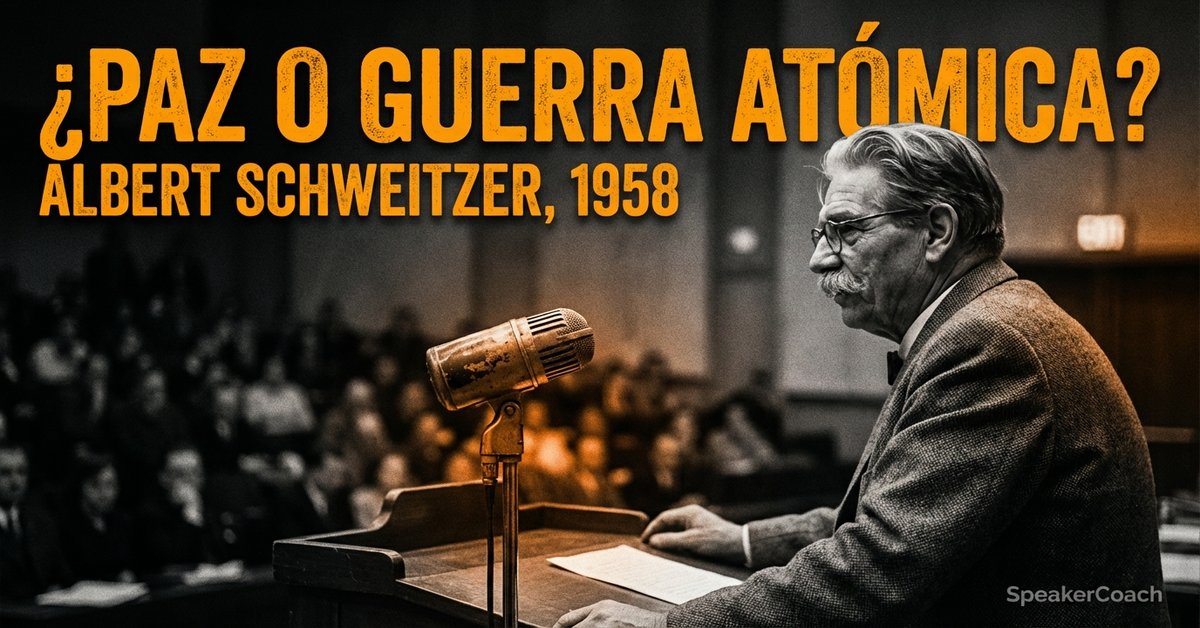
En '¿Paz o guerra atómica?', Albert Schweitzer pronuncia tres llamamientos interconectados transmitidos desde Radio Oslo en abril de 1958, pidiendo el fin inmediato de las pruebas de armas nucleares y la renuncia a las armas atómicas. Hablando como un laureado Nobel de la Paz de 83 años, médico y filósofo, Schweitzer reúne evidencia científica sobre la lluvia radiactiva, advierte que la guerra atómica sería 'el acto más insensato y lunático que jamás podría tener lugar', e insta a los líderes de las tres potencias nucleares a reunirse cara a cara para negociaciones sinceras. Los llamamientos representan un momento histórico en el movimiento antinuclear global, combinando la filosofía de 'Reverencia por la vida' de Schweitzer con razonamiento científico urgente para argumentar que la humanidad enfrenta una elección binaria: confianza y paz, o desconfianza y aniquilación.
Contexto histórico
Los tres llamamientos de Albert Schweitzer fueron transmitidos desde Radio Oslo el 28, 29 y 30 de abril de 1958, bajo los auspicios del Comité Nobel Noruego. Los manuscritos fueron leídos al aire por Gunnar Jahn, presidente del comité, mientras Schweitzer permanecía en su hospital en Lambarene, Gabón. Las transmisiones llegaron en el apogeo de las tensiones nucleares de la Guerra Fría: Estados Unidos y la Unión Soviética estaban realizando pruebas nucleares atmosféricas, la carrera armamentista se aceleraba y el temor público a la lluvia radiactiva crecía. En 1957, Schweitzer ya había transmitido su 'Declaración de Conciencia' desde Oslo, llegando a audiencias a través de 140 estaciones de radio en todo el mundo, aunque algunos gobiernos prohibieron la transmisión. En enero de 1958, el profesor Linus Pauling presentó a las Naciones Unidas una petición firmada por 9.235 científicos de todo el mundo pidiendo el fin de las pruebas nucleares. Los llamamientos de Schweitzer de 1958 se construyeron sobre este impulso y se convirtieron en un texto fundamental en el movimiento internacional que finalmente condujo al Tratado de Prohibición Parcial de Ensayos Nucleares de 1963. Los llamamientos fueron publicados como libro por Henry Holt and Company en Nueva York ese mismo año. Schweitzer había ganado el Premio Nobel de la Paz en 1952 (pronunció su conferencia en 1954), y su autoridad moral como médico, teólogo y humanitario otorgó un peso extraordinario a sus argumentos científicos y éticos contra las armas nucleares.
Texto del discurso
PEACE OR ATOMIC WAR? Three Appeals Broadcast from Oslo, April 28, 29, and 30, 1958 By Albert Schweitzer
I. THE RENUNCIATION OF NUCLEAR TESTS
Since March 1, 1954, hydrogen bombs have been tested, by the Americans at Bikini Atoll in the Pacific and by the Russians in Siberia. After the explosion of a hydrogen bomb, something remains in the air, namely, an incalculable number of radioactive particles emitting radioactive rays. These particles are carried up into the higher strata of the atmosphere, where they float as clouds of radioactive dust. The winds drive them over the whole earth, and in time the dust falls to the ground, contaminating the soil, the vegetation, the water, and the food of men and animals.
The radiation resulting from the explosions which have already taken place represents a danger to the human race -- a danger not to be underrated -- and that further explosions of atomic bombs will increase this danger to an alarming extent.
The harm that has come to us from these explosions has been brought home to us in an especially poignant way by the fate of the Japanese fishermen who were exposed to the radioactive particles produced by the hydrogen bomb explosion at Bikini Atoll on March 1, 1954. Through the contaminated fish which they carried to port, radioactive material found its way to whole populations. The fact is established beyond question that the testing and the use of nuclear weapons carry in themselves the absolute reasons for being renounced.
Who authorized the individuals who in the name of modern technology have brought into being this danger which threatens the existence of the human race? There was no authority. It was done in secret and we were faced with accomplished facts. Moreover, we are told that still greater and more devastating hydrogen bombs are being prepared.
We are further told that under certain circumstances an increase in radioactivity of the air does not necessarily need to be dangerous. The concept of a so-called permissible amount of radiation has been introduced. Who gave these scientists the right to determine how much radioactive damage the population of the world can sustain? They are acting on their own authority. This authority is not theirs to exercise.
In January 1958, a declaration was signed by 9,235 scientists of all countries and given to the Secretary-General of the United Nations by Professor Linus Pauling. This declaration stated that every additional nuclear explosion increases the danger to the human race, and that further explosions must be prevented at all costs. This declaration refutes the claim that disagreement exists among scientists about the harmful effects of nuclear tests.
I appeal especially to the women in all countries to give thought to what nuclear testing means for their children and their children's children. Generation after generation, for centuries to come, will witness the birth of an ever-increasing number of children with mental and physical defects.
What is at stake is the health and the lives of present and future generations. Mankind insists that nuclear tests stop, and that the great powers come to an agreement among themselves.
II. THE DANGER OF AN ATOMIC WAR
We face the choice between two risks. The one holds no possibility of a fruitful future. The other does. We must risk the second.
The first risk is a mad atomic-arms race with the danger of an unavoidable atomic war. The second is a mutual renunciation of nuclear weapons in the hope that we can manage to live in peace.
Atomic warfare, as it is now possible, is the most senseless and lunatic act that could ever take place. The idea that the nation which has nuclear weapons superior in number and power would triumph in an atomic war is sheer delusion. Victory and defeat in such a war would be meaningless. Both sides would suffer the most terrible destruction and would be left in a most pitiable condition.
Radioactive clouds from such a war would endanger the whole of humanity. The lands of peoples not participating in the war would be contaminated. The radioactivity would make these lands uninhabitable for generations. No part of the globe would escape the effects.
The hydrogen bomb missile has fundamentally altered strategic calculations. One cannot even base a calculation on any supposed advantage to be derived from a surprise attack. For even the nation subjected to such an attack would still have the ability to strike back with terrible retaliation.
We must not rely on deterrence. The idea that atomic armaments can prevent a war is out of the question for our time with its intensified danger of war. The possession by both sides of these dreadful weapons of mass destruction has not diminished the possibility of war but has made it more likely. The danger to humanity is greater than ever before.
An important step which could contribute to the easing of world tensions would be the creation of atom-free zones. If certain territories were freed from the threat of atomic weapons, this would constitute a beginning toward a more peaceful situation.
III. NEGOTIATIONS AT THE HIGHEST LEVEL
The three nuclear powers must decide independently to renounce atomic weapons. This decision should not depend on first achieving a complete agreement on general disarmament. The renunciation of nuclear weapons is an issue that must be dealt with on its own merits.
Only when the states agree not to carry out nuclear tests any more can promising negotiations about disarmament and peace take place. Prior agreement on any other conditions cannot be considered. The fact is that the testing and the use of nuclear weapons carry in themselves the absolute reasons for being renounced. Both cause the deepest damage to human rights. The tests, in that they do harm to peoples far from the territories of the nuclear powers and endanger their lives and their health -- and this in peacetime; an atomic war, in that the resulting radioactivity would make uninhabitable the land of peoples not participating in such a war.
We must rid ourselves of the paralyzing mistrust of our adversaries and approach each other in the spirit that we are human beings, all of us, who must find a way to settle our disputes peacefully and with due regard for the rights of others.
True negotiations can only take place at the highest level, between the leaders of the three nuclear powers themselves. These leaders must come together with the sincere intention of seeking a solution -- not with the purpose of scoring diplomatic victories or of putting the other side at a disadvantage.
Letters and diplomatic notes will not suffice. The statesmen must sit down together face to face. They must be prepared to make concessions and to accept reasonable compromises. The spirit in which these negotiations are conducted will determine whether they succeed or fail.
I call upon the leaders of the nuclear powers to enter into such negotiations without delay. The fate of all humanity is now at stake, and it is urgently necessary to make the bold decisions that can deal adequately with the agonizing situation.
May those who have in their hands the fate of nations take care to avoid whatever may worsen our situation and make it more dangerous. May they take to heart the words of the Apostle Paul: "If possible, so far as it depends on you, live peaceably with all."
We must accept the risk of trusting one another rather than the risk of distrusting. For in trust there lies at least the possibility of peace. In distrust there lies only the certainty of further danger.
The end of further experiments with atom bombs would be like the early sunrays of hope which suffering humanity is longing for.
Análisis retórico
Schweitzer aprovecha su credibilidad única como laureado Nobel, médico, teólogo y filósofo para hablar con autoridad moral incontestable sobre la intersección de la ciencia, la ética y la supervivencia humana.
¿Quién autorizó a los individuos que en nombre de la tecnología moderna han creado este peligro que amenaza la existencia de la raza humana? No hubo autoridad. Se hizo en secreto y nos encontramos ante hechos consumados.
Schweitzer enmarca el dilema nuclear como una elección binaria tajante entre dos caminos irreconciliables, obligando a la audiencia a confrontar las consecuencias de la inacción al eliminar cualquier término medio.
Enfrentamos la elección entre dos riesgos. Uno no ofrece posibilidad de un futuro fructífero. El otro sí. Debemos arriesgar el segundo.
Schweitzer despliega datos científicos concretos y ejemplos específicos del mundo real para transformar peligros nucleares abstractos en realidades tangibles e innegables que obligan a la acción.
En enero de 1958, una declaración fue firmada por 9.235 científicos de todos los países y entregada al Secretario General de las Naciones Unidas por el profesor Linus Pauling. Esta declaración afirmaba que cada explosión nuclear adicional aumenta el peligro para la raza humana.
Schweitzer canaliza los hechos científicos en apelaciones profundamente emocionales, apuntando particularmente a la vulnerabilidad de los niños y las generaciones futuras para crear un sentido urgente de responsabilidad moral.
Apelo especialmente a las mujeres de todos los países a que reflexionen sobre lo que significan las pruebas nucleares para sus hijos y los hijos de sus hijos. Generación tras generación, durante siglos venideros, presenciarán el nacimiento de un número cada vez mayor de niños con defectos mentales y físicos.
Schweitzer utiliza preguntas retóricas incisivas para desafiar la legitimidad de quienes crearon peligros nucleares sin consentimiento público, convirtiendo cuestiones de autoridad en acusaciones morales.
¿Quién autorizó a los individuos que en nombre de la tecnología moderna han creado este peligro que amenaza la existencia de la raza humana?
Schweitzer cierra sus llamamientos invocando las palabras del apóstol Pablo y desplegando una luminosa metáfora del amanecer, elevando su argumento político a un registro espiritual y poético. Al citar las Escrituras, el teólogo-médico añade una dimensión trascendente a su razonamiento científico y estratégico, mientras que la metáfora de cierre transforma el objetivo abstracto del desarme nuclear en una vívida imagen sensorial de esperanza.
Que tomen a pecho las palabras del apóstol Pablo: "Si es posible, en cuanto dependa de vosotros, vivid en paz con todos".
Lecciones clave
- **Fundamenta los argumentos morales en evidencia empírica.** Schweitzer no se basa solo en apelaciones éticas -- abre con la física de la lluvia radiactiva, el destino de víctimas específicas y una petición firmada por 9.235 científicos. Al abogar por un cambio, acompaña tu convicción moral con evidencia concreta y verificable que haga tu posición difícil de desestimar.
- **Enmarca las decisiones complejas como elecciones binarias claras.** Schweitzer destila la cuestión nuclear en un tajante esto o aquello: 'una loca carrera armamentista atómica' o 'una renuncia mutua a las armas nucleares'. Al eliminar el término medio, obliga a la audiencia a elegir -- y hace obvia la elección moral. Cuando necesites mover a una audiencia a la acción, simplifica la elección a sus alternativas esenciales.
- **Usa tu credibilidad única de manera deliberada.** Como médico, teólogo, laureado Nobel y humanitario, Schweitzer aportó una autoridad moral inigualable al debate nuclear. Convirtió su credibilidad en arma a través de preguntas retóricas que desafiaron la legitimidad de científicos nucleares actuando 'por su propia autoridad'. Identifica qué hace tu voz distintiva y usa esa posición única estratégicamente.
- **Apela a la identidad más profunda de la audiencia.** El llamamiento de Schweitzer a las madres sobre 'sus hijos y los hijos de sus hijos' y su llamado a 'acercarnos unos a otros con el espíritu de que somos seres humanos' trascienden las divisiones políticas invocando vínculos humanos universales. Los argumentos más persuasivos conectan con identidades que son más profundas que la política.
- **Termina con esperanza, no con desesperación.** A pesar del tema apocalíptico, Schweitzer cierra con la luminosa imagen de 'los primeros rayos de sol de la esperanza que la humanidad sufriente anhela'. Incluso cuando abordes los temas más oscuros, deja a tu audiencia con una visión por la que valga la pena luchar.

Los llamamientos de Schweitzer demuestran el poder de la escalada estructurada a lo largo de un argumento en múltiples partes. Observa cómo cada llamamiento se construye sobre el anterior: la evidencia científica crea la base intelectual, el análisis estratégico destruye el contraargumento (la disuasión), y el llamado moral a la acción proporciona el camino a seguir. Cuando necesites persuadir sobre un tema complejo, resiste la tentación de comenzar con la emoción. En su lugar, construye tu caso sistemáticamente -- primero la evidencia, luego el análisis, luego la acción -- de modo que cuando llegues a tu llamado a la acción, la audiencia no tenga alternativa racional. Practica esto dividiendo tu próximo argumento importante en tres fases: 'Esto es lo que sabemos', 'Esto es lo que significa' y 'Esto es lo que debemos hacer'.
Ver el programa