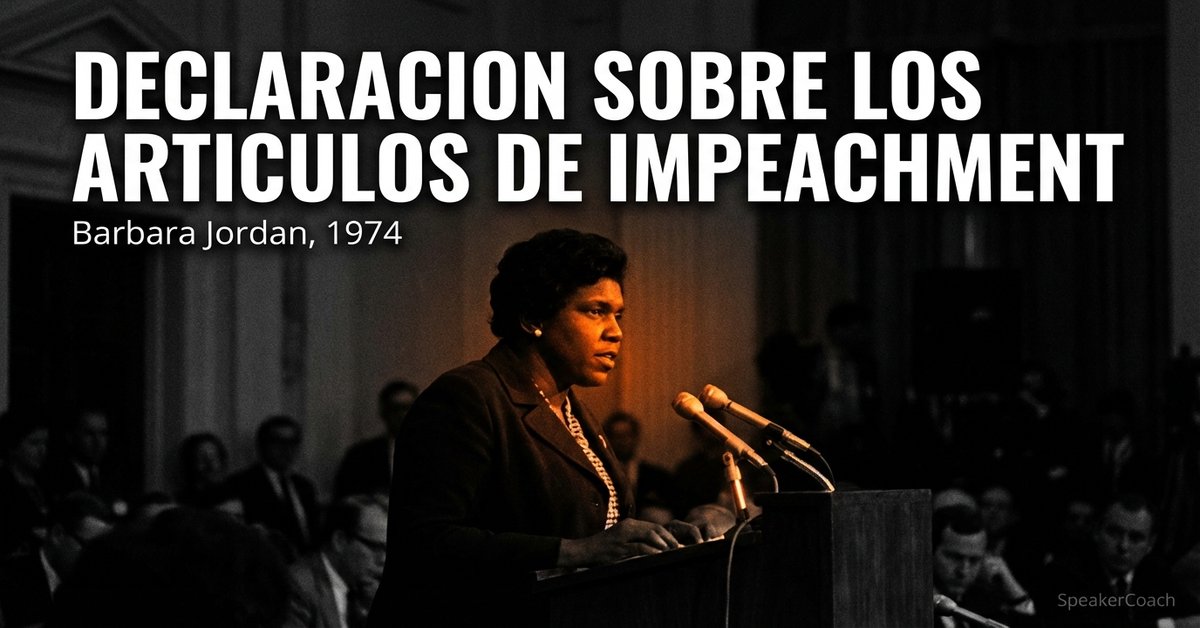
En esta declaracion durante las audiencias de impeachment del Comite Judicial de la Camara contra el Presidente Richard Nixon, Barbara Jordan pronuncia uno de los argumentos constitucionales mas poderosos de la historia legislativa estadounidense. Abre agradeciendo al presidente del comite, luego gira hacia una observacion personal devastadora -- como mujer negra, ella no fue incluida en 'Nosotros, el pueblo' -- antes de declarar su fe total en la Constitucion y su negativa a ver como es subvertida. A traves de la cita sistematica de los Documentos Federalistas, las convenciones de ratificacion de Virginia, Carolina del Norte y Carolina del Sur, la Convencion Constitucional y el texto de la Constitucion misma, Jordan construye un caso legal hermetico para el impeachment. Luego yuxtapone estos criterios de impeachment con evidencia especifica de la conducta de Nixon -- dinero de campana republicano encontrado con ladrones, reuniones con Henry Petersen seguidas de reuniones con los acusados, el allanamiento de la oficina del psiquiatra de Ellsberg, y el Presidente aconsejando a sus asistentes a cometer perjurio mientras exhibia publicamente su cooperacion con la justicia. El climax devastador del discurso -- 'quizas esa Constitucion del siglo dieciocho deberia ser abandonada a una trituradora de papel del siglo veinte!' -- obliga al comite a elegir entre el impeachment y abandonar la Constitucion. Jordan cierra pidiendo razon sobre pasion, modelando el temperamento judicial que exige de sus colegas.
Contexto histórico
El 25 de julio de 1974, el Comite Judicial de la Camara comenzo su debate televisado a nivel nacional sobre si recomendar articulos de impeachment contra el Presidente Richard Nixon. El escandalo de Watergate habia consumido a la nacion por mas de dos anos: el allanamiento en la sede del Comite Nacional Democrata (junio de 1972), el encubrimiento, la Masacre del Sabado por la Noche (octubre de 1973) y la revelacion del sistema de grabacion de la Casa Blanca habian erosionado la confianza publica en la presidencia. Solo un dia antes, el 24 de julio, la Corte Suprema habia dictaminado unanimemente en Estados Unidos contra Nixon que el Presidente debia entregar las cintas de la Casa Blanca -- una decision que el publico estadounidense habia esperado ansiosamente durante ocho horas para saber si Nixon obedeceria. Barbara Jordan, una congresista novata del distrito 18 de Texas y una de solo dos afroamericanos del sur en el Congreso, era uno de los 38 miembros del comite. Su declaracion de 15 minutos, pronunciada con notable gravedad y precision constitucional, electrifico a la nacion. El comite voto 27-11 para recomendar el impeachment. Nixon renunciaria el 9 de agosto de 1974, menos de tres semanas despues. El discurso de Jordan es reconocido por cristalizar el caso constitucional para el impeachment en un lenguaje que los ciudadanos comunes pudieran entender y apoyar, y la lanzo a la prominencia nacional.
Texto del discurso
Thank you, Mr. Chairman.
Mr. Chairman, I join my colleague Mr. Rangel in thanking you for giving the junior members of this committee the glorious opportunity of sharing the pain of this inquiry. Mr. Chairman, you are a strong man, and it has not been easy but we have tried as best we can to give you as much assistance as possible.
Earlier today, we heard the beginning of the Preamble to the Constitution of the United States: "We, the people." It's a very eloquent beginning. But when that document was completed on the seventeenth of September in 1787, I was not included in that "We, the people." I felt somehow for many years that George Washington and Alexander Hamilton just left me out by mistake. But through the process of amendment, interpretation, and court decision, I have finally been included in "We, the people."
Today I am an inquisitor. An hyperbole would not be fictional and would not overstate the solemnness that I feel right now. My faith in the Constitution is whole; it is complete; it is total. And I am not going to sit here and be an idle spectator to the diminution, the subversion, the destruction, of the Constitution.
"Who can so properly be the inquisitors for the nation as the representatives of the nation themselves?" "The subjects of its jurisdiction are those offenses which proceed from the misconduct of public men." And that's what we're talking about. In other words, the jurisdiction comes from the abuse or violation of some public trust.
It is wrong, I suggest, it is a misreading of the Constitution for any member here to assert that for a member to vote for an article of impeachment means that that member must be convinced that the President should be removed from office. The Constitution doesn't say that. The powers relating to impeachment are an essential check in the hands of the body of the Legislature against and upon the encroachments of the Executive. The division between the two branches of the Legislature, the House and the Senate, assigning to the one the right to accuse and to the other the right to judge, the Framers of this Constitution were very astute. They did not make the accusers and the judges the same person.
We know the nature of impeachment. We've been talking about it awhile now. It is chiefly designed for the President and his high ministers to somehow be called into account. It is designed to "bridle" the Executive if he engages in excesses. "It is designed as a method of national inquest into the conduct of public men." The Framers confided in the Congress the power if need be, to remove the President in order to strike a delicate balance between a President swollen with power and grown tyrannical, and preservation of the independence of the Executive.
The nature of impeachment: a narrowly channeled exception to the separation-of-powers maxim. The Federal Convention of 1787 said that. It limited impeachment to high crimes and misdemeanors and discounted and opposed the term "maladministration." "It is to be used only for great misdemeanors," so it was said in the North Carolina ratification convention. And in the Virginia ratification convention: "We do not trust our liberty to a particular branch. We need one branch to check the other."
"No one need be afraid" -- the North Carolina ratification convention -- "No one need be afraid that officers who commit oppression will pass with immunity." "Prosecutions of impeachments will seldom fail to agitate the passions of the whole community," said Hamilton in the Federalist Papers, number 65. "We divide into parties more or less friendly or inimical to the accused." I do not mean political parties in that sense.
The drawing of political lines goes to the motivation behind impeachment; but impeachment must proceed within the confines of the constitutional term "high crimes and misdemeanors." Of the impeachment process, it was Woodrow Wilson who said that "Nothing short of the grossest offenses against the plain law of the land will suffice to give them speed and effectiveness. Indignation so great as to overgrow party interest may secure a conviction; but nothing else can."
Common sense would be revolted if we engaged upon this process for petty reasons. Congress has a lot to do: Appropriations, Tax Reform, Health Insurance, Campaign Finance Reform, Housing, Environmental Protection, Energy Sufficiency, Mass Transportation. Pettiness cannot be allowed to stand in the face of such overwhelming problems. So today we are not being petty. We are trying to be big, because the task we have before us is a big one.
This morning, in a discussion of the evidence, we were told that the evidence which purports to support the allegations of misuse of the CIA by the President is thin. We're told that that evidence is insufficient. What that recital of the evidence this morning did not include is what the President did know on June the 23rd, 1972.
The President did know that it was Republican money, that it was money from the Committee for the Re-Election of the President, which was found in the possession of one of the burglars arrested on June the 17th. What the President did know on the 23rd of June was the prior activities of E. Howard Hunt, which included his participation in the break-in of Daniel Ellsberg's psychiatrist, which included Howard Hunt's participation in the Dita Beard ITT affair, which included Howard Hunt's fabrication of cables designed to discredit the Kennedy Administration.
We were further cautioned today that perhaps these proceedings ought to be delayed because certainly there would be new evidence forthcoming from the President of the United States. There has not even been an obfuscated indication that this committee would receive any additional materials from the President. The committee subpoena is outstanding, and if the President wants to supply that material, the committee sits here. The fact is that on yesterday, the American people waited with great anxiety for eight hours, not knowing whether their President would obey an order of the Supreme Court of the United States.
At this point, I would like to juxtapose a few of the impeachment criteria with some of the actions the President has engaged in. Impeachment criteria: James Madison, from the Virginia ratification convention. "If the President be connected in any suspicious manner with any person and there be grounds to believe that he will shelter him, he may be impeached."
We have heard time and time again that the evidence reflects the payment to defendants money. The President had knowledge that these funds were being paid and these were funds collected for the 1972 presidential campaign. We know that the President met with Mr. Henry Petersen 27 times to discuss matters related to Watergate, and immediately thereafter met with the very persons who were implicated in the information Mr. Petersen was receiving. The words are: "If the President is connected in any suspicious manner with any person and there be grounds to believe that he will shelter that person, he may be impeached."
Justice Story: "Impeachment" is attended -- "is intended for occasional and extraordinary cases where a superior power acting for the whole people is put into operation to protect their rights and rescue their liberties from violations." We know about the Huston plan. We know about the break-in of the psychiatrist's office. We know that there was absolute complete direction on September 3rd when the President indicated that a surreptitious entry had been made in Dr. Fielding's office, after having met with Mr. Ehrlichman and Mr. Young. "Protect their rights." "Rescue their liberties from violation."
The Carolina ratification convention impeachment criteria: those are impeachable "who behave amiss or betray their public trust." Beginning shortly after the Watergate break-in and continuing to the present time, the President has engaged in a series of public statements and actions designed to thwart the lawful investigation by government prosecutors. Moreover, the President has made public announcements and assertions bearing on the Watergate case, which the evidence will show he knew to be false. These assertions, false assertions, impeachable, those who misbehave. Those who "behave amiss or betray the public trust."
James Madison again at the Constitutional Convention: "A President is impeachable if he attempts to subvert the Constitution." The Constitution charges the President with the task of taking care that the laws be faithfully executed, and yet the President has counseled his aides to commit perjury, willfully disregard the secrecy of grand jury proceedings, conceal surreptitious entry, attempt to compromise a federal judge, while publicly displaying his cooperation with the processes of criminal justice. "A President is impeachable if he attempts to subvert the Constitution."
If the impeachment provision in the Constitution of the United States will not reach the offenses charged here, then perhaps that 18th-century Constitution should be abandoned to a 20th-century paper shredder!
Has the President committed offenses, and planned, and directed, and acquiesced in a course of conduct which the Constitution will not tolerate? That's the question. We know that. We know the question. We should now forthwith proceed to answer the question. It is reason, and not passion, which must guide our deliberations, guide our debate, and guide our decision.
I yield back the balance of my time, Mr. Chairman.
Análisis retórico
Jordan abre con una ironia devastadora: la misma Constitucion que ahora esta encargada de defender alguna vez la excluyo. Al reconocer su exclusion historica de 'Nosotros, el pueblo' y luego declarar que 'finalmente ha sido incluida,' establece una autoridad moral que ningun otro miembro del comite posee. La persona que alguna vez fue excluida de la promesa constitucional es ahora su defensora mas apasionada -- una posicion retorica que hace imposible cualquier descalificacion partidista.
Pero cuando ese documento fue completado el diecisiete de septiembre de 1787, yo no fui incluida en ese 'Nosotros, el pueblo.' Senti de alguna manera durante muchos anos que George Washington y Alexander Hamilton simplemente me dejaron fuera por error. Pero a traves del proceso de enmienda, interpretacion y decision judicial, finalmente he sido incluida en 'Nosotros, el pueblo.'
Jordan declara su fidelidad a la Constitucion en un tricolon tan contundente que cualquier vacilacion de un colega parece una traicion. La estructura tripartita -- 'entera, completa, total' -- crea una sensacion de finalidad matematica. Luego la empareja con un segundo tricolon de amenaza escalante -- 'disminucion, subversion, destruccion' -- dejando claras las consecuencias de la inaccion. La simetria entre su fe y la amenaza eleva el discurso de argumento legal a juramento constitucional.
Mi fe en la Constitucion es entera; es completa; es total. Y no voy a sentarme aqui y ser una espectadora ociosa de la disminucion, la subversion, la destruccion de la Constitucion.
En lugar de argumentar desde la opinion personal, Jordan construye todo su caso citando a los Padres Fundadores y los documentos fundacionales mismos. Cita los Documentos Federalistas, las convenciones de ratificacion de Carolina del Norte y Virginia, a James Madison en la Convencion Constitucional, al juez Story y a Woodrow Wilson. Esta tecnica hace de su voz la voz de las instituciones, transformandola de congresista partidista en defensora constitucional. Cada cita anade otro ladrillo a un muro inexpugnable de autoridad.
'Quienes pueden ser tan propiamente los inquisidores de la nacion como los representantes de la nacion mismos?' 'Los asuntos de su jurisdiccion son aquellas ofensas que proceden de la mala conducta de hombres publicos.'
La linea mas devastadora del discurso usa un condicional 'si... entonces' para presentar al comite solo dos opciones: el impeachment o abandonar la Constitucion. La adicion de la imagen vivida -- 'una trituradora de papel del siglo veinte' -- transforma un argumento legal abstracto en algo visceral e inolvidable. Jordan esta diciendo: si estas ofensas no activan el impeachment, la Constitucion ya esta muerta, y bien podriamos destruirla fisicamente. El condicional elimina cualquier terreno intermedio.
Si la disposicion de impeachment en la Constitucion de los Estados Unidos no alcanza las ofensas aqui imputadas, entonces quizas esa Constitucion del siglo dieciocho deberia ser abandonada a una trituradora de papel del siglo veinte!
Lecciones clave
- **Establece una legitimacion unica antes de hacer tu argumento.** La apertura de Jordan -- su exclusion y posterior inclusion en 'Nosotros, el pueblo' -- le da una autoridad moral que ningun otro miembro del comite poseia. La persona alguna vez excluida de la promesa se convierte en su defensora mas poderosa. Cuando tienes una perspectiva unica sobre tu tema, abre con ella.
- **Usa el tricolon para construir hacia la finalidad.** 'Entera, completa, total' y 'disminucion, subversion, destruccion' usan grupos de tres en intensidad ascendente. El tricolon es una de las herramientas mas confiables de la retorica para crear una sensacion de completitud e inevitabilidad. Jordan lo usa al menos cuatro veces en este discurso.
- **Cita la autoridad mas alta que tu audiencia reconoce.** Jordan no ofrece su propia opinion sobre el impeachment -- cita los Documentos Federalistas, a Madison, al juez Story, las convenciones de ratificacion y la Constitucion misma. Cuando tu audiencia respeta la autoridad institucional, deja que las instituciones hablen por ti.
- **Yuxtapon criterios con evidencia para impacto de fiscalia.** La tecnica mas devastadora de Jordan se anuncia abiertamente: 'Me gustaria yuxtaponer algunos de los criterios de impeachment con algunas de las acciones del Presidente.' Enuncia el estandar, presenta la evidencia, luego repite el estandar. Los propios Fundadores parecen estar acusando al Presidente.
- **Usa el condicional para hacer la inaccion intolerable.** 'Si la Constitucion no alcanza estas ofensas, entonces quizas deberia ser abandonada a una trituradora de papel del siglo veinte' presenta al comite solo dos opciones: el impeachment o admitir que la Constitucion no vale nada. El condicional elimina el terreno intermedio mientras la imagen vivida hace la eleccion visceral.
- **Cierra nombrando el principio, no la conclusion.** 'Razon, no pasion' no dice al comite como votar -- les dice como deliberar. Esto es mas efectivo que una conclusion directa porque confia en que la audiencia llegara a la respuesta correcta una vez que adopte el marco correcto.

La declaracion de Jordan sobre Watergate demuestra la tecnica mas subutilizada en la oratoria moderna: el ethos constitucional -- argumentar no desde la opinion personal sino desde los principios fundacionales de tu institucion. En lugar de decir 'Creo que el Presidente deberia ser sometido a impeachment,' Jordan dice 'La Constitucion requiere que sea sometido a impeachment.' Esta tecnica esta disponible para cualquier orador: identifica el documento fundacional, la declaracion de valores centrales o la mision de tu organizacion, y argumenta desde ahi en lugar de desde tu propia autoridad. Cuando dices 'Creo que deberiamos...' eres una voz. Cuando dices 'Nuestra constitucion nos exige...' eres la voz de la institucion misma. Jordan tambien ensena una tecnica estructural magistral: la yuxtaposicion explicita. Anuncia 'Me gustaria yuxtaponer algunos de los criterios de impeachment con algunas de las acciones del Presidente' -- y luego hace exactamente eso, creando una devastadora llamada y respuesta entre las palabras de los Fundadores y las acciones de Nixon. En tus propias presentaciones, intenta esto: enuncia el estandar que tu audiencia acepta, presenta la evidencia, luego repite el estandar. Deja que la brecha entre el principio y la practica haga tu argumento por ti. Finalmente, su tricolon -- 'entera, completa, total' -- ensena una leccion practica: cuando quieras expresar conviccion absoluta, dilo de tres maneras. No dos (que se siente incompleto), no cuatro (que se siente excesivo), sino tres (que se siente definitivo). Practica entregar tricolon con una ligera pausa entre cada elemento y enfasis creciente en cada palabra.
Ver el programa