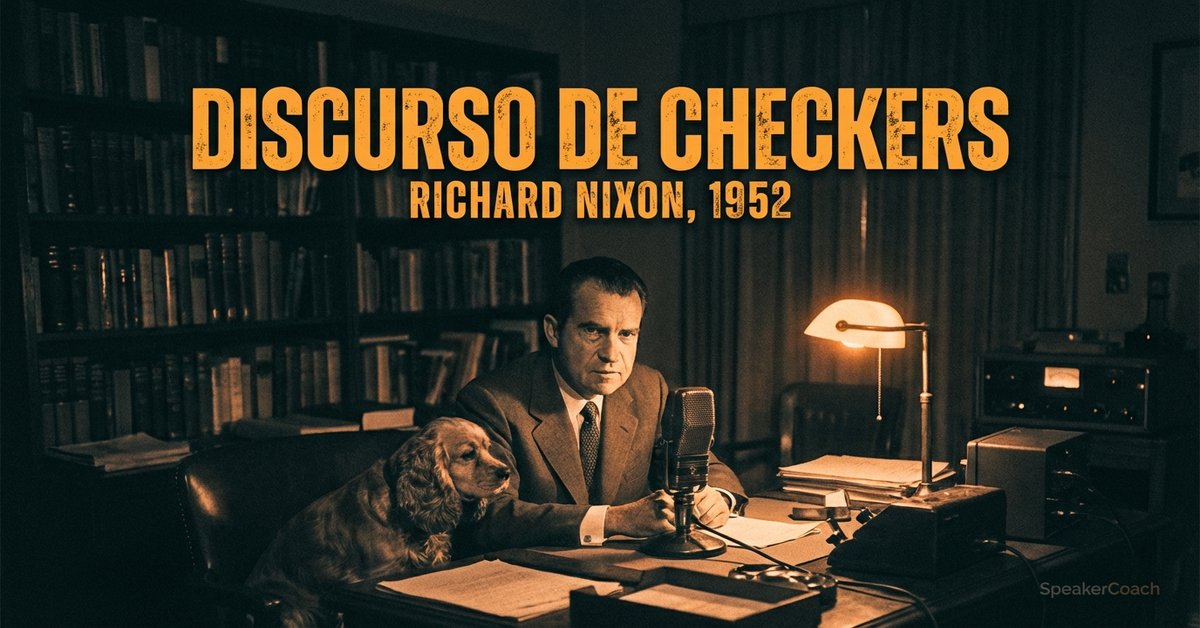
El discurso 'Checkers' de Richard Nixon, pronunciado el 23 de septiembre de 1952, es una de las transmisiones políticas más trascendentales de la historia estadounidense y un hito en el uso de la televisión como herramienta política. Enfrentando acusaciones de haber usado indebidamente un fondo político de $18,000, el candidato a la vicepresidencia Nixon se dirigió directamente al pueblo estadounidense a través de un discurso televisado a nivel nacional, pasando por alto al establishment del Partido Republicano. El discurso combinó revelación financiera detallada con apelaciones emocionales, culminando en el famoso pasaje sobre un perro llamado Checkers -- un cocker spaniel regalado a su familia que se negó a devolver. La estrategia funcionó espectacularmente: el discurso generó millones de telegramas y llamadas telefónicas de apoyo, y Eisenhower mantuvo a Nixon en la candidatura.
Contexto histórico
Pronunciado el 23 de septiembre de 1952, desde el Teatro El Capitan en Los Ángeles, California, por televisión y radio nacionales. Nixon, el candidato vicepresidencial republicano de 39 años, había sido acusado por el New York Post de mantener un fondo político impropio de $18,000 proporcionado por patrocinadores adinerados de California. Varios líderes republicanos presionaron a Eisenhower para eliminar a Nixon de la candidatura. Nixon apeló directamente al público. Se estima que 60 millones de estadounidenses vieron o escucharon, la mayor audiencia para cualquier transmisión hasta ese momento. La respuesta fue abrumadoramente favorable: el Comité Nacional Republicano recibió más de 4 millones de cartas, telegramas y llamadas telefónicas apoyando a Nixon, y Eisenhower famosamente saludó a Nixon con 'Eres mi chico.' El discurso demostró por primera vez el poder de la televisión para pasar por alto la maquinaria partidista y apelar directamente a los votantes.
Texto del discurso
My Fellow Americans,
I come before you tonight as a candidate for the Vice Presidency and as a man whose honesty and integrity has been questioned.
Now, the usual political thing to do when charges are made against you is to either ignore them or to deny them without giving details. I believe we've had enough of that in the United States, particularly with the present Administration in Washington, D.C. To me the office of the Vice Presidency of the United States is a great office, and I feel that the people have got to have confidence in the integrity of the men who run for that office and who might obtain it.
I have a theory, too, that the best and only answer to a smear or to an honest misunderstanding of the facts is to tell the truth. And that's why I'm here tonight. I want to tell you my side of the case.
I'm sure that you have read the charge, and you've heard it, that I, Senator Nixon, took $18,000 from a group of my supporters. Now, was that wrong? And let me say that it was wrong. I'm saying, incidentally, that it was wrong, not just illegal, because it isn't a question of whether it was legal or illegal, that isn't enough. The question is, was it morally wrong? I say that it was morally wrong -- if any of that $18,000 went to Senator Nixon, for my personal use. I say that it was morally wrong if it was secretly given and secretly handled. And I say that it was morally wrong if any of the contributors got special favors for the contributions that they made.
And now I'm going to give you the answer to those questions. Not a word of that $18,000 or any other money of that type ever went to me for my personal use. Every penny of it was used to pay for political expenses that I did not think should be charged to the taxpayers of the United States.
Let me give you the immediate background. I was elected to Congress in 1946. I've lived on my salary as a Congressman and as a Senator. I've never made a dime outside of my salary. I've never been on the payroll of any corporation, any law firm. I've never accepted fees for speeches or articles.
But then I realized that there were some expenses that were necessary that shouldn't be charged to the taxpayer. I felt that the best way to handle this was to accept the aid which people in my home state of California who contributed to my campaign. That's what the $18,000 was for.
But then some of you will say, and rightly, 'Well, what did you use the fund for, Senator? Why did you have to have it?' Let me tell you in just a word how a Senate office operates. First of all, a Senator gets $15,000 a year in salary. He gets enough money to pay for one trip a year, a round trip, to and from his home to Washington, D.C.
Now let me tell you about my personal finances. Pat and I have the satisfaction of knowing that every dime that we've got is honestly ours.
I should say this, that Pat doesn't have a mink coat. But she does have a respectable Republican cloth coat, and I always tell her she'd look good in anything.
One other thing I probably should tell you, because if I don't they'll probably be saying this about me too. We did get something, a gift, after the election. A man down in Texas heard Pat on the radio mention the fact that our two youngsters would like to have a dog. And believe it or not, the day before we left on this campaign trip we got a message from Union Station in Baltimore, saying they had a package for us. We went down to get it. You know what it was? It was a little cocker spaniel dog in a crate that he'd sent all the way from Texas, black and white, spotted. And our little girl Tricia, the six-year-old, named it Checkers. And you know, the kids, like all kids, love the dog, and I just want to say this, right now, that regardless of what they say about it, we're gonna keep it.
But I have found that there are so many deserving stenographers and secretaries in Washington who have given up jobs to come to work with me, and many of them had to take a financial sacrifice. I felt it was my duty to see to it that they were adequately compensated.
I don't believe that I ought to quit, because I am not a quitter. And, incidentally, Pat is not a quitter. After all, her name was Patricia Ryan and she was born on St. Patrick's Day, and you know the Irish never quit.
But the decision, my friends, is not mine. I would do nothing that would harm the possibilities of Dwight Eisenhower to become President of the United States. And for that reason I am submitting to the Republican National Committee tonight, through this television broadcast, the decision which it is theirs to make.
Let them decide whether my position on the ticket will help or whether it will hurt. And I am going to ask you to help them decide. Wire and write the Republican National Committee whether you think I should stay on or whether I should get off. And whatever their decision is, I will abide by it.
But just let me say this last word: regardless of what happens, I'm going to continue this fight. I'm going to campaign up and down America until we drive the crooks and the Communists and those that defend them out of Washington. And remember, folks, Eisenhower is a great man. Believe me. He's a great man. And a vote for Eisenhower is a vote for what's good for America.
Análisis retórico
El pasaje de Checkers es el ejemplo más famoso de pathos en la historia política estadounidense. Al contar la historia de un cocker spaniel regalado a sus hijas, Nixon desplaza el debate de la impropiedad financiera a los valores familiares. El detalle es magistral: el perro vino 'desde Texas,' es 'blanco y negro, manchado,' y 'nuestra pequeña Tricia, de seis años, lo llamó Checkers.' Cada detalle hace la historia más concreta y más emotiva. La declaración desafiante 'nos lo vamos a quedar' transforma un potencial escándalo en una declaración de lealtad familiar que la audiencia no puede resistir.
Era un pequeño perro cocker spaniel en una caja que había enviado desde Texas, blanco y negro, manchado. Y nuestra pequeña Tricia, de seis años, lo llamó Checkers. Y saben, los niños, como todos los niños, adoran al perro, y solo quiero decir esto, ahora mismo, que sin importar lo que digan al respecto, nos lo vamos a quedar.
Nixon hace algo sin precedentes en la política estadounidense: revela públicamente sus finanzas personales en detalle exhaustivo, desde su salario del Senado hasta su hipoteca hasta la falta de un abrigo de visón de su esposa. Esta transparencia radical es en sí misma una técnica retórica -- al ofrecer voluntariamente más información de la que nadie pidió, Nixon crea la impresión de alguien que no tiene nada que ocultar.
Debo decir esto, que Pat no tiene un abrigo de visón. Pero sí tiene un respetable abrigo republicano de tela, y siempre le digo que se vería bien con cualquier cosa.
Nixon reenmarca la acusación de una cuestión legal a una moral, y luego responde la cuestión moral en sus propios términos. Al decir 'estuvo mal, no solo ilegal,' establece un estándar más alto que lo requerido, y luego triunfalmente lo cumple. Esta técnica es sofisticada porque permite a Nixon parecer más principista que sus acusadores.
Estoy diciendo, incidentalmente, que estuvo mal, no solo ilegal, porque no es cuestión de si fue legal o ilegal, eso no es suficiente. La pregunta es, ¿fue moralmente incorrecto?
Nixon fue pionero en la técnica de pasar por alto al establishment del partido hablando directamente a la audiencia televisiva y pidiéndoles que actuaran. Su llamado a 'Escribir y telegrafiar al Comité Nacional Republicano' transforma a los espectadores pasivos en participantes activos.
Escriban y telegrafíen al Comité Nacional Republicano si creen que debo quedarme o si debo irme. Y sea cual sea su decisión, la acataré.
Nixon emplea una poderosa estructura anafórica, repitiendo 'Digo que fue moralmente incorrecto' tres veces, cada vez seguida de una condición diferente. Esta triple repetición crea un crescendo retórico que cumple múltiples propósitos: demuestra la disposición de Nixon a ser juzgado por el más alto estándar, da a la audiencia un marco lógico claro (tres pruebas, tres condiciones), y la repetición rítmica crea un efecto casi encantatorio que graba el encuadre moral en la mente del oyente. Para cuando Nixon responde las tres condiciones en negativo, la audiencia siente que se ha realizado un examen moral exhaustivo -- y Nixon lo ha aprobado.
Digo que fue moralmente incorrecto -- si algo de esos $18,000 fue al Senador Nixon, para mi uso personal. Digo que fue moralmente incorrecto si fue entregado en secreto y manejado en secreto. Y digo que fue moralmente incorrecto si alguno de los contribuyentes obtuvo favores especiales por las contribuciones que hicieron.
Lecciones clave
- Cuando seas acusado, establece tu propio estándar de juicio. Nixon reenmarcó la acusación legal como una cuestión moral y luego respondió la cuestión moral. No luches en los términos de tu oponente -- redefine el campo de batalla.
- La transparencia radical puede ser una defensa poderosa. Al revelar más de lo que nadie pidió, Nixon creó la impresión de honestidad total.
- Un solo detalle vívido puede redirigir toda una narrativa. La historia de Checkers redujo un escándalo financiero complejo a una pregunta simple: ¿le quitarías un perro a un niño?
- Pasa por alto a los intermediarios apelando directamente al público. Nixon pasó por encima de los líderes del partido hacia la audiencia televisiva.
- Cierra con un llamado a la acción que empodere a tu audiencia. 'Escriban y telegrafíen' transformó la simpatía pasiva en apoyo activo.

Estudia el discurso de Checkers como una clase magistral en el uso de la narrativa personal para reformar una crisis política. La técnica clave es lo que podríamos llamar el 'giro humanizador': cuando el argumento lógico va bien pero la audiencia todavía tiene dudas, introduce una historia personal tan vívida y cercana que cambia el terreno emocional por completo.
Ver el programa